The Rise of Violent Video Games
By Scott Stilphen
The times they are a changin'...
Violence and conflict have always been popular aspects of all sorts of games - board games, arcade games, or playground games. Playing 'Cowboys and Indians' with fake guns and bow + arrows, or playing 'army' and attacking and invading the opponent's 'base' were what kids did to entertain themselves. Where did the ideas for those games come from? TV shows and movies were filled with themes of westerns or wars. Likewise, Saturday morning cartoons were overflowing with characters shooting each other or blowing themselves up. As it's been said, sex sells, be it magazines, movie tickets, cars, cigarettes... any number of products. But when it comes to games, violence is king.
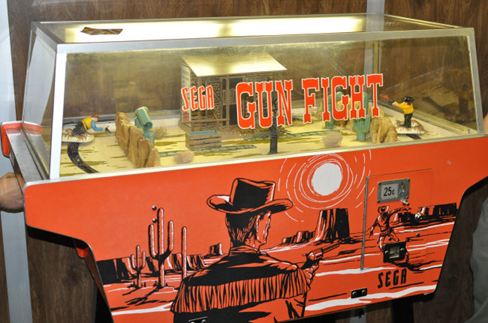
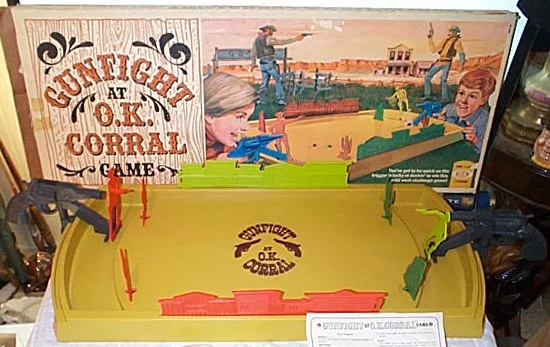
Sega's Gun Fight (1969) and Ideal's Gunfight at O.K. Corral (1973)
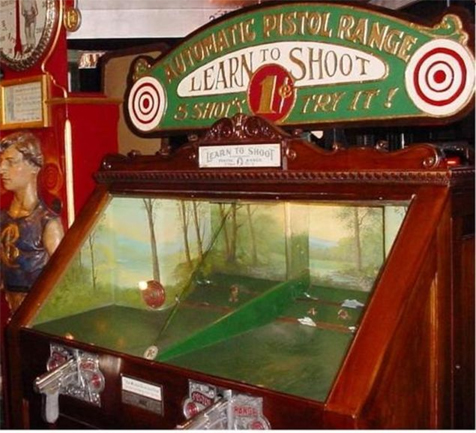
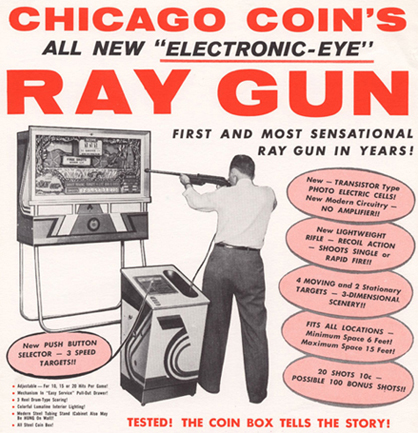
The early EM or electro-mechanical games often involved using all types of devices of a violent nature - guns, tanks, planes, ships, and rockets to name a few. The Automatic Target Machine Company was an early manufacturer of gun-based games like Automatic Pistol and Electric Rifle Range.
Video games are certainly no exception. As far back as the original Spacewar!, players were shooting each other. Many of the early video games were simply updated versions of earlier EM games. For example Midway's 1976 Sea Wolf was based on their 1969 Sea Raider and 1970 Sea Devil games. It's no coincidence that most of Midway's early games were war-themed, being the company took its name from a famous WWII naval battle, the Battle of Midway. Shooting gallery EM games were also very popular in the late 1960s/early 1970s, with players shooting a light gun at everything from cans and monsters to people. Atari was quick to adapt the light gun technology to video games with their 1974 Qwak! and 1976 Outlaw games.
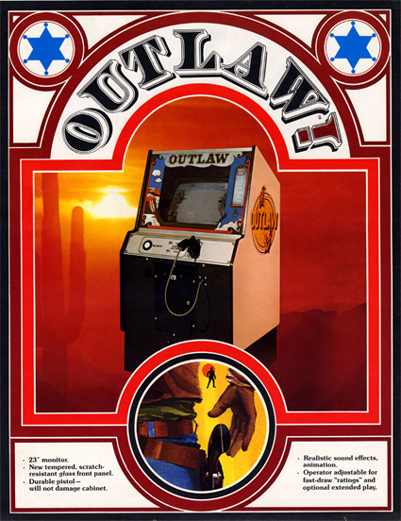
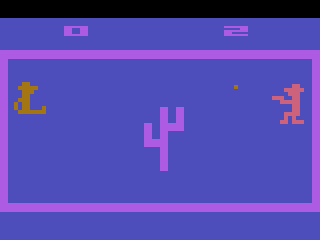
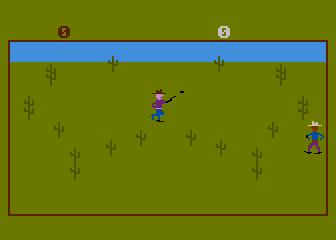
Atari's arcade Outlaw (1976), VCS/2600 Outlaw (1978), and 400/800
Outlaw / Howitzer (1979)
The first home-based console that featured an optional light gun was none other than Ralph Baer's original 1972 Odyssey that allowed players to shoot at a dot with a rifle, which was based on his 1968 Brown Box prototype that featured a light gun rifle as well. Years later, several of the early, dedicated systems from companies such as Coleco with their various Telstar models featured a light gun or rifle. Again, the graphics were simplistic with the targets being a single block. Light guns didn't become popular again with home consoles until Nintendo's Famicom/NES system, at which point Atari finally added light gun games to their VCS/2600, 7800, and XEGS systems. Why didn't Atari follow up with light guns for their home systems sooner?
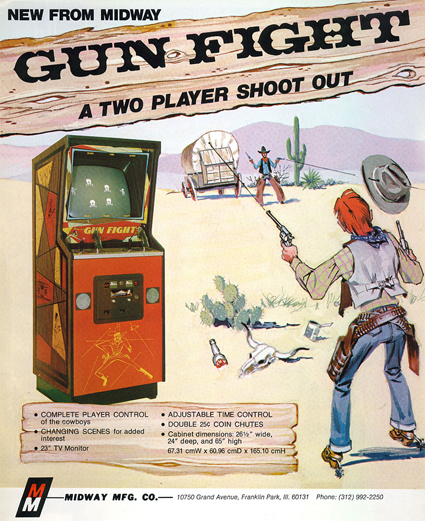
Taito's TTL-based Western Gun was the first video game version of Sega's EM-based Gun Fight and its success inspired Midway's 1976 Gun Fight and 1977 Boot Hill, and Taito's 1977 Gun Man. Gun Fight was also the first arcade game to be microprocessor-based.
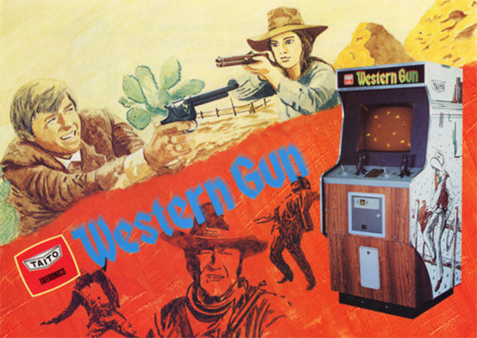
Taito's Western Gun (1975) and
Controversy has always shadowed video games, partly because of the horrible reputation pinball games had for decades, and partly because it was the latest 'craze' in the early 1980s. Much like how rock & roll music garnered negative attention from wary parents, the same happened with video games.
A 2003 study by Iowa State noted the "first phase," dominated by Atari, was all about abstract violence, and rarely about violence against human beings. Nolan Bushnell is quoted in the study as saying that this was intentional, that he felt there was a difference between "blowing up a tank... or a flying saucer" and blowing up people. "We felt that was not good form, and we adhered to that all during my tenure." (he clearly forgot about Atari's Outlaw arcade game). He counters, however, telling us that "kids who play video games have higher IQs, it’s clearly good for your brain," calling violent games studies "selective." "They love to say that playing Halo leads to a Columbine massacre, rather than look at the brain benefits." By the early 1980s, however, Bushnell was long gone from Atari, and while video games weren’t yet the virtual violent killing sprees we’ve come to recognize, the industry was beginning to see that violence could sell games - the earliest example of that being Exidy's Death Race.
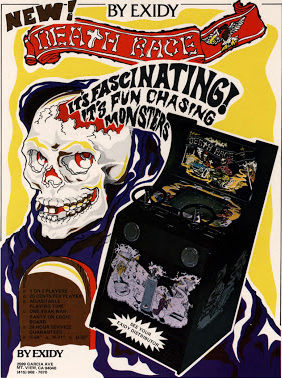
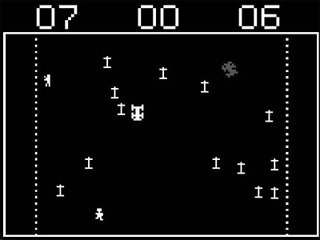
Death Race was released in 1976. Inspired by the cult classic Death Race 2000, it caused a media outrage on its release and formed the basis of the "violent video game" arguments which persist today. The game, which essentially involved running down pedestrians as its main objective, was defended by Exidy’s marketing director as a "humorous arcade piece requiring dexterity." A researcher and psychologist for the National Safety Council disagreed: rather than being a passive "viewer" of violence as with television, the player was "an actor in the process of creating violence." The game prompted 60 Minutes to explore the relationship between video games and violence, and the game was widely banned. Keith Smith did a nice article about Death Race, illustrating how all the notoriety only fueled sales of the game. Looking back, isn't it amazing how spun up people got over this game, considering how many different violent or 'morally corrupt' games have been produced before and since?
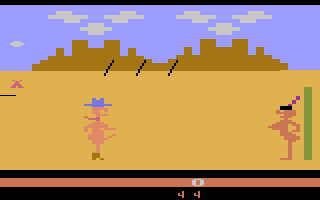
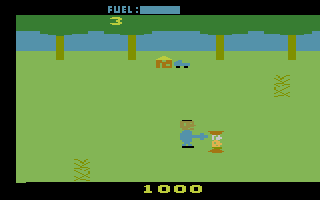
Mystique's 1982 Custer's Revenge for the Atari VCS/2600 was probably the next 'shocking' game to come out after Death Race, and ushered in the era of adult-oriented video games; that genre would later reach more mainstream success with the Leisure Suit Larry series. The slogan on the company's flyer for the game says, "When you score, you score!" Custer's Revenge is especially notorious, being that the central theme of the game is to rape a Native American woman. Predictably, feminist groups and Native Americans protested loudly, as did W.A.P. (Women Against Pornography). Atari even sued AMI (American Multiple Industries), which was the parent company of Mystique, for wrongful association with their console. As a result, most retailers refused to sell it. The company undoubtedly learned from Exidy's example with Death Race of how the saying "there's no such thing as bad publicity" is entirely applicable. What most people probably don't know is that Mystique courted their own negative publicity. From Michael Case, who started his career in video game design by creating adult games for the Atari VCS: "At the CES show, Mystique hired a homeless Indian woman to protest at their booth, so that it would get written up in the paper."
An article in the January 27th, 1984 issue of the Tampa Bay Times newspaper (St. Petersburg, FL) regarding collectible and controversial video games references a similar article that appeared in the February 1984 issue of Video Review. Most of the games mentioned are for the Atari VCS/2600, but it mentions one called Fire by Palmtex and states, "Fire! likewise generated protests because the 'hero' here had to enter a building, set it afire with kerosene, and then escape before the blazing building collapsed." Palmtex mostly made handheld games, one being Fire Attack and apparently involves putting fires out, so the author likely confused Fire Attack for Muse Software's Firebug, which was released the same year for the Apple II in June (InfoWorld June 7th, 1982, pg. 60). The game had the player using gas cans to burn down a 5-story building. By the end of the year, apparently several fire officials from around the country wrote Muse Software to voice their concerns about a game that promotes arson. The city council of Kentwood, MI even went so far as to pass a resolution encouraging local software dealers not to carry the game (Softline November 1982, pg. 18).
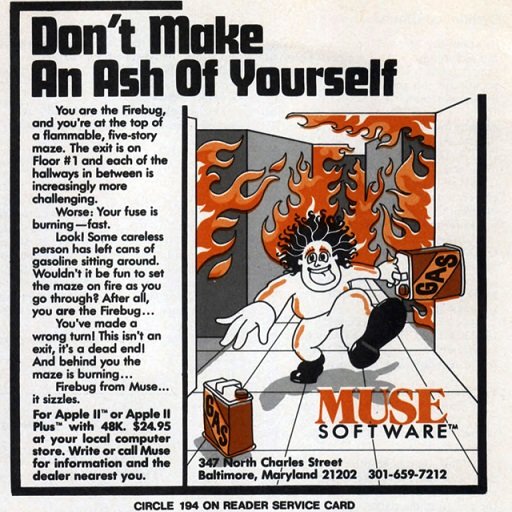
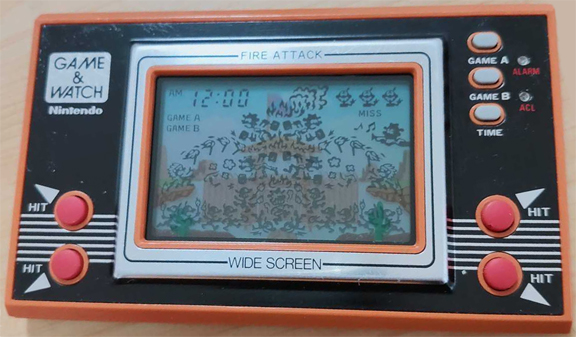
Muse Software's Firebug (1982) and Palmtex's Fire Attack
(1982)
A year later, Wizard Video Games released a pair of Atari VCS/2600 games, Halloween and Texas Chainsaw Massacre, that were likely the first to depict bloodshed; TCM was marketed as "a violent videogame that lets you play the part of the vengeful Leatherface, or an innocent victim looking for safety. Know the pleasures of total destruction as you put yourself in the classic horror movie... the first violent videogame." All 3 earned the scorn of both Atari and the media, although several magazines at the time reviewed Wizard's games.
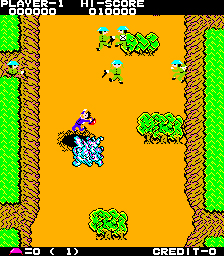
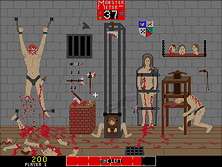
Taito's Front Line (1982) and Exidy's Chiller
(1986)
Taito's Front Line arcade video game, released in 1982 and later ported to the Atari VCS/2600 and Colecovision systems received no negative attention. Exidy's 1986 Chiller light rifle game brought the company back full circle into the macabre genre with a game that far surpasses Death Race as far as horror games are concerned, to the point that Chiller is often cited as the most disturbing video game ever made. Exidy tried to spin the game as one where players had to shoot monsters - same thing they did with Death Race. This time the public wasn't buying it, or rather playing it. For the all the articles written about it (such as this, or this, or this), and all the adjectives used to describe the game - 'sick', 'morbid', 'sadistic'... one that wasn't used was 'successful'. Rumor is Exidy mostly sold the game in 3rd-world countries but it's regarded as a flop everywhere else; they would only release a few more video games in the next 2 years.
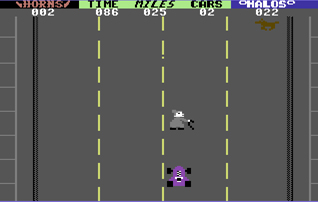
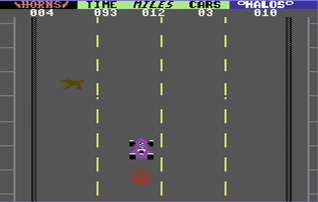
T&F Software's Speed Racer
(1984)
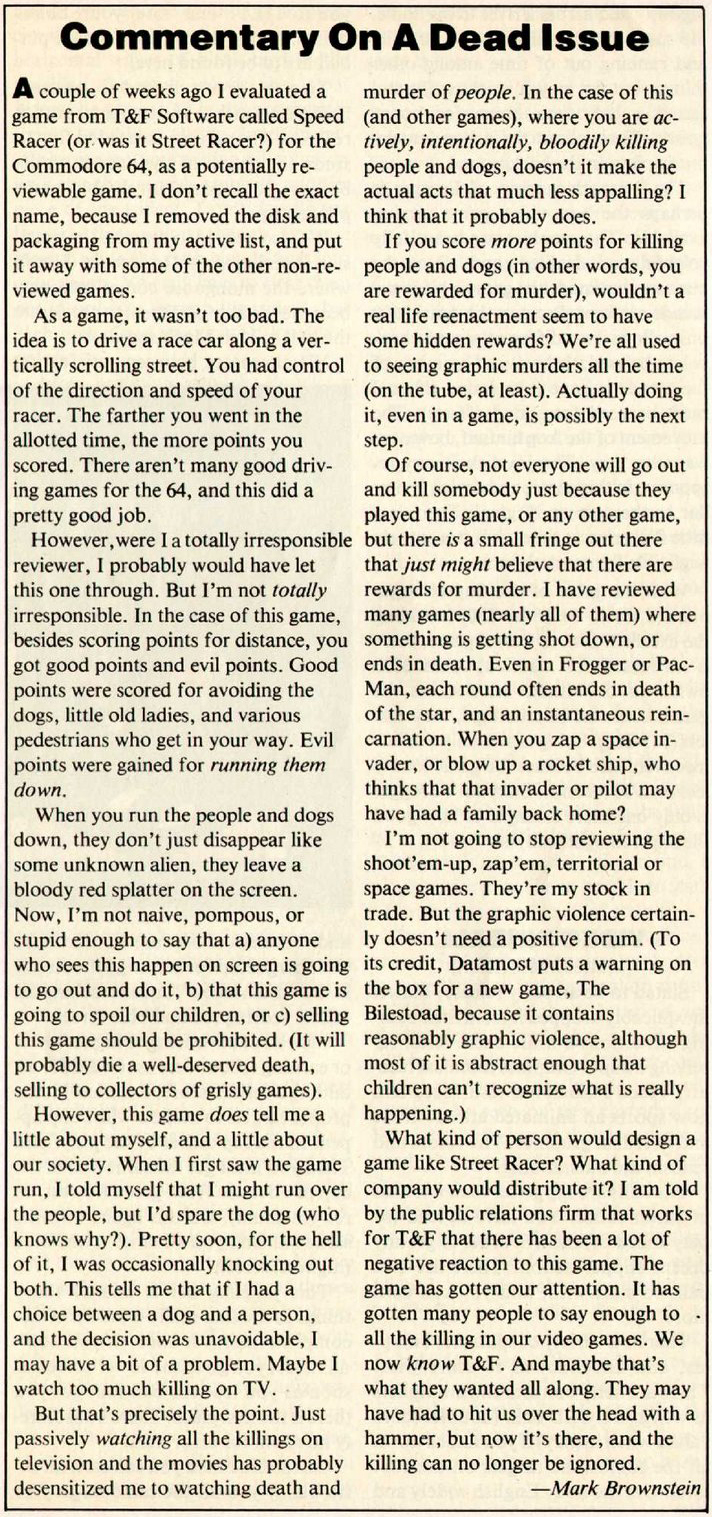
Also in 1983, T&F Software released a Commodore 64 game called Speed Racer, which was basically an updated version of Death Race. I found the above article in the March 1984 issue of Video Games.

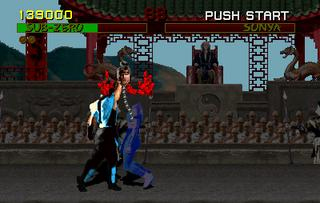
Razorsoft's Technocop (1988) and Midway's Mortal Kombat (1992)
Razorsoft's 1988 Technocop for the Sega Genesis was pretty shocking for its realistic violence at the time, but went largely unnoticed. Capcom's 1991 Street Fighter II set off a renaissance in the business. A massive success, Street Fighter II sold more than 60,000 cabinets worldwide, which was unheard of by the early ‘90s. Midway's Mortal Kombat took the next step in that genre the following year, replacing the cartoonish characters with digitized people and introducing "fatalities" - finishing moves that would leave your opponent a gory mess. Future sequels to the franchise expanded on the feature, with Babalities, Animalities, Brutalities, Heroic Brutalities, Kreate-A-Fatalities... you get the idea. The same year, Digital Pictures released Rob Fulop's Night Trap for the Sega CD. Like Mortal Kombat, it featured digitized characters, although this was more of an interactive game and featured implied violence. The game was actually created back in 1987 for Hasbro's cancelled NEMO system. Controversy followed these games, too, and by 1993 they had garnered everyone's attention, including children’s television icon Captain Kangaroo himself, Bob Keeshan; a 1994 ABC News report quoted Keeshan as saying that violent games caused "emotional damage" to children.
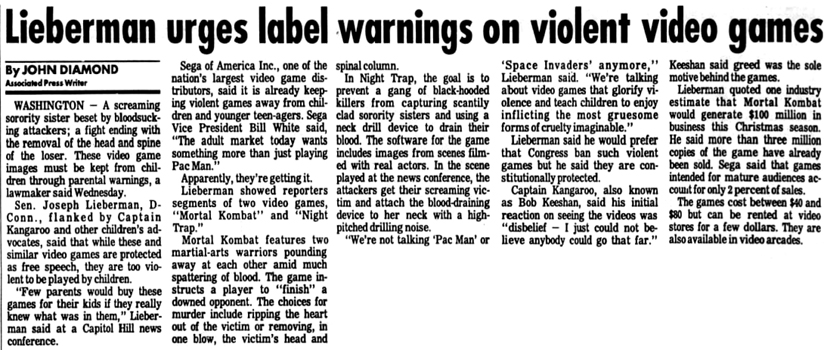
Citizens' Voice 12-2-93
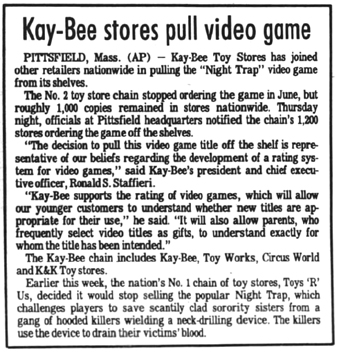
Congressional hearings on December 7th, 1993 (VIDEO) and March 14th, 1994 (VIDEO) led by Senators Joe Lieberman and Herb Kohl followed, the first of which is notable for Nintendo's Howard Lincoln effort to differentiate their stance in the home market compared to Sega as far as video game content was concerned, and how they've done a good job of self-regulating themselves, to which Sega's Bill White held up a Nintendo SNES Super Scope light gun. Lincoln's explanation as to how that was completely different from Sega's Lethal Enforcer light gun led to laughter from some.
The hearings ultimately led to the establishment of the ESRB (Entertainment Software Rating Board) ratings sticker system which is now on most video games. The games were given ratings, much like how movies are, and with the 'problem' solved, the subject was quickly forgotten... until the 1999 Columbine High School massacre.
I recently asked Rob Fulop about the topic of violent video games and the fallout from Night Trap:
|
Rob Fulop: Night Trap was getting a lot of negative publicity, with the primary "witch hunt" being led by Senator Joe Lieberman, who decided that "cleaning up video games" was as good a cause as any for him to get behind. One day, my friend Michael (who wrote for the Washington Post at the time) called me up to announce that Senator Lieberman had gone out and recruited none other than CAPTAIN KANGAROO to show up in front of his "clean up video games committee" and talk about Night Trap, and for me to tune my television in to whatever channel was broadcasting this spectacle. I still remember the chilling feeling of watching my childhood hero and friend, Captain Kangaroo, spout out some sort of rhetoric about how damaging a game Night Trap was, etc. It was soooo clear that the old guy had never even seen the game, let alone played it. Q: Do you think there's any correlation with the prevalence of gun violence/shootings, particularly in this country (U.S.)? Rob Fulop: Sure. But it pretty much occurs to me that were there a strong relation ship between the violence in a game to people taking it into the real world, we would see a lot more real world gun violence in other countries, like Japan, etc. so why don’t we? Q: I don't think any of these games are directly influencing people to commit murder, but I don't see how the proliferation of them aren't helping desensitize people to the idea. Rob Fulop: It occurs to me that, as well as a violent video game could possibly trigger somebody to commit a violent act which mirrors their in-game experience, it’s also possible that a person with violent tendencies could act such out in-game instead of the real world. In other words, we have no way of knowing how many violent people are using violent video games as a safe outlet. So I just don’t know how to link actual gun violence to videogames. It very well could be causal (ie. some linkage exists but I don’t know enough about how such tests could be constructed), only know that there are many self declared "experts" at such things who I’ve spoken with who can’t address the questions I’ve asked. Personally, I’ve always believed that it’s better if the opponents in a game are fantastical, and not human like. If the game must feature human enemies, then I would suggest showing the player the true costs of slaying another - pertains showing their families and friends reacting to the news of their demise, etc. showing a big splurt of their victim’s blood and flying body part is nothing compared to get wrenching shrieks of grief from the victim’s family; game makers let their players off the hook far too easily when it comes to the actual devastation caused by slaying another human being. And that’s related to desensitizing people to the true cost of killing another. The games and some movies make it seem like the blood and gore is the result of their action when the actual damage done was not to the victim as much as to unseen others. There’s that great scene in The Wire where to detective takes the punk kid thru photos of the victims family and kids. I seriously enjoyed Rockstar Games' 2010 Red Dead Redemption - to me it was a true step up in terms of a gaming experience. It really felt like an open world. Q: I agree. I don't know of any games that simulate the real-world repercussions of immoral behavior. But even if such a game existed, would people buy it? How successful would it be beyond being the first of that kind? Imagine a game where if you kill someone, you're arrested and stand trial where you hear from the victim's family and friends. And then extrapolate that to the consequences of going to jail and everything that might involve. I don't think gamers would support a simulation with that degree of accuracy. Rob Fulop: Well that’s the problem - nobody wants to play a game and feel bad. Even seeing their grave and being able to click through their Facebook - anything to demonstrate that this was an actual person. Such is what is recommended you do if ever held at gunpoint - remind them of your humanity etc. Q: And I agree with the notion that those who commit violent acts would very likely do so with or without any additional 'stimulation'. But I'm not sure I believe that would apply to 100% of them. If violent entertainment tipped 1% or some fraction to act that way, is it not worth taking action? I know the world has changed, and the morality 'bar' has been lowered to some degree, and the advent of the Internet and the Pandora's box it opened, from social media to the ease of accessing content for all ages, especially for those under age. Rob Fulop: From a pure gameplay perspective, the nature of the villain doesn’t matter. It’s just me vs. "the other" - the man-ape inside you doesn’t t care. But it’s certainly better if the villain did something "villianous" to you. So many times game makers forget that you hated the wicked witch in The Wizard of Oz because in the first few minutes you saw her take a little girl’s dog away from her. You can’t just say "this is Dr. Evil". Dr evil must do evil things first and foremost. Q: Some would say the wicked witch was justified because Dorothy's house crushed her sister! But you're right. We see the same actress steal Toto prior to the Oz dream sequence, so the audience was already conditioned to hate her, even if her sister wasn't killed. Nazis are often the stand-in villain in many stories and games, and rightly so. And one of the earliest FPS was id Software's 1992 Wolfenstein 3D, which was based on MUSE Software's 1981 Castle Wolfenstein computer game. Again, the player was killing Nazis, so that was acceptable. But Nazis aren't the villain in most FPS these days. Who's the villain in Rockstar Games' Grand Theft Auto? Well, I'd have to say you, the player, is. If you shoot someone in the game, the police will soon show up, and will likely shoot you. Where's the lesson for the player there? There isn't any. They simply start the game over. The whole ESRB system that your game was made an example of for creating was never really enforced. Sales of tobacco and liquor are more strictly enforced, and even then there's enough places selling them who don't do ID checks to be an issue. So here's my 12-year-old self with a game like GTA. I play the game for 4 years and get my driving permit, and at some point I'm pulled over for some infraction, say speeding. I spent 4 years playing a game where running from the police is part of the game, and I've gotten rather skilled at getting away from them... can I make a comparison to playing Death Race and running over stick figures? I mean, that game was laughable the first time I saw it. Enough people had an issue with that game that it became Exidy's best-selling game. Death Race "crossed over the line" in 1976. Where's the line now? Rob Fulop:
The premise of most any story featuring a villain is they finally get caught
driving home the point that crime doesn’t pay. I like that in GTA I get to
be the naughty boy and finally when I go get caught it feels "right" - the world
eventually behaves as it should. I can only get away with my bad behavior
for so long. If I drive like a crazed lunatic, eventually the cops shut me
down. Sure I can play again and "misbehave", but I need to do it quite
skillfully, which feels somewhat fair. Playing as a villain feels like the
story dovetails cleanly with the game. In both cases, the villain (me)
pays a penalty for my crimes. Q: I like the free-roaming aspect of games like GTA where the player can basically go anywhere in the 'world', and frantic driving have always been fun (look no further than Night Driver, where you can potentially drive head-first into someone). The original GTA was primarily about stealing cars (hence the name Grand Theft Auto), although it was possible to run down pedestrians; the same is possible with Crazy Taxi, but without the gory aspects. The latest GTA games have greatly expanded on the criminal aspects. The player can now own a strip club, a cocaine business, and so on. Is a game far behind where the player can be Jack the Ripper, or any number of serial killers? A few years ago, the game Scarface: The World Is Yours came out, so I suppose anything is possible. As for James Bond, it's like any traditional 'hero' game. If Superman can die, it wouldn't be realistic in regards to the character. Sure, James Bond is just a man, but he keeps getting reincarnated, much like Doctor Who. Rob Fulop: At the end of the day, even if one COULD prove a linkage between consuming media focused on an evil action, and people actually taking that action in the real world, there's no way to restrict people from their fantasy lives. The notion of the government monitoring one's fantasy lives is pretty much straight out of Orwell's 1984 where one can get arrested for "Thought Crime". I really do think that the question of "Why are school shootings so much an AMERICA? thing" is a much more productive area to research and nobody could argue that there isn't some sort of REASON it's happening here but not in Canada or Germany or Japan. Q: An easy answer is to say that's been part of America's culture since it's very founding from the start. The U.S. spends more on its military (the various branches, production and R&D on weapons, etc) than on anything else, and more than any other country. That sort of approach affects everything. Every conflict this country gets involved with invariably becomes subject material for books, shows, plays, movies, and of course games. The first World War ended over 100 years ago, and there's still movies being made about it. It's like some perpetual motion machine, constantly feeding itself. And as you know, anything that's massively popular/successful only spawns more of the same. Sure, the argument that violent video games have a correlation to actual violence is certainly tough to quantify or measure, but it's part of everything else in our culture that I think overall contributes to it. People in this country are constantly 'bombarded' by it in some form, thanks in part to everyone having a portable TV (smartphone). Compare that to people who lived over 100 years ago. There were plenty of guns available back then, thanks to WW1, the Civil War, the American Revolution... but mass shootings, with people walking into churches or schools or places of business? That didn't exist. Something changed, and it happened in our lifetime. It happened in the era of video games. I can just as easily say it happened in the era of the Internet, home computers, and smart phones. Rob Fulop: Yeah, it didn’t happen when we were kids. It happened in the past twenty years, along with the emergence of social media, but again, how can we blame Facebook for school shootings? I mean, if you are a weird guy or a heavy set girl, it’s easy to find yourself "cancelled" overnight, and that’s hard to get over. Boys in high school or college have never had a tougher time finding a romantic companion, leading to lots of testosterone-fueled porn addictions, perpetual frustration, and eventually to a type of desperation beyond what you and I grew up with. With social media, everybody else just seems to be living their best life, and I just don’t see how putting the blame on interactive games is useful time spent. I CAN say that games today are much more about control, and how the game world is finally something that one can have some control over, so when they can take a real gun and go run around shooting people it’s like for those ten minutes, they can have control over their shitty frustrating reality as well. So maybe that’s a contributor, but in no way does this occur to me as the center of the puzzle. |
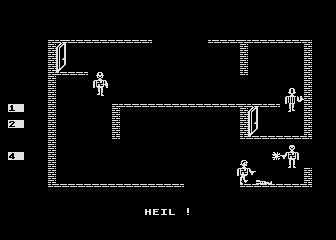
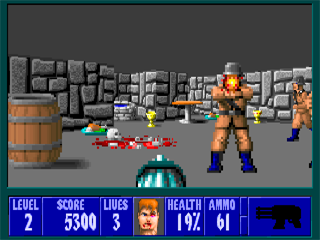
Id Software created the first modern first-person shooter (FPS) with Wolfenstein 3-D in 1992, which was an updated version of MUSE Software's classic Castle Wolfenstein game. A sequel to the game, Spear of Destiny, came out later that year. In December 1993, Id Software released Doom, which was the company's breakout hit, and several sequels to both franchises would continue to follow, as well as new FPS franchises Quake and Rage (since Doom, FPS and war games have become by far the most-popular games). The company that published the original Wolfenstein 3-D and Doom games, Apogee Software, would go on to re-develop their 1991 side-scrolling Duke Nukem game into a FPS. Also released in 1992 was Konami's arcade game Lethal Enforcers, bringing digitized characters to light gun games for the first time; the game was mentioned in the hearings. It certainly appears the use of digitized graphics was the 'line' that had to be crossed to illicit attention from politicians. How else can you explain why Night Trap, a game in which no gun violence is shown and the game's objective is to save people, was grouped together with Mortal Kombat, but Doom wasn't mentioned once? But Doom would be in the hot seat by the end of the decade, with parents and politicians once again blaming video games, as well as rock music (another favorite target), for the underlying cause for the Columbine shooting. Rumors regarding the shooters creating a layout of the school in Doom were unfounded; levels they designed were found, but none of the school.
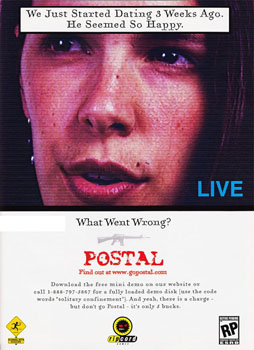
Prior to the Columbine massacre, Ripcord Games released Postal in 1997. Developed by Running With Scissors, it was a FPS with only one goal - shoot people. The game's premise is your character wakes up to find everyone in town is insane and hostile, and you advance by killing a certain number of them per level. The game ends with an attempt to kill elementary school children, after which you end up in a mental institute in a paddled cell with a doctor's report describing your condition as "going postal" (a slang term referencing several USPS worker-related shootings at the time). Being it was a mass murder simulator, the game was banned in over 10 countries. Although only less than 50k copies were sold, several sequels have been made since.

In 2001, it was Rockstar's turn with Grand Theft Auto III, which led to Representative Joe Baca introducing the Protect Children from Video Game Sex and Violence Act in 2003, but the bill never went anywhere beyond the House and wasn't reintroduced. In 2004, Grand Theft Auto: San Andreas and the hidden Hot Coffee mini game reignited the subject and prompted calls for more regulation in the video game industry; in 2005, Joe Lieberman and Senator Hillary Clinton proposed the Family Entertainment Protection Act that would have fined anyone for selling games rated for adults to minors, but that bill failed to become a law as well. Similar state laws have since been removed on the grounds they're unconstitutional. For example, in 2011 the Supreme Court struck down a California law similar to Lieberman and Clinton's bill, after determining the evidence linking violent video games and aggression was flawed.
In 2007, activist Jack Thompson blamed Counter-Strike for the Virginia Tech shooting, even though there was little evidence the shooter ever played the game. Video games were again blamed for the 2012 Sandy Hook shooting. Although the State Attorney of Connecticut determined the shooter played School Shooter (a Half Life 2 mod) and several other FPS games, he also played Super Mario Bros. and Dance Dance Revolution.
After the Florida Parkland shooting in 2018, the White
House held a round table with representatives from the video game industry as
well as some critics of the industry - one, Dave Grossman, calling FPS
games "murder
simulators". Since
 most FPS are war-themed, with the player shooting
enemy targets, they've long been given a 'pass' by the general public. But
war is simply 'legalized' murder, isn't it? The U.S. has been invading
countries with unfathomable regularity ever since WWII. How is it that
fact consistently goes unmentioned by the general media? Let's talk about
the proliferation of military-type assault rifles, and the ease in which people
can obtain them. Or about how the NRA has been donating ungodly sums of
money to politicians to curry favor and ensure the U.S.'s gun regulations remain incredibly lax compared to
every other country, given this country's population and the number of guns
within it.
most FPS are war-themed, with the player shooting
enemy targets, they've long been given a 'pass' by the general public. But
war is simply 'legalized' murder, isn't it? The U.S. has been invading
countries with unfathomable regularity ever since WWII. How is it that
fact consistently goes unmentioned by the general media? Let's talk about
the proliferation of military-type assault rifles, and the ease in which people
can obtain them. Or about how the NRA has been donating ungodly sums of
money to politicians to curry favor and ensure the U.S.'s gun regulations remain incredibly lax compared to
every other country, given this country's population and the number of guns
within it.
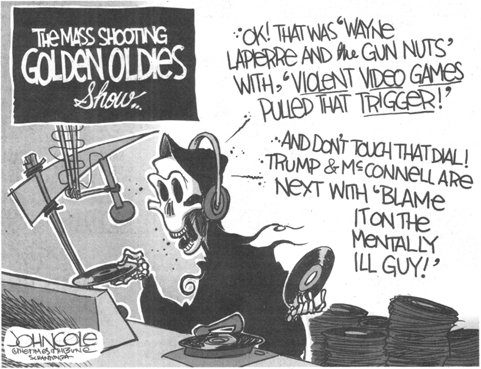
The mass shootings in August 2019 prompted some politicians - including the U.S. President Donald Trump - to once again lay the blame for them at the feet of FPS games. Even though one of the mass shootings happened in a Walmart, and Walmart sells guns and ammunition, Walmart decided to - yes, you know what I'm going to say - blame video games, and really went out on a limb by banning violent video game displays. No, they didn't stop selling violent video games, they simply removed the dealer displays for them. In the 25 years after leading the charge against violent video games, former Senator Joe Lieberman again doubled-down on his anti-video game tirade and included the Internet, but finally admitted more restrictions on gun control are needed: "If it were up to me in Congress right now, I would hope they would seize the moment and find some common ground on gun control. When a guy can walk into a nightclub and restaurant and - in 30 seconds - kill so many people because he had an automatic weapon, it is time to make automatic weapons illegal."
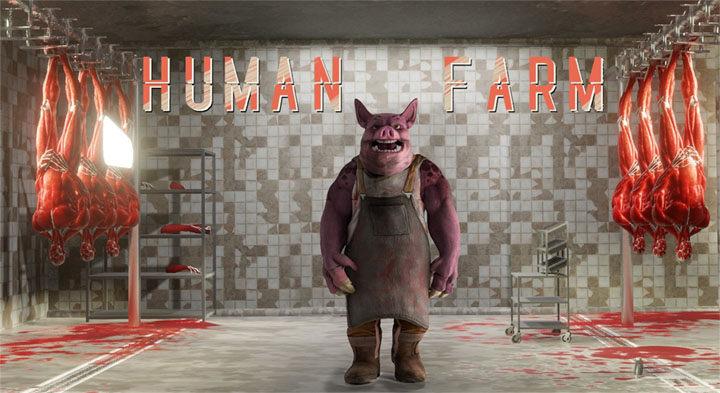
Gaming Factory revisited the gore genre that Chiller started when it announced Human Farm in 2020. You might sale it's role-reversal taken to the extreme. It remains to be seen if there will be any outcry over it, but I suspect there won't be, due to people by and large having been effectively desensitized at this point.
With the earliest video games, it was quite easy to make the distinction between destroying an object (car, plane, ship, etc) and killing a person when all you can see is the object and not the people inside the object. Although games like Western Gun featured human figures being shot, they would simply bounce back up to life; there was no visible injury or bloodshed. With the advent of digitized graphics in the early 90s, gaming violence became all too realistic. Whereas early FPS such as Doom were basically the cartoons of old as far as the level of realism they offered, today's FPS are extremely realistic, and VR gaming creates an all-encompassing experience that will soon rival the most lucid dream. But that factor alone certainly doesn't explain the level of gun violence in the U.S. Movies have featured realistic violence long before video games, and with the continuing expansion and graphical capability of the Internet, all types of content are available to the masses, regardless of how young the user may be - again, all of which is accessible to many countries throughout the world.
Dan Hewitt, the vice president of communications for the Entertainment Software Association (the trade association for the gaming industry), rejected suggestions that video games lead to violent behavior in a statement to Vox: "Study after study has established that there is no casual link between video games and real world violence. Violent crime has been decreasing in our country at the very time that video games have been increasing in popularity. And other societies, where video games are played as avidly, do not contend with the tragic levels of violence that occur in the U.S. Pointing fingers at video games should not be allowed to obscure other factors that likely contribute to such incidents."
Long before Mortal Kombat became a favorite target of critics, video games were already the scapegoat for a myriad of societal problems (truancy, delinquency, vandalism, etc), with some towns outright banning arcade games, much like how New York outlawed pinball games for decades (GameSpot article). Back in November 1982, the U.S. surgeon general, Dr. C. Everett Koop, claimed that kids could be addicted to video games ''body and soul'', as though they were like any drug, and said ''more and more people are beginning to understand'' the adverse mental and physical effects of video games, although he admitted he had no scientific evidence to back it up, merely claiming he predicted statistical evidence would be forthcoming soon from the health care fields. In 25 years since Joe Lieberman's crusade, every study done on trying to find some sort of link between real violence and violent video games have reached the same conclusion: inconclusive. There's simply nothing there.
So what's so different about the U.S. compared to every other
developed country? Well, our form of government for one, the 2nd Amendment
allowing the right to bear arms for another, and gun rights advocate groups and
how organizations such as the NRA can influence our politicians, being a third
reason. In my opinion,
the 2nd Amendment needs some severe restrictions to it (a law banning assault
weapons was passed in 1994 under Clinton, which expired in 2004 under Bush), or it needs to be
abolished, because we clearly can't handle it the way it
 is now.
What about the influence derived from this
country's huge military infrastructure, otherwise known as the 'other' national
pastime? In 2017 alone, we spent close to $700 billion, or around 3.5% of
the country's gross domestic product (GDP). Or to
put it in another perspective, the U.S. spends nearly as much as the next
eight-largest spending countries combined. That is insanity run amok. Love him
or hate him, Michael Moore covered the same ground 20 years ago in his movie,
Bowling for Columbine, and unfortunately the only thing that's really
changed since then is the frequency of mass shootings. Why do our
politicians (and the media to some extent) refuse to address the issue, instead
focusing on various forms of entertainment that everyone in the world has access
to? The comment in this MarketWatch article
regarding video games
causing gun violence in America sums up the tired excuse of blaming games - "The data on bananas causing suicide is
about as conclusive." Hours of playing FPS games didn't turn me into
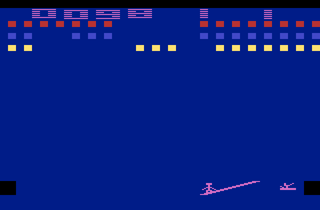
a gun-wielding homicidal maniac any more than playing Circus Atari
motivated me to put a plank on a rock and see if the same, sickening 'crack' in
the game was heard when my friend hit the ground. And yet we keep hearing the same diatribe over and over
about how there's a connection. It's no
different than reading articles about how Atari's E.T. game caused the
video game industry to crash. We got it. Those writers did zero research and simply
"Googled" the topic, found similar articles on other sites making the same
comments (sometimes verbatim), and figured what they're saying must be
true... except that most of those other writers did the exact same thing.
Some politicians employ the same knee-jerk reactions, simply repeating
what others have said, instead of thinking for themselves and doing their own
research. Politicians are hesitant to take on the NRA, which is not
surprising.
I wonder what would happen if the video game industry contributed to their
campaigns at the same level the NRA does...
is now.
What about the influence derived from this
country's huge military infrastructure, otherwise known as the 'other' national
pastime? In 2017 alone, we spent close to $700 billion, or around 3.5% of
the country's gross domestic product (GDP). Or to
put it in another perspective, the U.S. spends nearly as much as the next
eight-largest spending countries combined. That is insanity run amok. Love him
or hate him, Michael Moore covered the same ground 20 years ago in his movie,
Bowling for Columbine, and unfortunately the only thing that's really
changed since then is the frequency of mass shootings. Why do our
politicians (and the media to some extent) refuse to address the issue, instead
focusing on various forms of entertainment that everyone in the world has access
to? The comment in this MarketWatch article
regarding video games
causing gun violence in America sums up the tired excuse of blaming games - "The data on bananas causing suicide is
about as conclusive." Hours of playing FPS games didn't turn me into
a gun-wielding homicidal maniac any more than playing Circus Atari
motivated me to put a plank on a rock and see if the same, sickening 'crack' in
the game was heard when my friend hit the ground. And yet we keep hearing the same diatribe over and over
about how there's a connection. It's no
different than reading articles about how Atari's E.T. game caused the
video game industry to crash. We got it. Those writers did zero research and simply
"Googled" the topic, found similar articles on other sites making the same
comments (sometimes verbatim), and figured what they're saying must be
true... except that most of those other writers did the exact same thing.
Some politicians employ the same knee-jerk reactions, simply repeating
what others have said, instead of thinking for themselves and doing their own
research. Politicians are hesitant to take on the NRA, which is not
surprising.
I wonder what would happen if the video game industry contributed to their
campaigns at the same level the NRA does...