Bill Hogue interview
By Scott Stilphen
(2026)
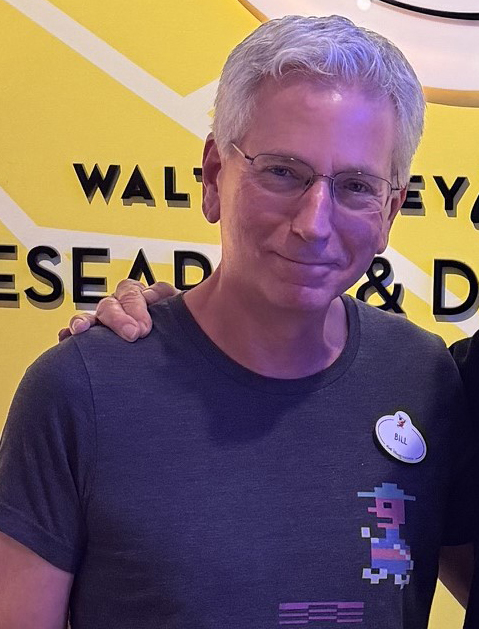
Bill Hogue is best known for his Big Five Software company's creation of Miner 2049er. It's often described as a cross between Donkey Kong and Pac-Man, but is also similar to Space Panic. The similarities to Donkey Kong are apparent, and that's because the game's development originally started off being a knockoff of Donkey Kong! Bill's prowess at doing arcade adaptations for the TRS-80 served him well for creating an original game with the same addictive gameplay characteristics as some of the most successful and seminal arcade games. Upon its release in 1982, it quickly garnered attention for having 10 different screens and varied play mechanics (ladders, slides, transporters, lifts, and even a cannon). It was also the first game to be widely licensed and adapted for several consoles and computer by MicroLabs (Apple II, Colecovision, and IBM), Reston Software (VIC-20 and C-64), and Tiger Electronics (Atari VCS, TI-99/4a, and handheld), among others. Mindscape also released a version for the Game Boy in 1991, and most recently a version was released for the Intellivision and PS5, proving that 'ole Bounty Bob is still trying to claim that radiactive mine.
Q: What's your educational background?
Bill Hogue: I attended California State University
Northridge (CSUN) studying Computer Science right after high school in 1979.
My first programming class there used punch cards! You would sit at a
terminal, enter your program, and then take the stack of cards to a desk where
they would run your program on their computer and later you would get a
fan-folded listing of the output.
I left CSUN in my second semester when Big Five started up. Years later,
sometime after 1990, I decided to go back and get my degree. I started at
Moorpark College and got an Associate Degree in Computer Science. Then
later in 1994 I transferred back into CSUN. It was right after the 1994
Northridge quake so a lot of the campus was wrecked and we had classes in
trailers. But CSUN rebuilt itself and I finished my BS in Computer
Science. The following semester I went to the first night of a class
towards getting a Masters degree. But I was pretty deathly ill from the
flu so I went home and later convinced myself to take a semester off. But
I never went back.
Q: I understand that you got your start with designing and programming games from using a TRS-80 at your high school. Were there any games you saw for it that inspired you, or any arcade games?
Bill Hogue: Well obviously it was Atari’s Asteroids at the pizza restaurant next to the Radio Shack that I worked at in Reseda, California that I really wanted to do a home version of. I also enjoyed playing Atari’s Space Race at Castle Golfland in the Valley of which the inspiration for Meter Mission came from.
Q: Your experience with the TRS-80 led you to working at a local Radio Shack store, which I'm guessing is when you bought yourself a TRS-80. Was there an employee discount to help with that, and if so, is that why you wanted to work there?
Bill Hogue: Yes, that was when I got my first TRS-80. There must have been an employee discount, but I can’t be sure. For a young guy who was also tinkering with electronics, that was the cool place to work. I used to cherish getting the new Radio Shack catalogs in the mail to check out all the new toys. Later, Radio Shack opened up a nearby Computer Center and I transferred over there.
Q: What inspired you to pursue a career in game design? Were there any programmers or games that inspired you?
Bill Hogue: I’m sure it stemmed from the late nights working at Radio Shack where there few customers and there was not a lot to do other than tinker with the store’s TRS-80. Having an Atari 2600 locked away at home was probably the reason I tried to create my own games to play on the TRS-80. I do want to give a shout-out to the Adventure series of text-based games that Scott Adams wrote. They weren’t graphical games of course but they were still fun to play!
Q: When did you start Big Five Software with your friend Jeff Konyu? And what's the meaning behind the name?
Bill Hogue: Jeff was also experimenting with
electronic circuits and he came into the store while I was working there to buy
some parts. We both loved to play Asteroids but he was WAY better at it
than I was!
In junior high school, I was in a TV production class. I guess our
proximity to actual Hollywood is why our school had such a class! My four
friends and I in that class were living the dream working cameras and “special
effects generators” to record to ¾” videotape. We were technical gurus who
called ourselves “The Big Five” of the class! For the longest time I
thought my future career would be something behind the scenes in TV or film
production.
Q: Besides yourself and Jeff, was there anyone else involved with Big Five at this point?
Bill Hogue: Initially I was selling games out of my parent’s house in Van Nuys. Later when I got my first office, I hired others including my mom and later my stepdad.
Q: It looks like Big Five started advertising in 80 Microcomputing magazine in their July 1980 issue, with your first game (Super Nova), and by the December 1980 issue you were advertising that and 4 other. Did you advertise anywhere else at the time?
Bill Hogue: That’s something I just don’t remember anymore!
Q: Were all the TRS-80 games Big Five did basically derivatives of arcade games? Here's a list of all the Big Five Software TRS-80 titles I could find (in the order they were released), and the original arcade games they're derivative of:
Super Nova - Asteroids (Atari 1979)
Meteor Mission - Space Race (Atari 1973)
Galaxy Invasion - Galaxian (Namco 1979)
Attack Force - Targ (Exidy 1980)
Cosmic Fighter - Astro Fighter (Gremlin 1980)
Meteor Mission II - Lunar Rescue (Taito 1979)
Robot Attack - Berzerk (Stern 1980)
Bill Hogue: Initially they were, yes. I was trying to not infringe by not literally copying the arcade games and using different trademarked names. Defense Command was the first game I wrote that was a totally new creation for the TRS-80. We also released Stellar Escort and Weerd! which were written by other programmers and those weren’t based on any existing games. Of course Miner 2049er and Bounty Bob Strikes Back! for Atari were totally new games, and that’s also where I had the most success.
Q: Many of those early TRS-80 ads mention each game having "Level I or II". The original cassette copies show that one side of the tape says "Level 1" and the other says "Level 2". I'm guessing the 2 levels were the same game with level 2 being a harder version? There's also someone on YouTube showing footage of your original Meteor Mission game, and he says that someone else claimed people could send in their tapes to exchange for a copy of Meteor Mission II.
Bill Hogue: I do vaguely remember what he’s talking
about now where we were allowing people to exchange one for the other. But
that is just so long ago at this point.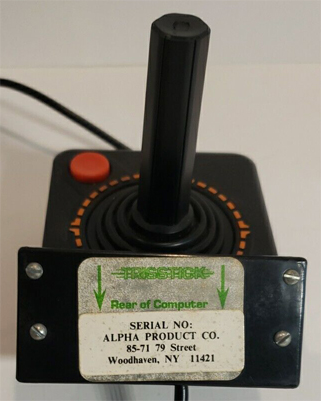
Q:
Regarding the Trisstick controller that was advertised, you mentioned in Matthew
Reed's interview that Alpha Products approached you about modifying your games
to support their Alpha Joystick controller (later called the Stick 80).
The controllers were modified Atari Standard joysticks. You later decided
to sell your own version of the controller, called the Trisstick. Unlike
Alpha Products controller, your controller was wired directly into a TRS-80
interface connector. I found one on Ebay that had an Alpha Products
sticker on top of the Trisstick sticker!
There was also a device called the Stickeroo which sounds like a
knockoff of the Stick-80 and Trisstick. This was just an interface device
that didn't include a joystick.
Bill Hogue: That is a great question about that joystick on Ebay. It doesn't seem to make sense that it would have both stickers. I don't remember what our case looked like so I can't tell if it's the one we made or not.
Well, I used to think Trisstick was a pretty cool name, but now I have heard of the incredible Stickeroo!
Q: What or who prompted you to make the pivotal decision to developing games for the Atari 800?
Bill Hogue: I really wanted to do a game with proper color and sound. I remember taking a look at the Radio Shack Color Computer, but I wasn’t impressed. The Apple computer was ok, but for the games I wanted to program, the Atari 400/800 was the best choice.
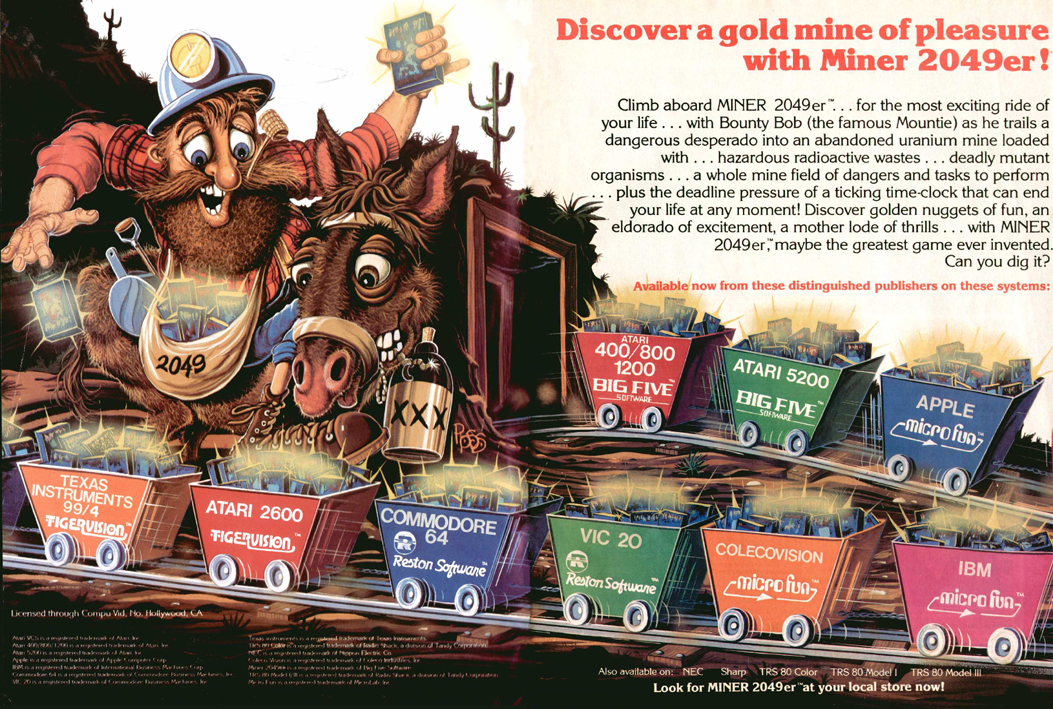

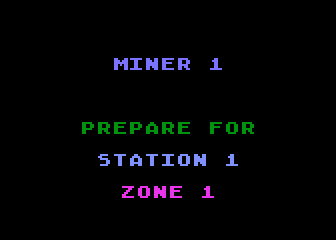


Big Five Software's Atari 400/800 Miner 2049er.
Q: Miner 2049er is of course your 'magnum opus' as far as game development success. According to an article in the August 1983 issue of Electronic Games, the original version started with one guy, a bounty hunter, chasing another, and it was too much like Donkey Kong. The concept was reworked but the "Bounty" name stayed and became Bounty Bob. I know at least 2 other people were involved with the original Atari 400/800 - Curtis A. Mikolyski and Kelly Bakst. Who contributed what to the game?
Bill Hogue: Curtis designed the levels and I coded them, but for Bounty Bob Strikes Back!, I had written a full-blown level editor for Curtis to go crazy with. Kelly was coding a version for the TRS-80, but we never released it.
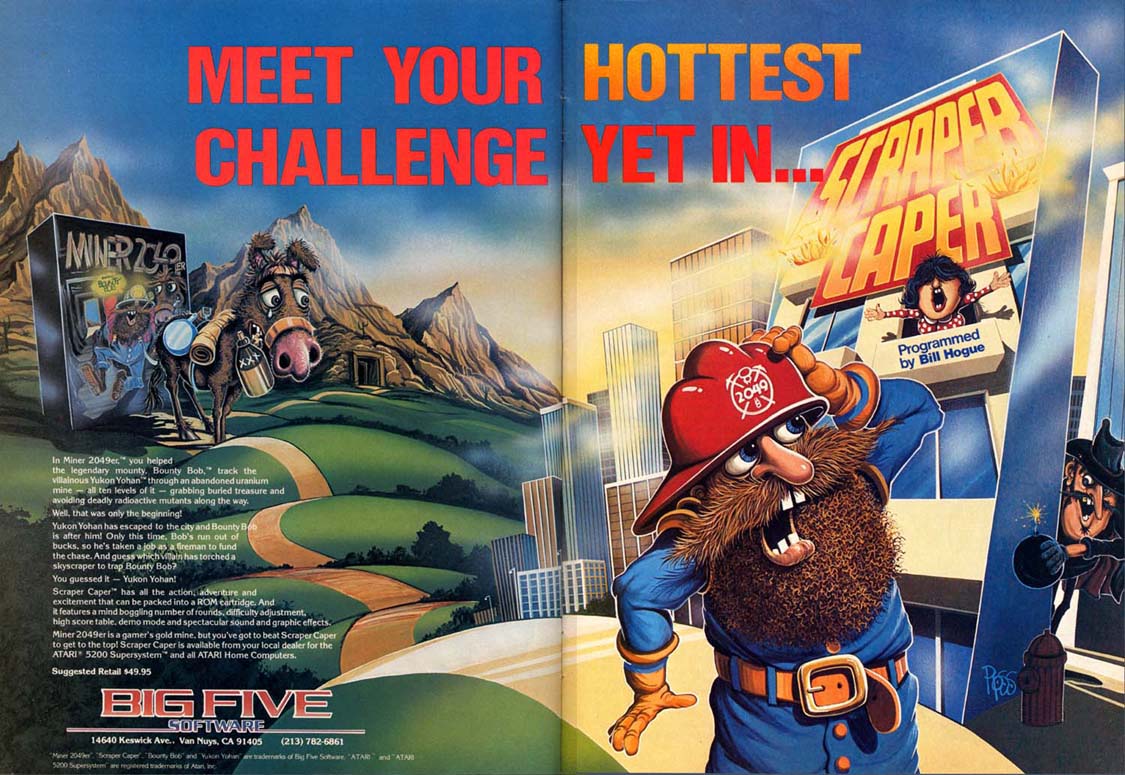
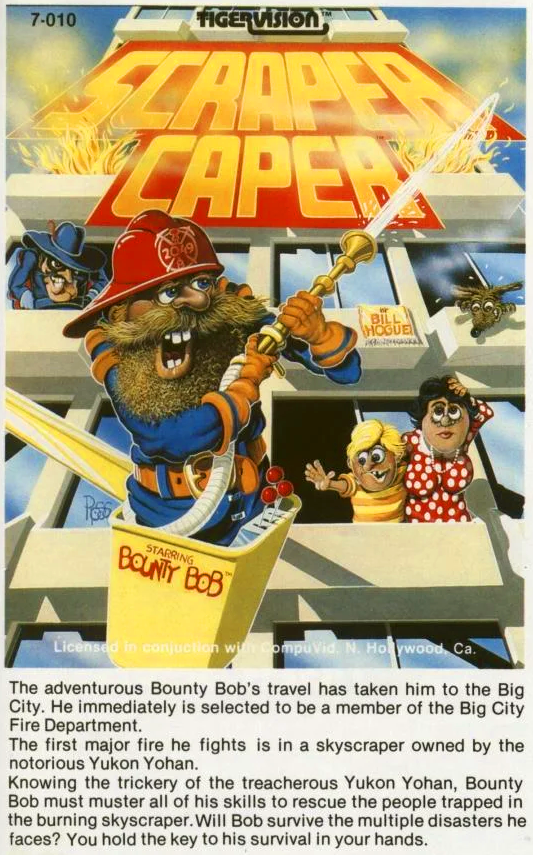
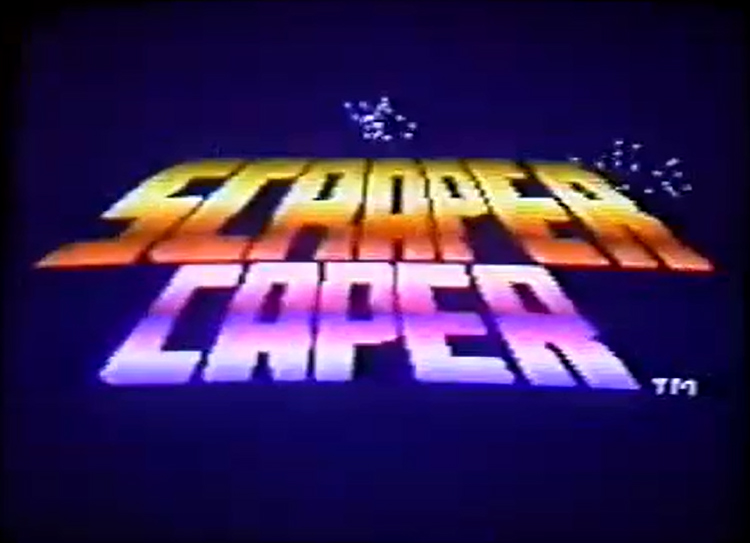
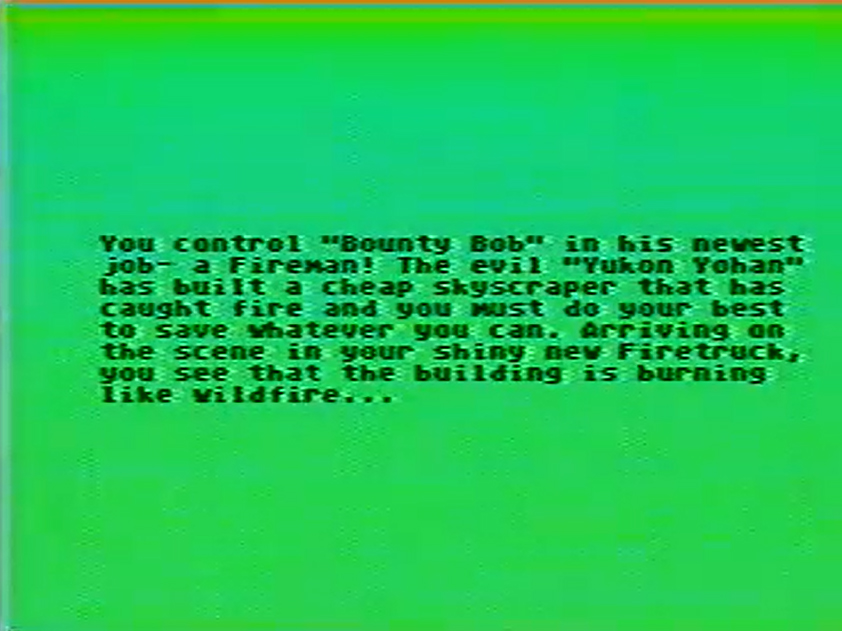
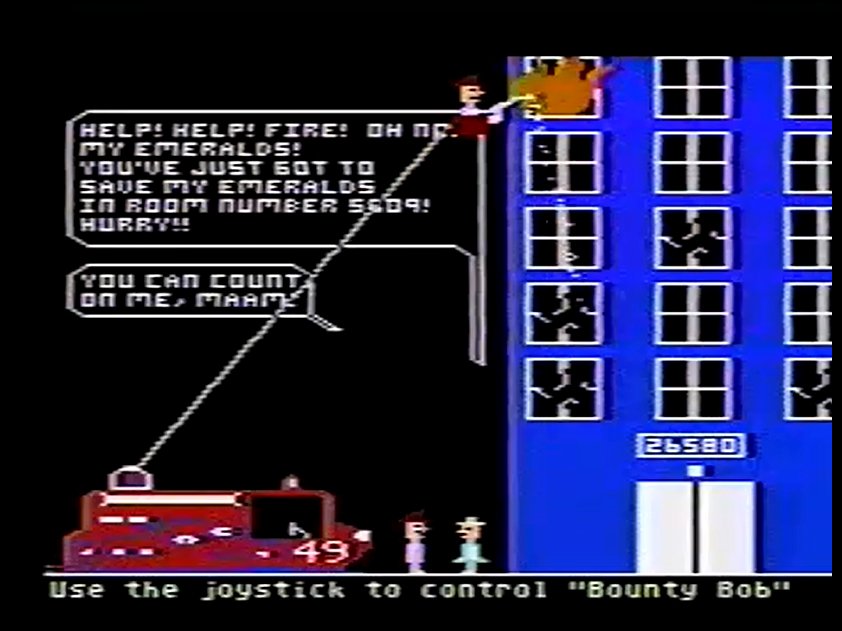
Q: Probably the 2nd-most popular game you worked on was one that was never released, although it was highly advertised by both Micro Fun and Tigervision, and even shown at CES and other trade shows. That was of course Scraper Caper, and 2 very different versions were developed, with the first being quite unique and original that may or may not have been a scrolling game, with the player either putting out fires or going room to room rescuing people and items.
Bill Hogue: It was a vertical scrolling game where you went up to the room to save or recover what you were asked to do.
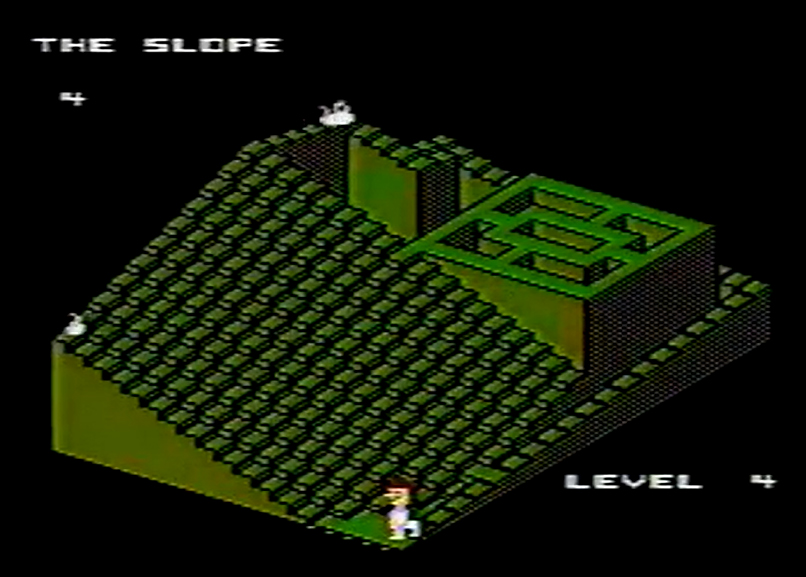
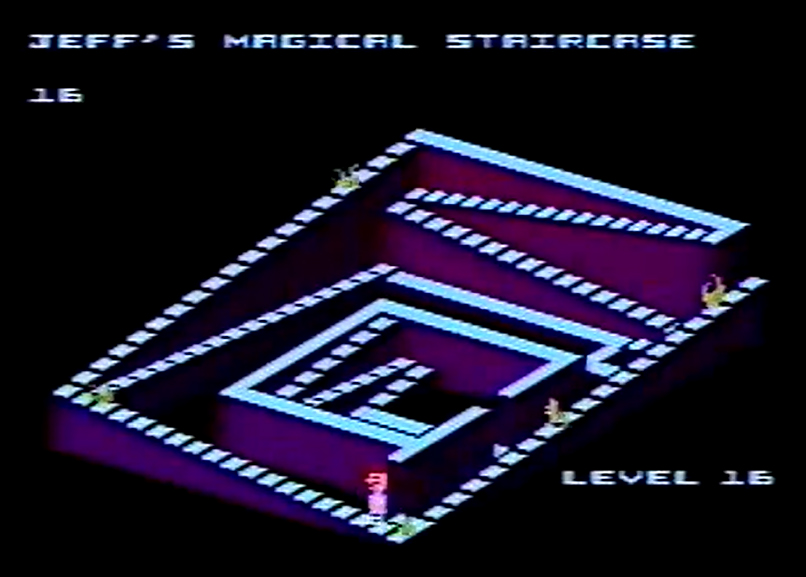
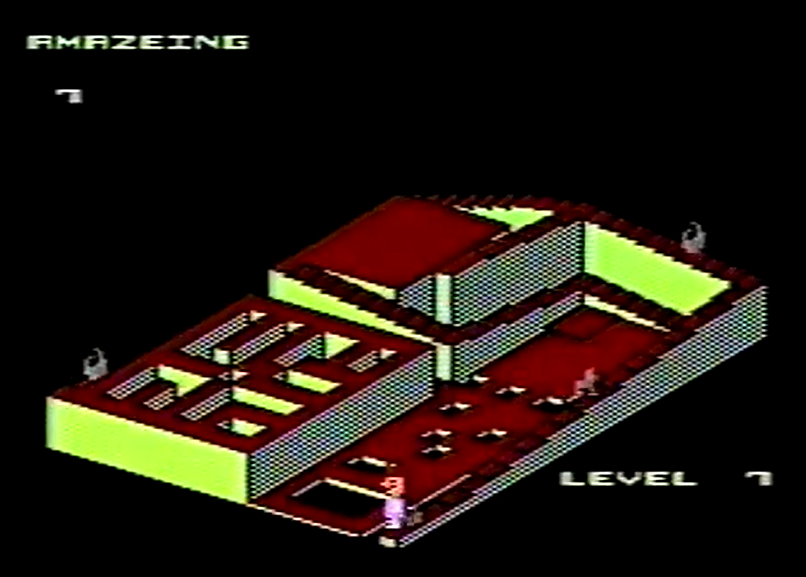
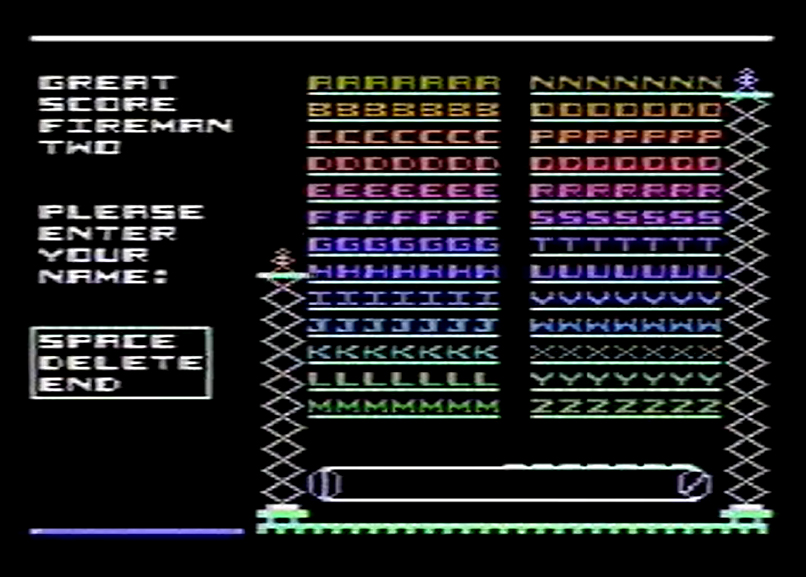
Q: The other version was a variant of Crystal Castles. The May 1984 issue of Video Game Update has a blurb about the game that sounds more like the later version:
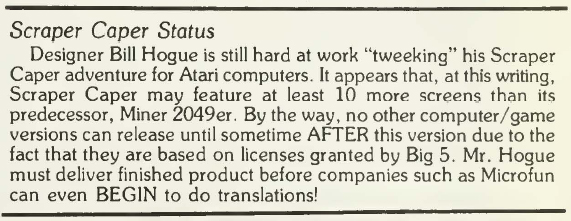
Bill Hogue: Yeah… I was really trying to top myself after how successful Miner 2049er was. Both of the Scraper Caper versions didn’t seem to be reaching the level I was looking for. So I went back and did a really over the top sequel to Miner.
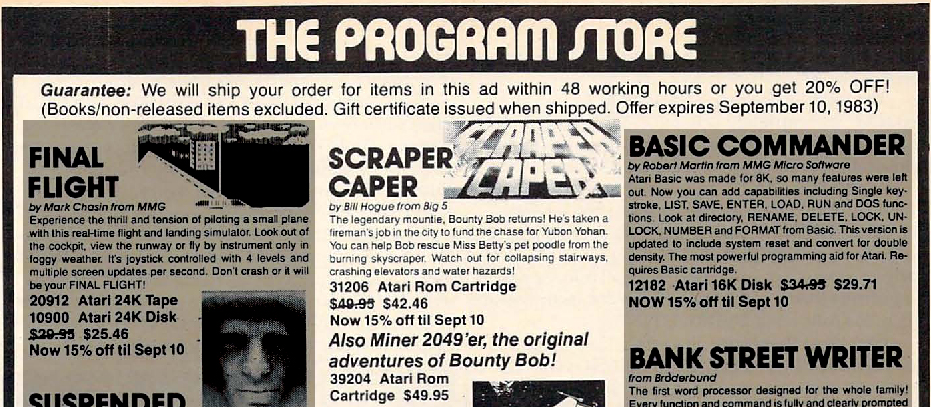
Q: I came across this ad from a software distributor called The Program Store. It's from the September 1983 issue of Compute! magazine. In looking at several of their ads, they were clearly one of those companies back then who advertised 'vaporware' titles for sale, as no sooner did a company announce an upcoming title, they'd quickly follow it up with an ad for it :) The ad below shows they listed Scraper Caper. If that wasn't enough of a surprise, they even were selling it at a discount! MicroLabs was also advertising Miner 2049er II at the same time they were advertising Scraper Caper.
Bill Hogue: When we were wasting time with Scraper Caper, MicroLabs got angry at me and decided to do another Miner version with levels they created on their own.
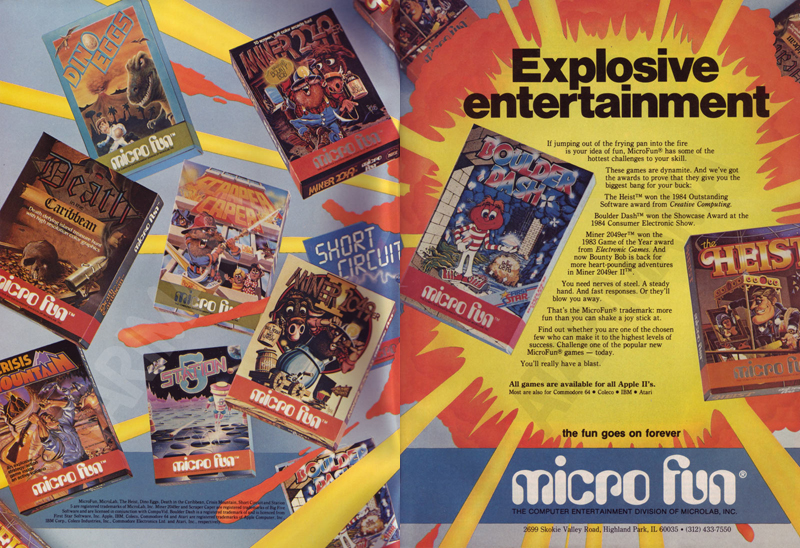
Micro Fun ad featuring several unreleased games
such as Scraper Caper and Miner 2040er II.
Q: At the height of Big Five Software's success, you were taking helicopter flying lessons. Do you still fly, and how was it that skill didn't lead you to developing a video game involving helicopters?
Bill Hogue: I do still fly! But I only have a fixed wing aircraft license – I never finished the helicopter training. Flying planes is expensive. Flying a helicopter was just crazy to even think about!


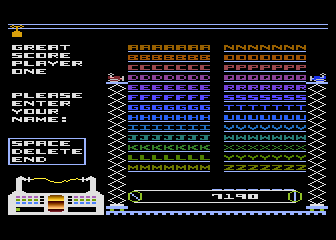
Big Five Software's Atari 400/800 Bounty Bob
Strikes Back!
Q: After plans for Scraper Caper fell through (or should we say "burned up"), you salvaged some of your code for use with Miner 2049er's follow-up sequel (BBSB), particularly with the high score page and the Scraper Caper title screen fireworks (which appear after beating the game). This would prove to be not only your last game, but Big Five Software's as well, as the market crash pretty much decimated the video game industry by then. What were those final days in the industry like, and how hard was it to transition away from game development?
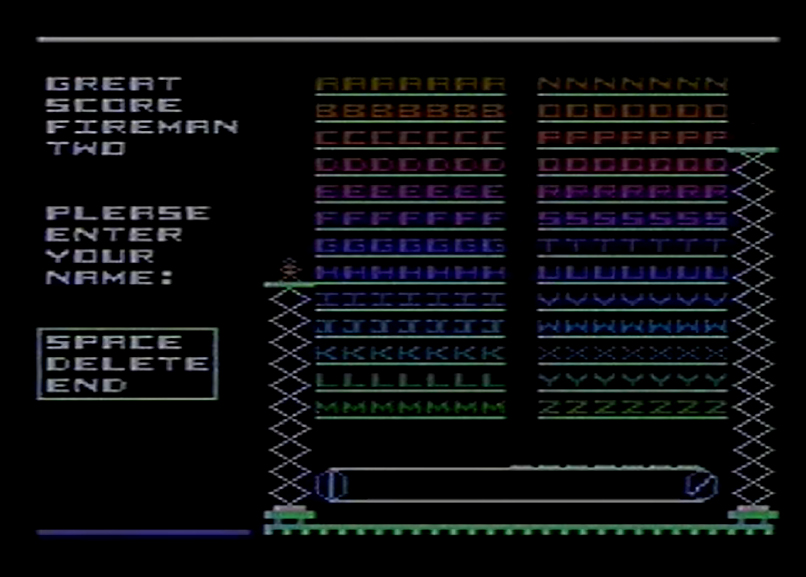
Bill Hogue: You can definitely see a lot of what I did for version two got recycled into Bounty Bob Strikes Back, including the high score entry screen, the scrolling between levels, the fonts, and even the level and character editor that Curtis used to make the levels.
It wasn’t too hard for me to get a "real" job in industry. My first post-Big Five job was at some place near LAX called Information International. That was back in the days when newspapers were still around. Their equipment used a vector-beam monitor that was focused onto photo-sensitive paper to draw fonts for use as a master for printing. So my video game background was actually a pretty good fit! But alas, the drive was insane and I didn’t stay there that long.
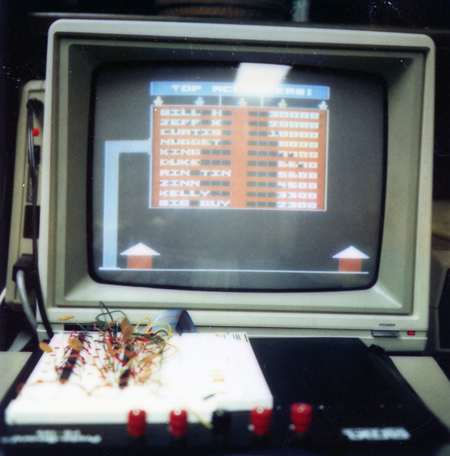
A photo of the circuitry for the Bounty Bob
Strikes Back! cartridge.
Q: In 1990 you went to work at Technicolor. In an interview you did for Matthew Reed in 2008, you mentioned if the film business transitioned to digital projection, you’d apply to Disney’s Imagineering. That’s exactly what happened, and what you did!
Bill Hogue: Yep, they finally hired me in 2015. That was when Galaxy’s Edge in Disneyland was being planned and built. I’ve been there over 10 years now and I have worked on many, many things including Rise of the Resistance, Holotile, and the extending lightsaber used in Galactic Starcruiser. We give a lot of demos at R&D and I'm the lightsaber guy! Here's a video of one of those demos. Two other things I contributed to are coming on-line soon – one this week at Disneyland and another later for the D23 show in Anaheim. Did I mention I recently got to meet Nolan Bushnell? That was a fun day!
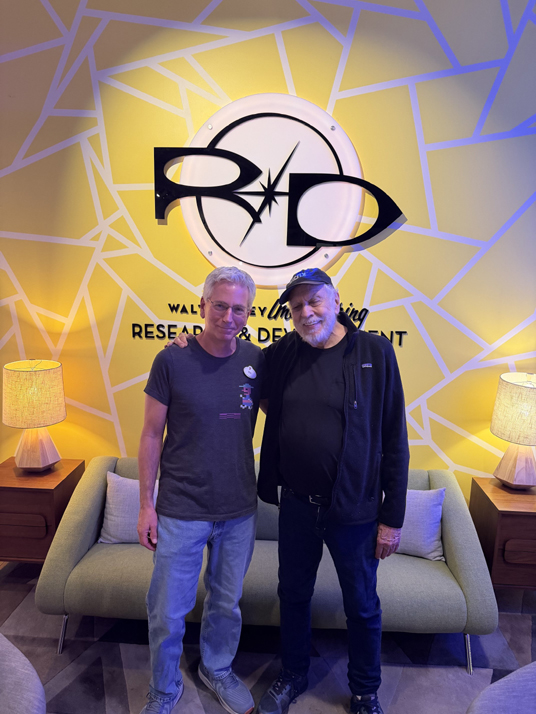
Bill Hogue and Nolan Bushnell at Walt Disney
Imagineering Research & Development.
Q: With your games, were there any features you would have liked to added, or any known bugs or glitches that gave you trouble (or never got resolved)?
Bill Hogue: There was bug we discovered on the acid
tank level of Miner 2049er where you could get trapped in the tank with no way
to die other than running out the clock. We couldn’t fix it of course
since it was code burned into a ROM in the cartridge. A later version of
the ROM has the fixed code.
In Bounty Bob Strikes Back, we were using multi-channel sound for different music
harmonies. Occasionally the music would get muted and I could never
understand why. Years and years later when I wrote an emulator for it on
Windows, I was shocked to hear the muted audio again! I was finally able
to figure out that the two channels would occasionally sync up and cancel each
other out! I put a fix into the emulator so that wouldn’t happen.
Q: Besides the TRS-80 version of Miner 2049er, were there any games or projects that you or others at Big Five Software worked on that ultimately never got released or even finished?
Bill Hogue: Probably the biggest mistake I made as a company owner was hiring three or four other programmers and letting them loose to make games. None of their efforts went anywhere and I can only blame myself for hiring them and then not working with them enough to make something releasable.
Q: Miner 2049er has 'surfaced' a few times in the last few years. In 2017 programmer William Moeller converted the game to the Intellivision system, and Chris Mikolyski even designed 11 new mines for the game (LINK). The Intellivision was one of the few consoles back then that didn't see a version of Miner 2049er. The game was released and sold the following year. In 2021, Atari Interactive added both Miner 2049er and Bounty Bob Strikes Back to their list of IPs and both games appeared on Atari's recent Atari 50: The Anniversary Celebration compilation. Atari also released the 400 Mini system in 2024, and Miner 2049er was one of the 25 classic games that were included on it. Were you aware of those?
Bill Hogue: Yes, William Moeller was working with me and paid me some small amount of money for his Intellivision version. I'm not sure he ever turned a profit on it, though. He missed the period for getting rich off of video games by three or four decades I'm afraid.
Yep, Atari paid me a boatload of money for Miner. I didn't know who the offer was from until it was almost finalized. Perhaps they thought I'd ask for more when I found out it was Atari. I have a Blu-Ray they published (I had to buy it, what's up with that!) and I can now play Miner on my PlayStation 5!
Q: Occasionally, programmers would put little Easter eggs in some of their games that would reveal their name, or a message. Are there Easter eggs in any of your titles? Do you recall any fellow co-workers that did?
Bill Hogue: Bounty Bob has several special function codes that can be entered to produce silly little messages. We actually started including a copy of them in the package toward the end.
Q: What were some of your experiences working in the game industry? Do you have any stories or anecdotes from those days that you relate?
Bill Hogue: I did get to meet Scott Adams in a trade show once! And Curtis and I got to fly to New York in tuxedos to receive an award! We got to meet Don Bluth who did Dragon’s Lair during that trip! There was some game party event I went to, I think perhaps in Chicago, where Meat Loaf was playing.
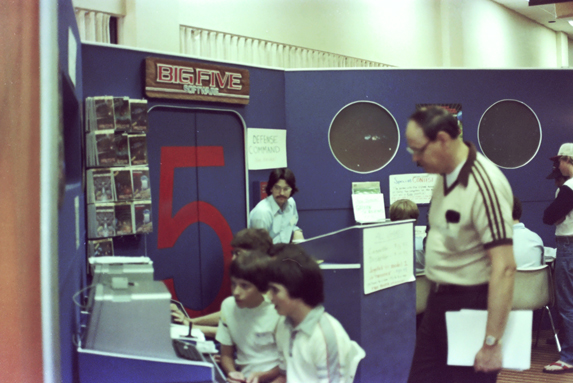
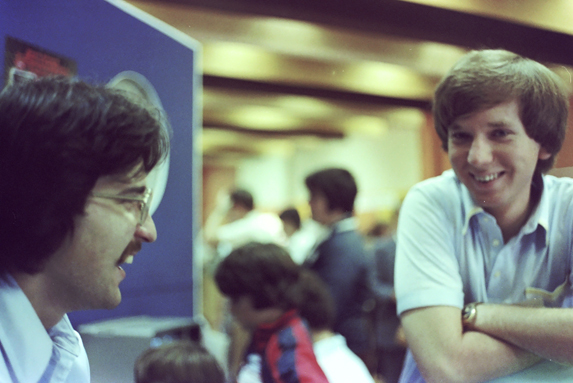
Bill Hogue and Curtis Mikolyski at
their Big Five Software booth for a convention in
Florida.
Q: Do you still own any of your games for these systems, either as a keepsake, or to show friends or family?
Bill Hogue: I do have a handful of all of the games safely stored away in storage boxes.
Q: Which of your titles are your favorite, and what types of games in general? What’s your preferred platform for gaming?
Bill Hogue: Bounty Bob Strikes Back is my favorite
because it includes everything I wanted to do packed into a then-revolutionary
40K cartridge.
Today I have a PS5 Pro. My favorite game of all time is without a doubt
The Last of Us. I have played that through way too many times on three
different Playstation consoles. Not too long ago I finished the Indiana
Jones game. I ended up liking it more and more as I played it, but it
doesn’t feel like the kind of game I would want to play over. I just
started playing the new James Bond game, but I barely have an hour into it.
Like a lot of people on the planet, I’ll be playing GTA IV when it comes
out.
Q: Have you stayed in touch with any of your former Big Five Software co-workers?
Bill Hogue: I see Curtis every now and then. I’m probably due to go flying somewhere with him. And Jeff comes by every few weeks.
Q: What are your thoughts on how the industry has evolved?
Bill Hogue: Back when I got started it was just a programmer and perhaps a graphics artist making a game. Now you have hundreds of people working together – pretty much how a movie is made. There’s no way I would ever even consider doing video game work these days. I don’t have any of the skills they would be looking for.
| GAME | SYSTEM | COMPANY | STATUS |
| Super Nova | TRS-80 | Big Five Software | released |
| Meteor Mission | TRS-80 | Big Five Software | released |
| Galaxy Invasion | TRS-80 | Big Five Software | released |
| Attack Force | TRS-80 | Big Five Software | released |
| Cosmic Fighter | TRS-80 | Big Five Software | released |
| Meteor Mission II | TRS-80 | Big Five Software | released |
| Robot Attack | TRS-80 | Big Five Software | released |
| Defense Command | TRS-80 | Big Five Software | released |
| Miner 2049er | Atari 400/800 | Big Five Software | released |
| Scraper Caper (v1) | Atari 400/800 | Big Five Software | unreleased |
| Scraper Caper (v2) | Atari 400/800 | Big Five Software | unreleased |
| Bounty Bob Strikes Back! | Atari 400/800 | Big Five Software | released |