ATARI ARCADE COIN-OP UNRELEASED PROTOTYPE GAMES AND HARDWARE
Last updated 5-15-2026
|
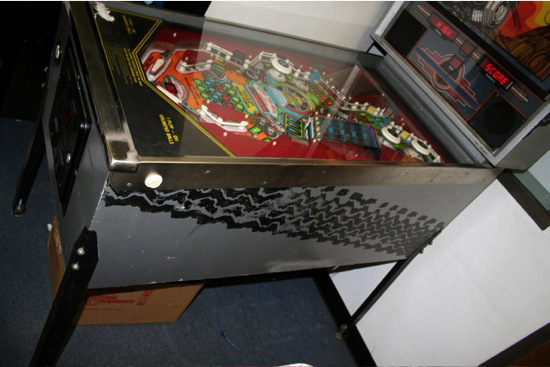
4x4 (pinball) (1983) |
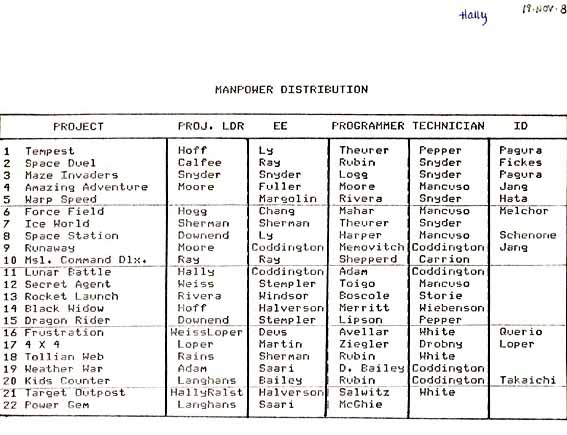
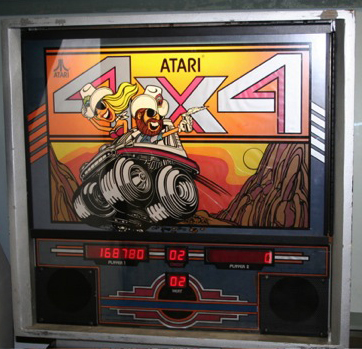
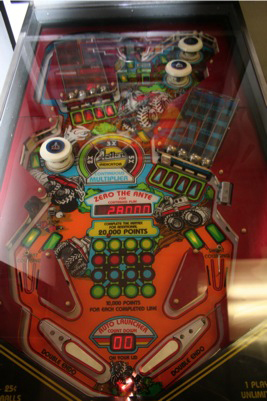
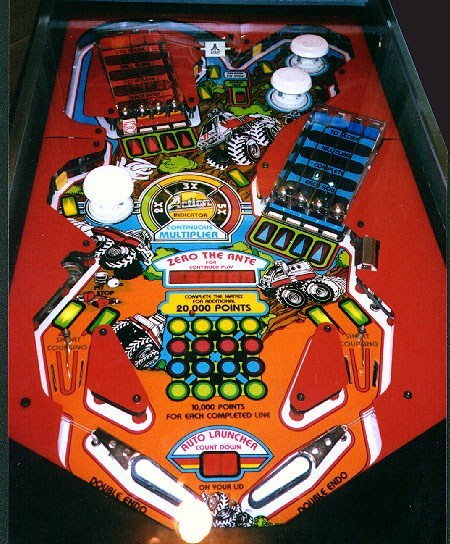
Designed by Milt Loper. The game was originally designed to be E.T. and later re-themed to be 4x4. Only 2 were produced, with 1 confirmed still in existence.
|
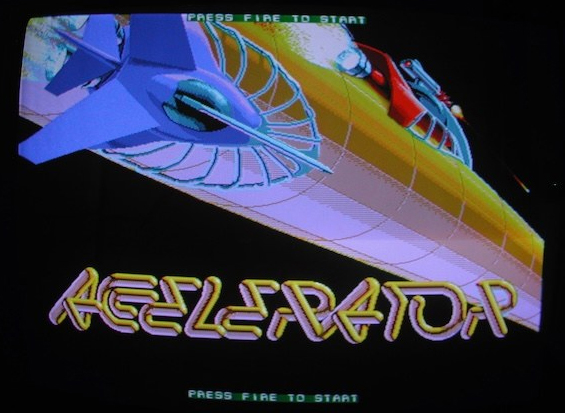
ACCELERATOR (1988) |
A 2 player space racing game where the screen was divided up like Xenophobe and your space ship rides on a pipe of some kind. Runs on Atari System II hardware.


|
ADVENTURE / AMAZING ADVENTURE (1982) |
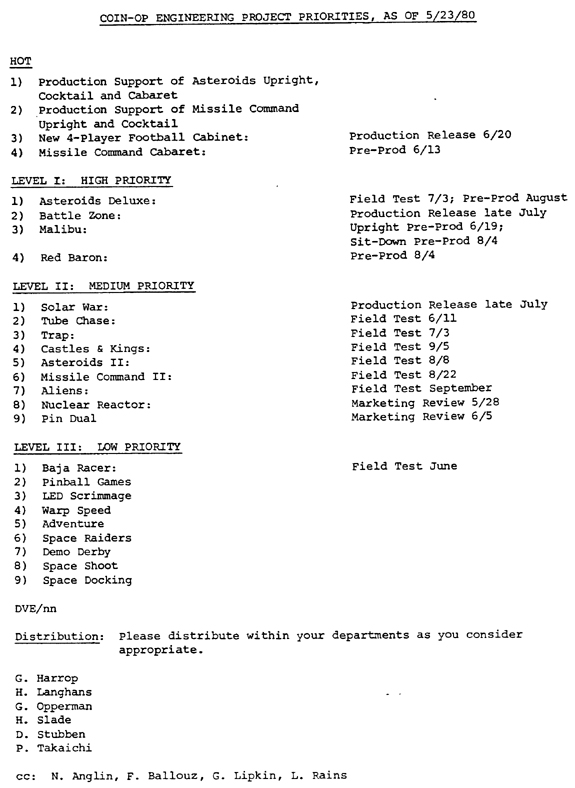
Deemed a low priority, according to a 5-23-80 memo. From Michael Albaugh
regarding any unreleased or unfinished games of his:
Of mine, maybe the most
interesting would be the first-person Adventure game (cave/maze exploration and the occasional opponent). I could go to lengths about it, but the important thing was that it
was quite ambitious. The feasibility study (with using a Flying Spot Scanner) did not
get that far. Then Dave Sherman came up with a multiple-ellipse drawer to
combine with the scalable motion objects from the original concept.
I do remember that the Amazing Adventure (name) was word-play for 'A Maze (ing)
Adventure', that is emphasizing the maze-exploration aspect of the game, which
implies that if it was "my game", it might have been after the shift from
film-strip backgrounds (necessarily fixed) to digital ones (potentially
algorithmically-generated), hence more opportunity for maze exploration without
getting stale.
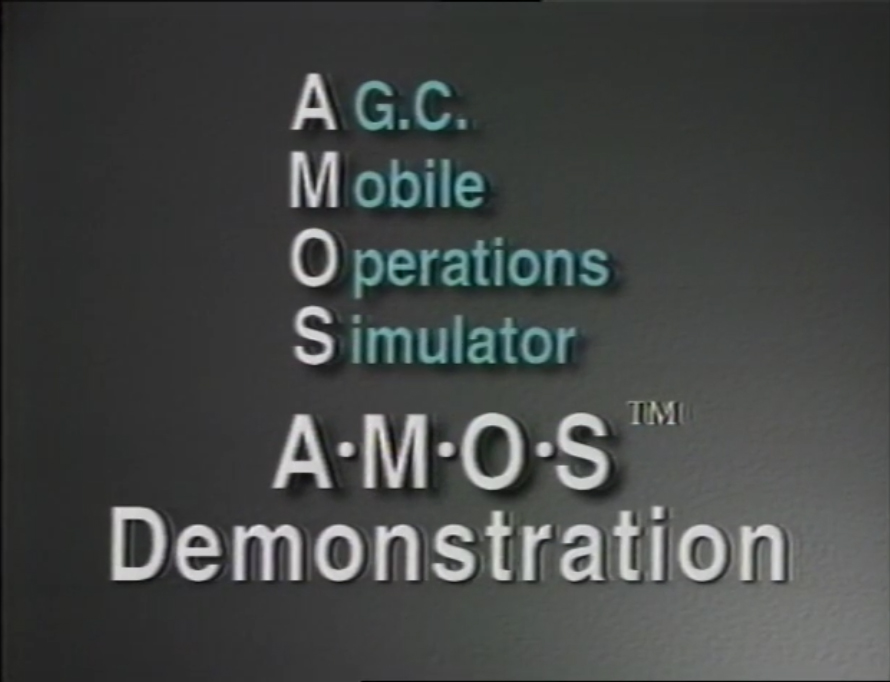
AGC
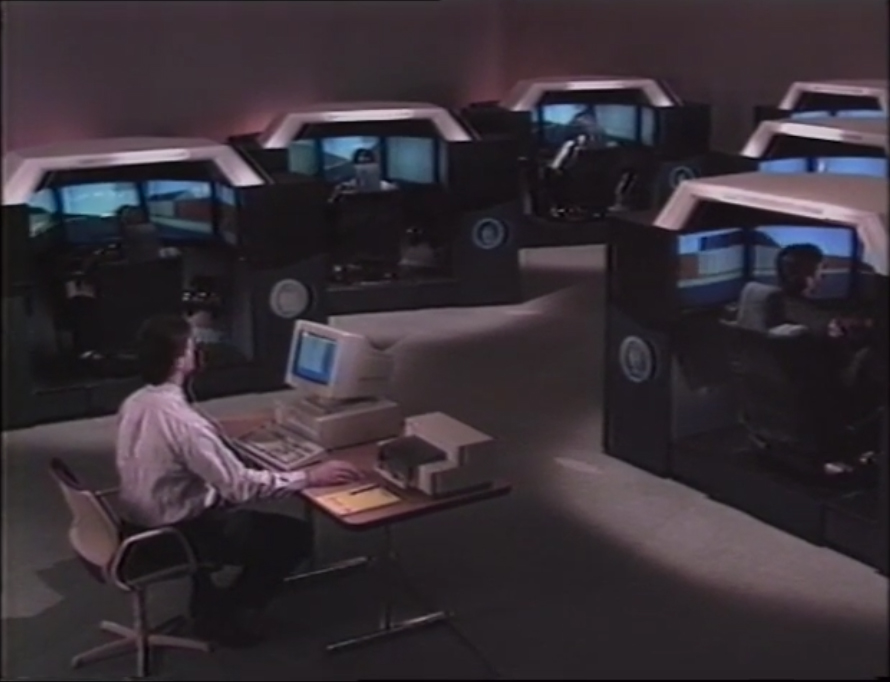
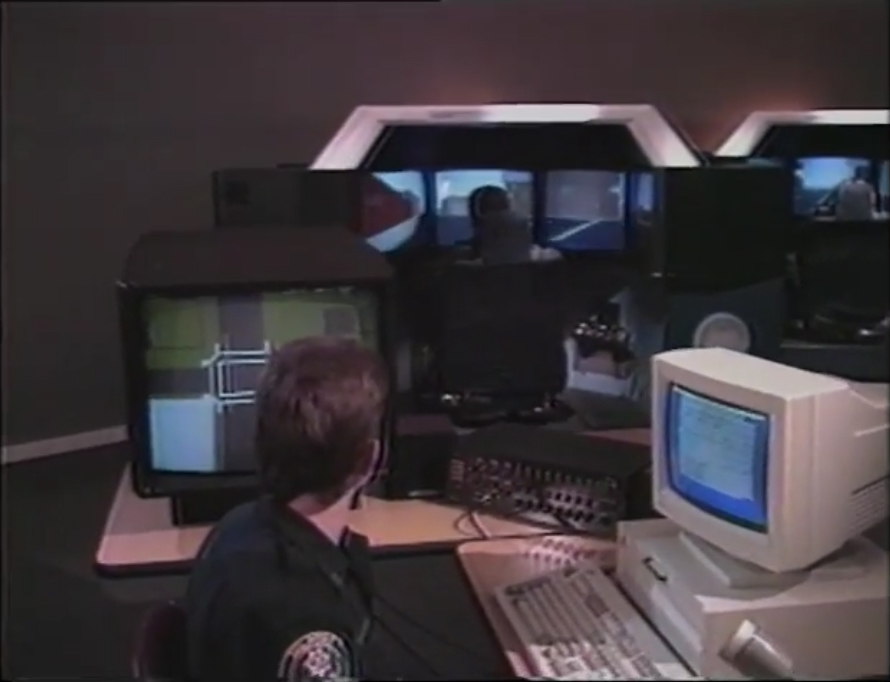
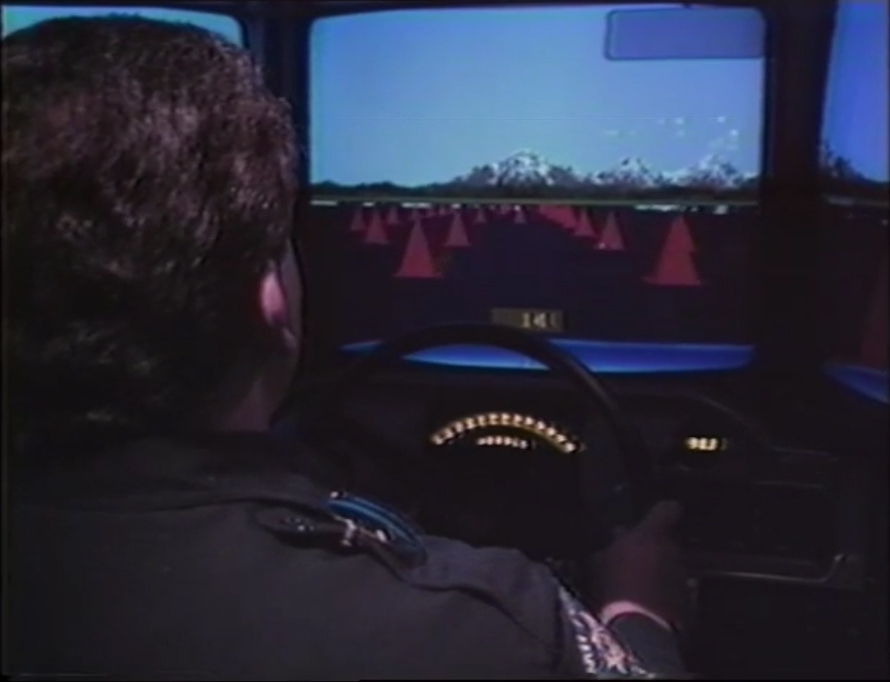
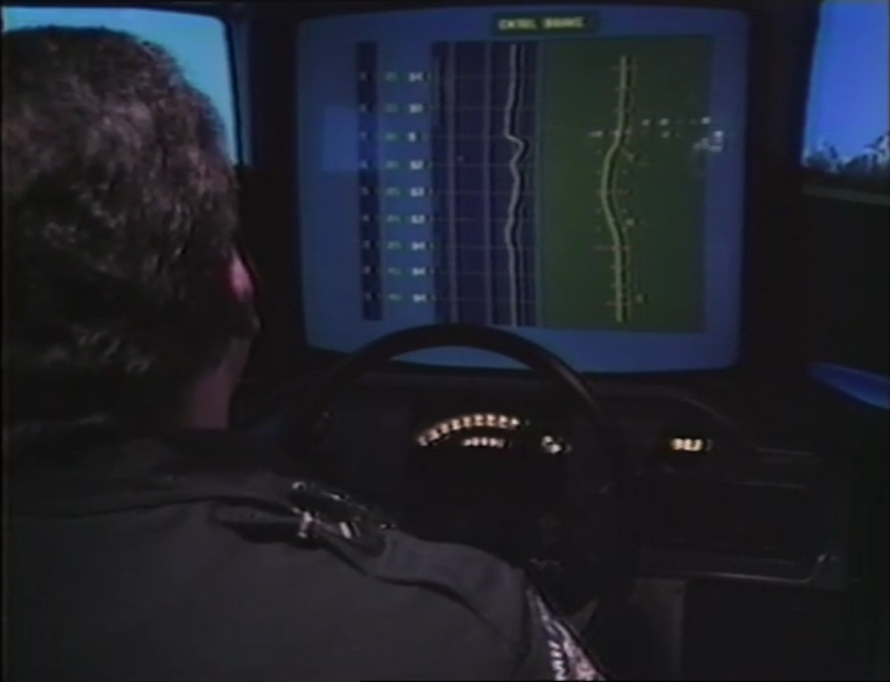
MOBILE OPERATIONS SIMULATOR
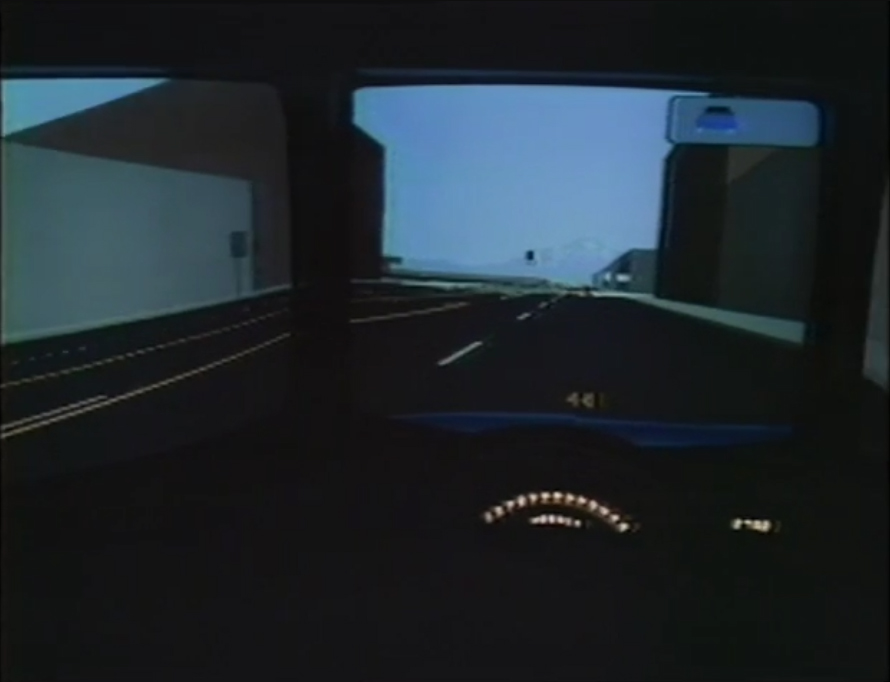
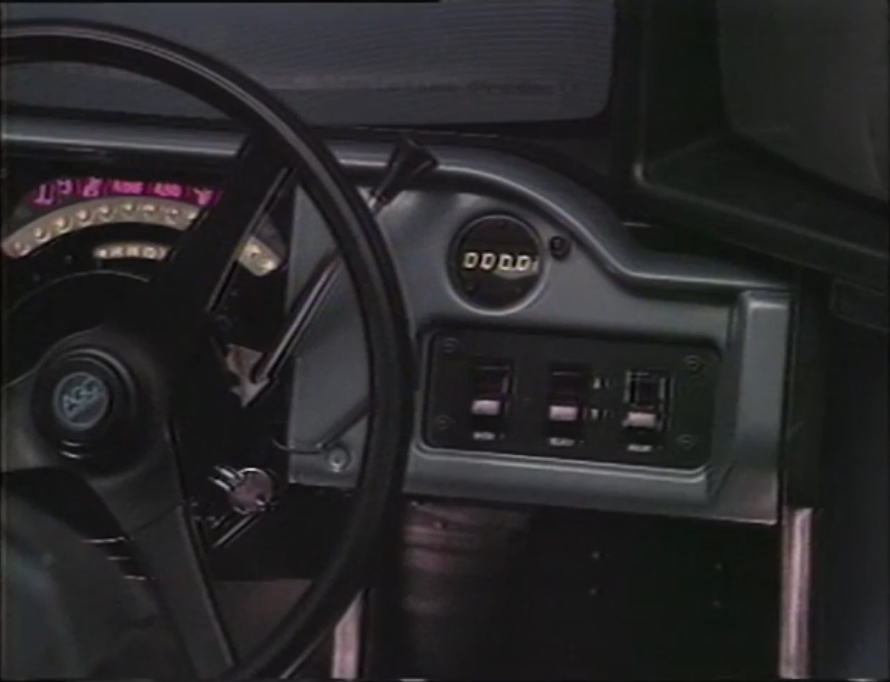
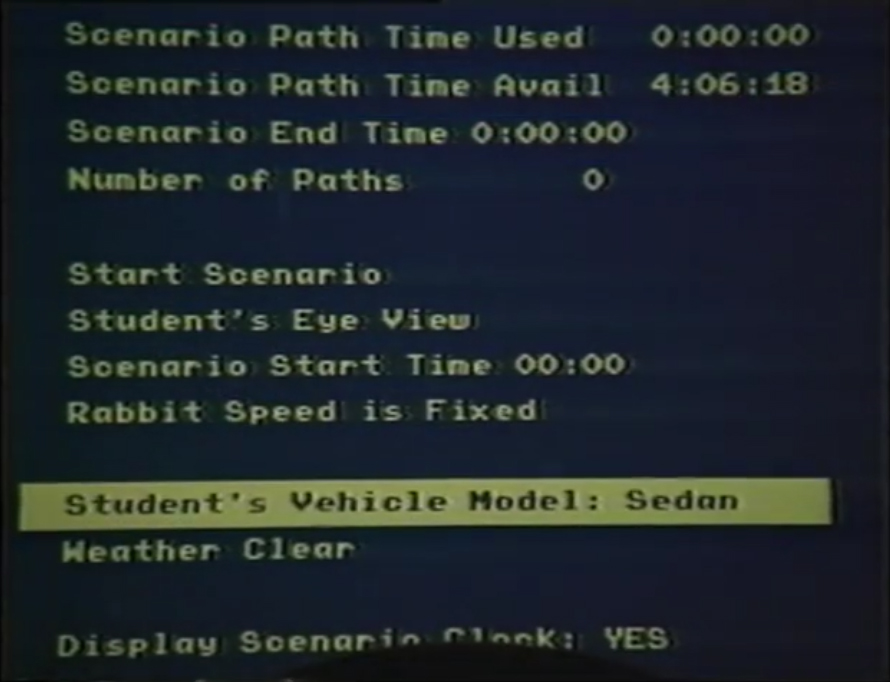
(1989-90) Atari Games Corp. (AGC) developed this police training
simulator, using the same hardware used for Race Drivin'. Each simulation station featured 5 monitors offer
225 degree field of
view, with an option for 8 monitors for a full 360 degree view. Each
station featured realistic vehicle controls. Up to 8 simulators could be
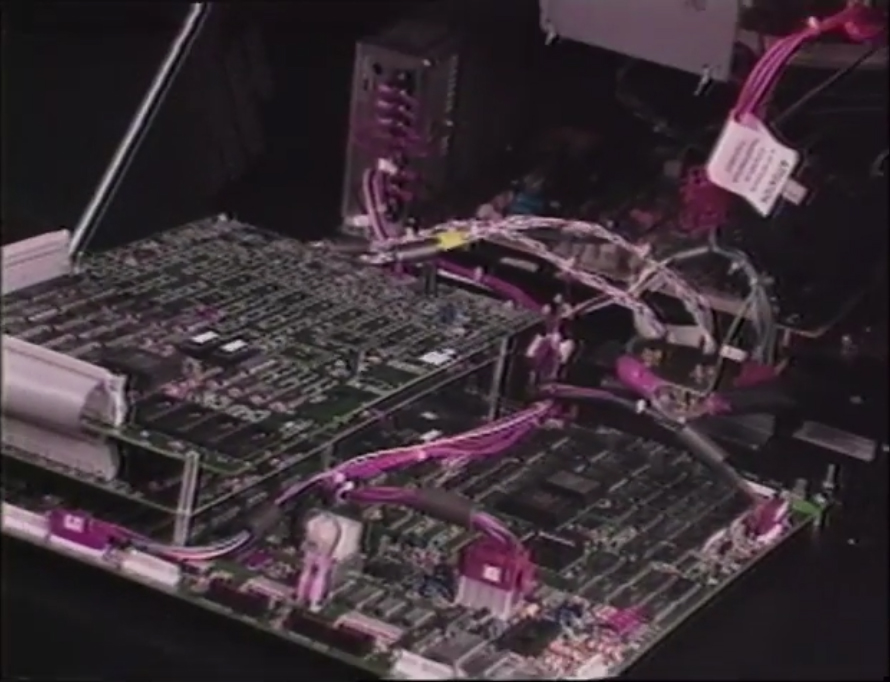
linked together for interactive group training scenarios. Jed Margolin,
who was the hardware engineer for Race Drivin', mentioned he wrote most of the
game's self-test code, including the code for the 48T02 TimeKeeper. He
also designed the MultiSync II main board that was only used in the police
trainer as far as he knew.

|
AGENT X (1983) |
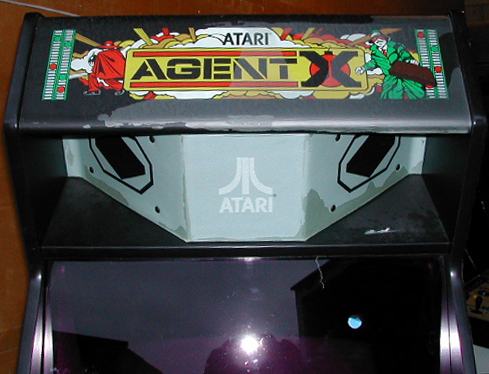
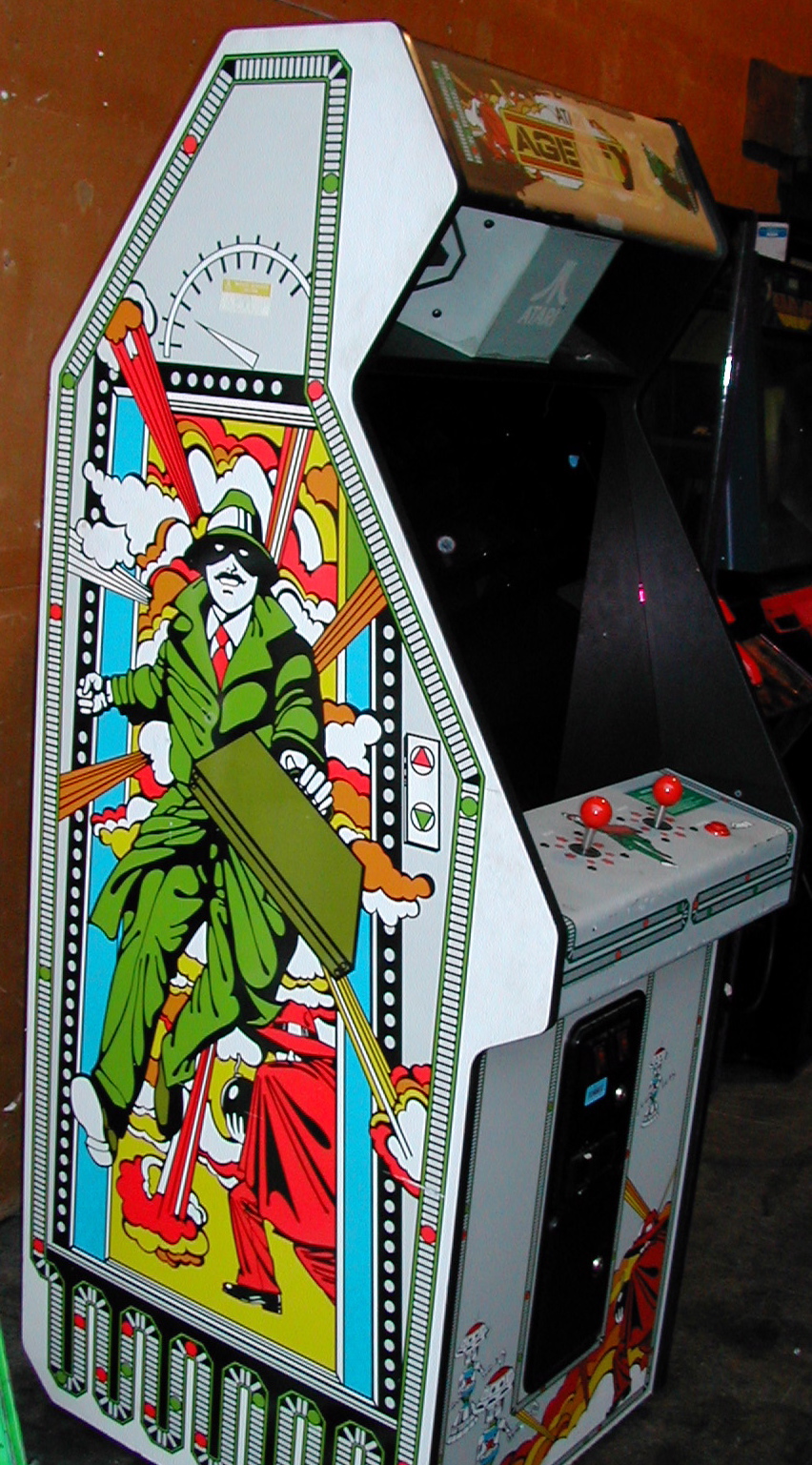
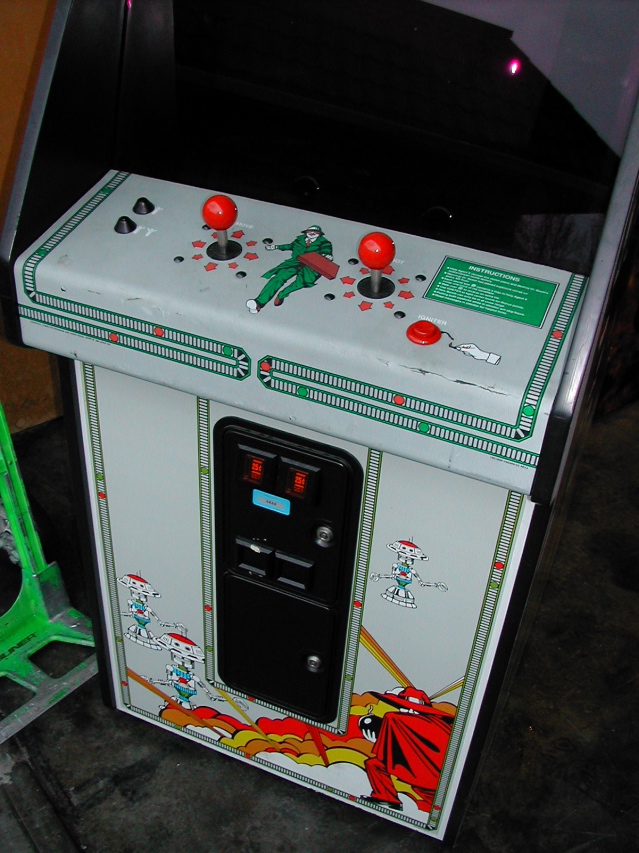
Designed and programmed by Russel Dawe (RBD). This was the original name of Cloak & Dagger. When the game was about 70% completed and the movie was about 40% done, the movie producers and editors came to Atari to see if Atari had a game they could film as backdrop to the movie scenes which needed a 'cloak & dagger-like spy game'. Atari agreed to change the name of its game to Cloak & Dagger and they put a couple of tid-bits into their script which referred to 'Agent X' (Dabny Colman's character). The game actually arrived on the scene about 2 months before the movie was released. It was tested under the name Agent X in its initial field test (about 5 months before the movie was released), but was never produced as anything but Cloak & Dagger. There were about 5,000 games produced which made it into the market place.
|
AIR RACE (1985) |
Air Race was a futuristic racing game where you piloted a ship around a race course. The game used the same hardware as another unreleased game, The Last Starfighter. If released, this would have been the first racing game to use flat-shaded 3-D polygons. This was to use Atari's System IV hardware. The technology developed was later used for Atari's Hard Drivin' and S.T.U.N. Runner games (both released in 1989). Atari created the world's first 3-D polygon video game in 1983, with I, Robot. Although the hardware is long gone, some code was recovered from a VAX backup tape; unfortunately the 2D overlay data was missing.
In 2007 I met up with former Atari graphics artist Alan Murphy and archived a VHS tape of his that contained footage of this prototype arcade game that was in development in 1985!
|
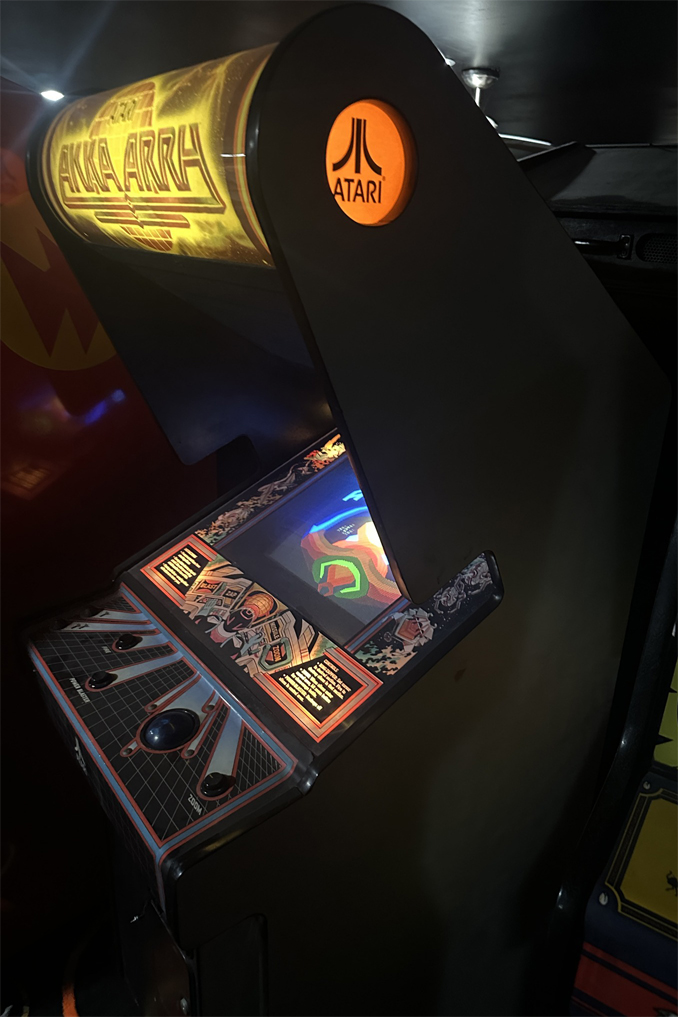
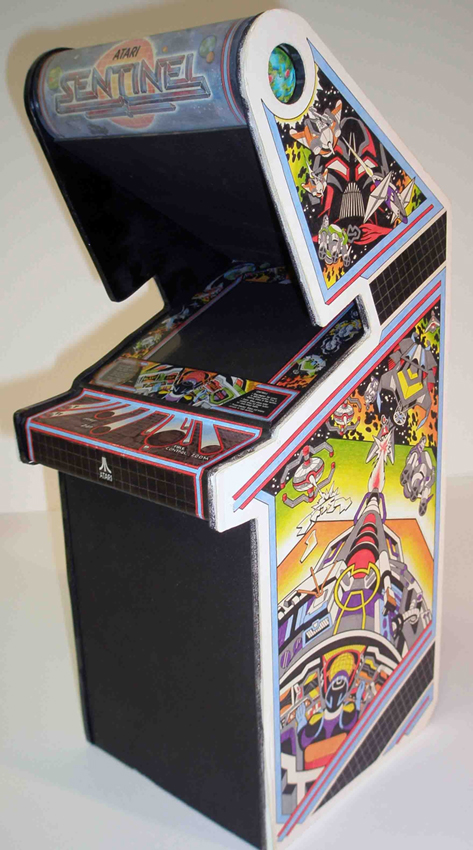
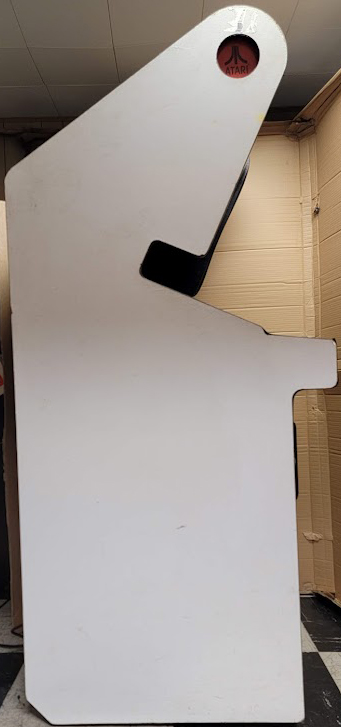
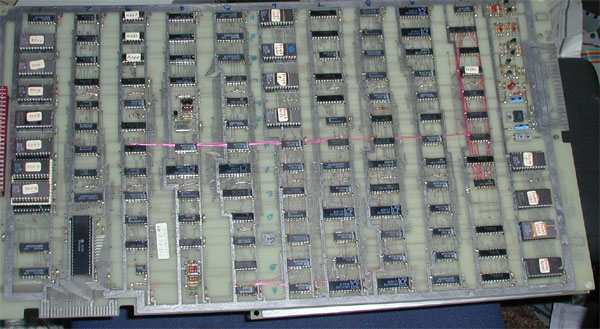
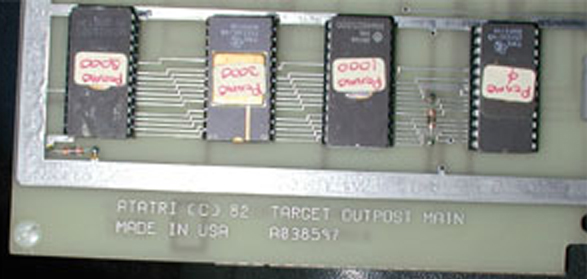
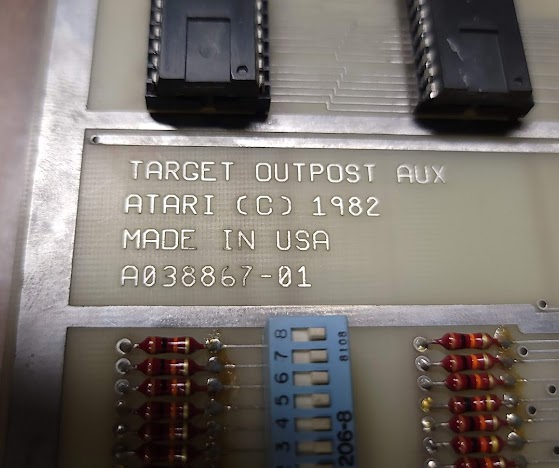
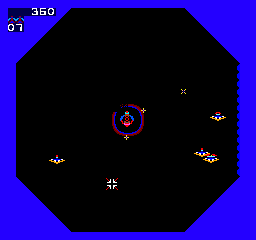
AKKA ARRH / THE SENTINEL / TARGET OUTPOST (1982) |
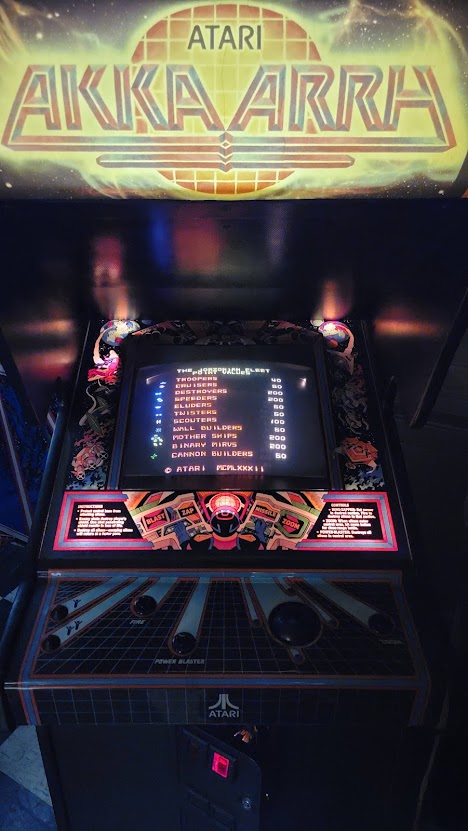
According to John Salwitz in his 2019 GDC presentation (LINK), Akka Arrh was the original, unofficial name and The Sentinel and Target Outpost were later titles:
|
Akka Arrh is an unreleased prototype arcade game made by Atari's Mike Hally and Dave Ralston. The name Akka Arrh is a play on words for Also Known As Another Ralston Hally production. The arcade game was shown in 1982 to a small test market. However, the test-market was unsuccessful as those that played Akka Arrh considered the game to be too difficult. This caused Atari to cancel Akka Arrh in support of other Atari arcade games at the time. |



|
ALADDIN (198X) |
This might have been an early name for Arabian.
|
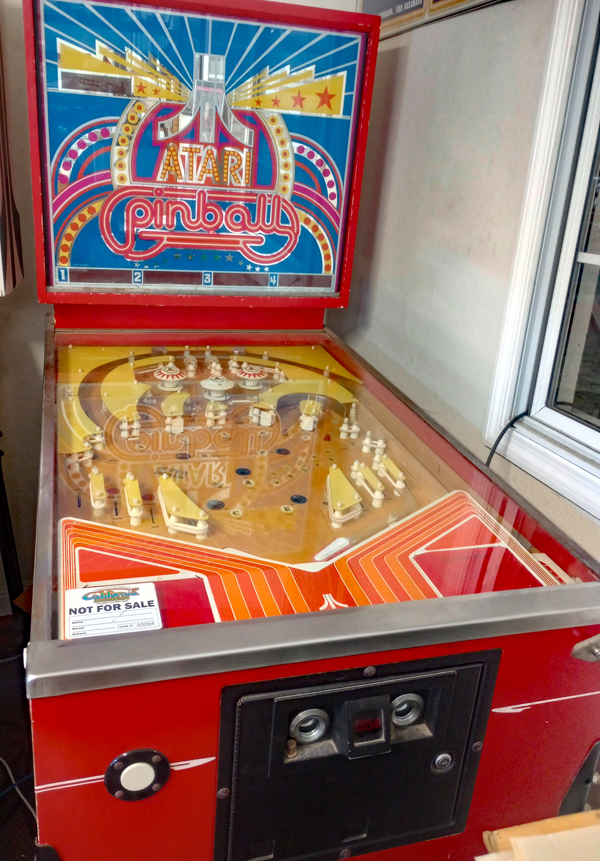
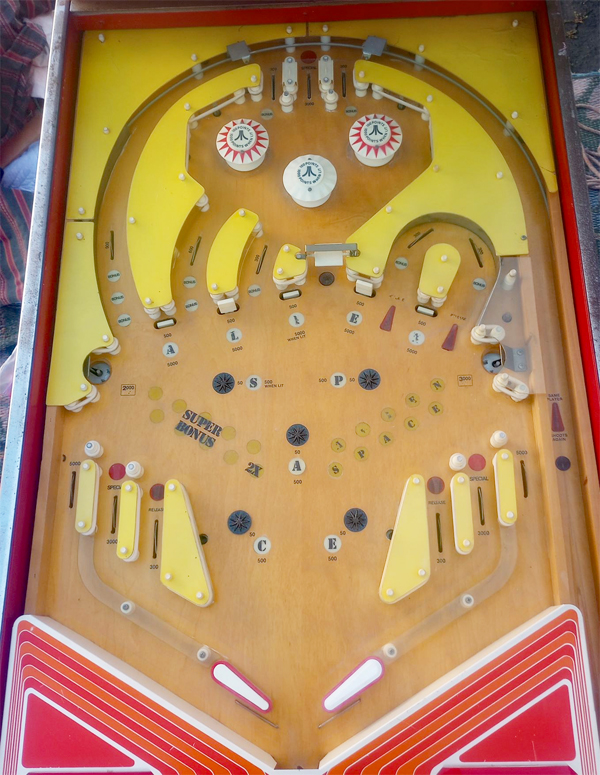
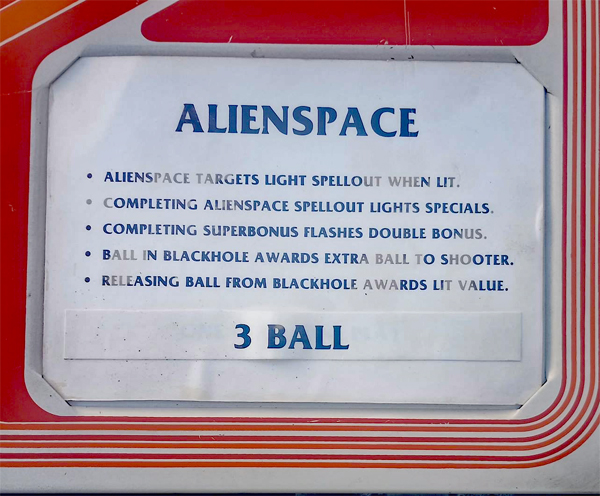
ALIEN SPACE (pinball) (1979) |
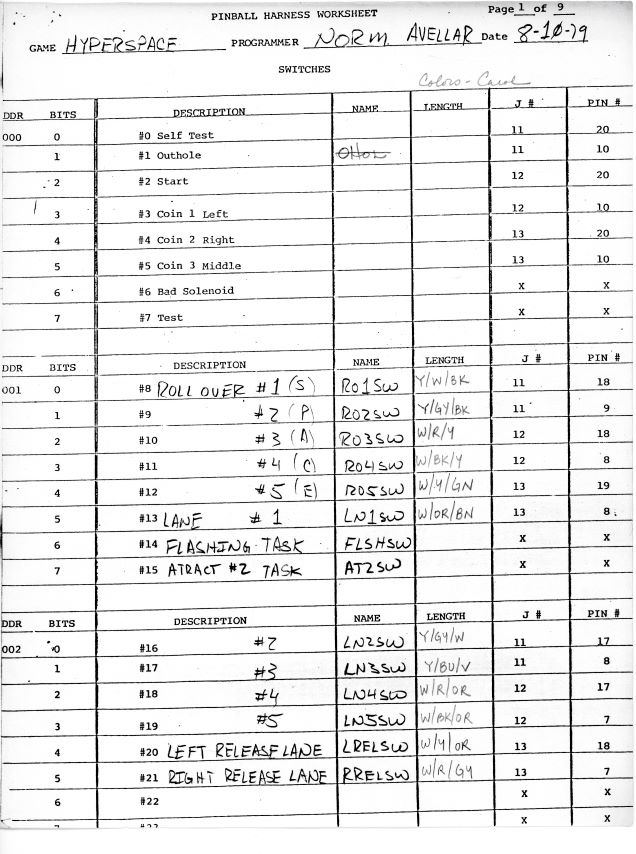
This is a Generation 2 prototype game that was never produced. Norm Avellar was the programmer. The generic backglass was used by Atari on prototype machines while in testing. According to Evelyn Seto, the artwork for this test glass was done by George Opperman. A Pinball Harness Worksheet dated 8-10-79 shows the original name was Hyperspace. Reportedly, the name was changed because Asteroids had a hyperspace button. The owner of this prototype reports that the cabinet is similar to Generation 1 Atari wide-bodies in that the same size backglass that was used on those games is used here. However, the backbox had been changed to accommodate the new board design and to put the score displays in the backbox.
|
ALIENS (1980) |
Early development name of Tempest, prior to Vortex. Deemed a medium priority, according to a 5-23-80 memo.
|
ALPHA ONE / ALPHA-1 (1983) |
This was the second prototype name (and the earliest ‘official’ name) for The Adventures of Major Havoc. A proto marquee and pcb were produced with that name, which were in a white Crystal Castles cabinet. The controller was also an early version – picture #1). It was later changed (briefly) to Rex Havoc (which contained a “Star Castle” level – picture #2) before the final name was decided.


|
ANTI-GRAVITY |
|
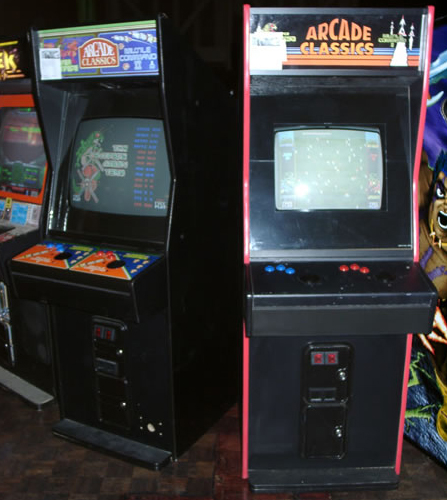
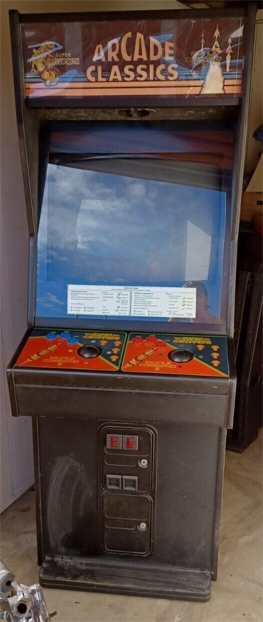
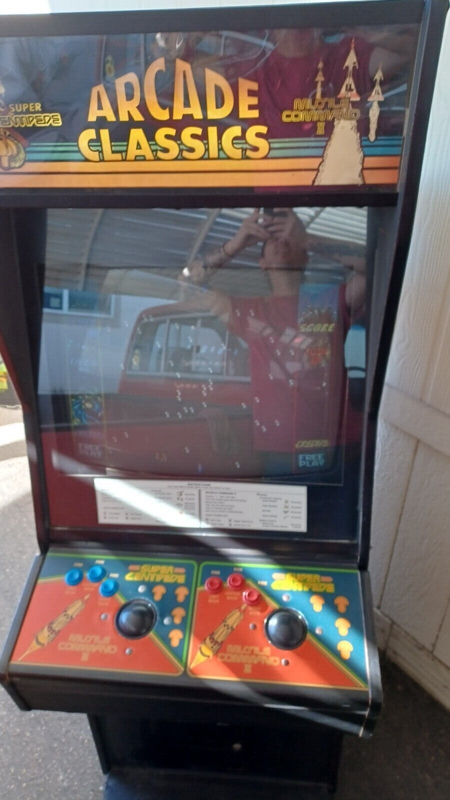
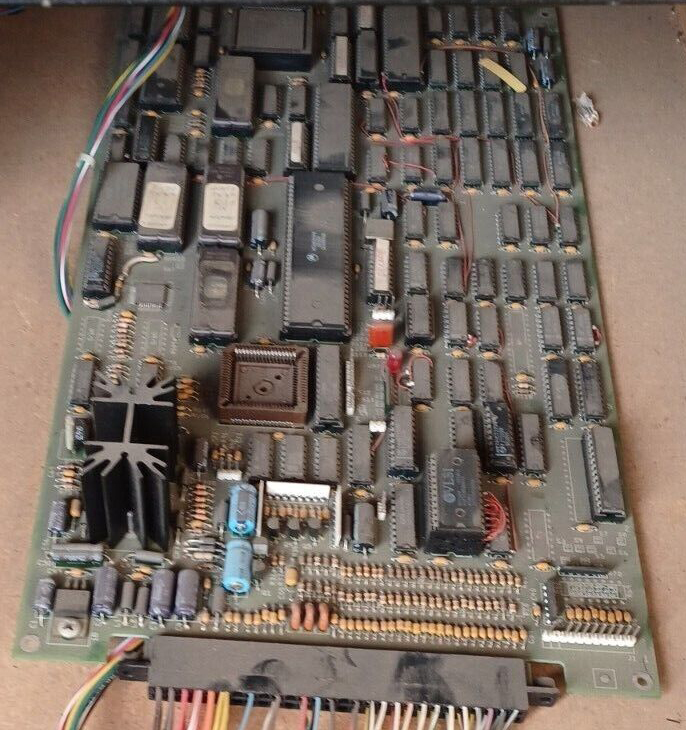
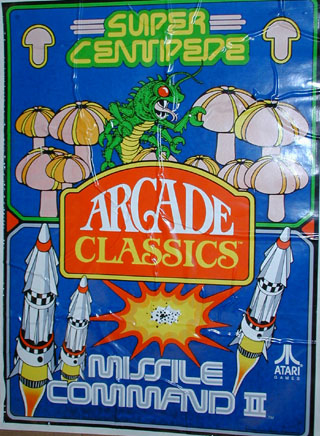
ARCADE CLASSICS (1992) |
6 units are known to exist. If this game had been released on
schedule it would have commemorated Atari's 20th anniversary. It has 2 games on
offer: Super Centipede and Missile Command II. They are both re-makes of the
original classics but with enhanced graphics and sound.
After selecting "more new stuff" in the operator's mode; two kinds of spaceships
will appear in the Missile Command II game. The "Mothership" that appears
after a few levels is exactly the same as (except less detailed than) "Birdsnest",
which is a spaceship on page 21 of the 1978 book Spacecraft 2000 to 2100AD. The spaceships in the "Invasion Wave" are probably ripped from
another book in the series.
Project Leader: Kelly Turner
Programmers: Norm Avellar, Kelly Turner, Matt Setzer
Engineer: Brian McKee
Animators: Rhiz Bugawan, Patrice Moriarity, Ron Seawright
Technician: Gleen McNamara
Audio: Don DieKneite
Product Manager: Linda Benzler
Team Leader: John Ray
Special Thanks: Rich Moore, Mary Fujihara, Peter Lipson,
Stu Shepard
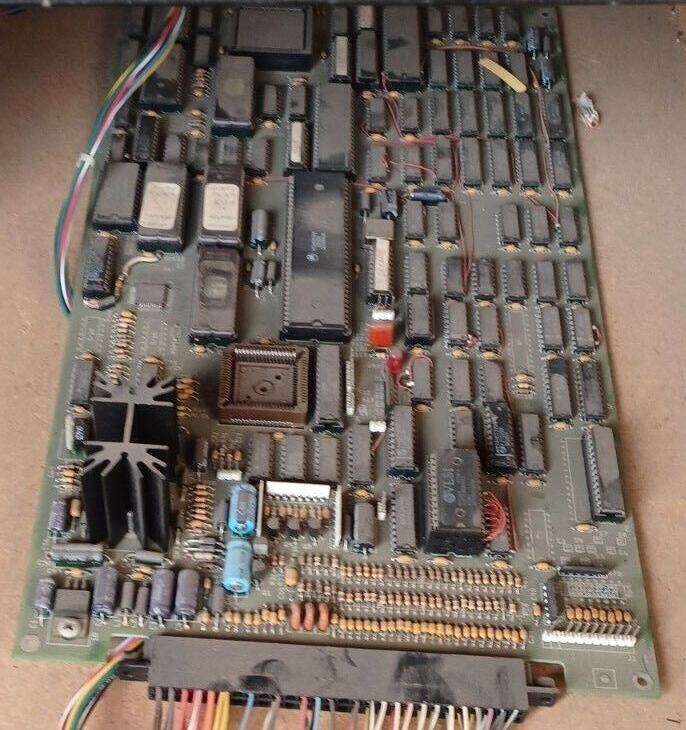
This was likely the early name for Asteroids Deluxe. Deemed a medium priority, according to a 5-23-80 memo.
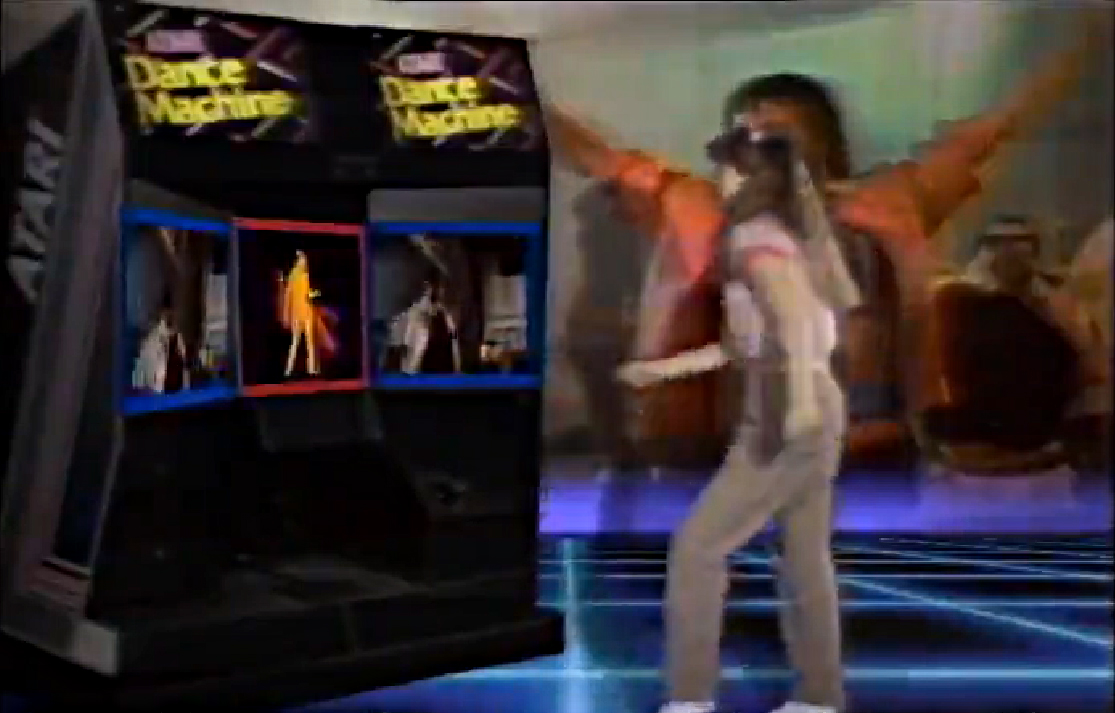
A rhythm laserdisc game that used motion tracking.
|
BAJA RACER (1980) |
Deemed a low priority, according to a 5-23-80 memo.
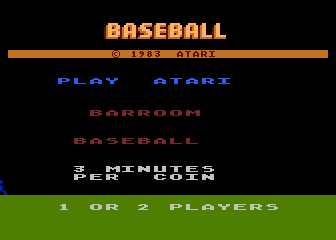
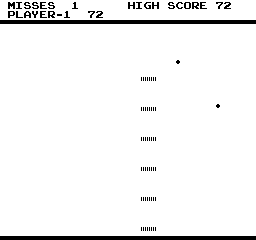
This is a version of 5200 RealSports Baseball (picture #1) that has been modified for use in an arcade cabinet (picture #2). The inclusion of a timer limited gameplay to 3 minutes per credit. Arcade cabinets w/ 5200 systems inside were popular in Mexico and other Latin American countries.

|
BATTLESTAR GALACTICA (1984) |
Based on the 1978 TV show and intended to be a conversion kit for Firefox. From Owen Rubin:
|
On Knight Rider and Battlestar Galactica, we went to Universal and got to look through a LOT of footage (some aired some not) of shots from the shows. We started Battlestar Galactica, for which an early LD was made but not much else. On Battlestar Galactica, it was my idea originally as I was a Galactica fan obviously, (those are Cylon ships in Major Havoc, and the graphics displays in the tactical display were drawn like in Galactica as well), the guys who did Star Wars and Firefox started the project. I did a small amount of work as well. All that was really done was some footage on the LD that let you land a fighter ship into one of the landing bays on either side of the large ship. The video on the disk is recorded in such a way that playing it back would look like garbage. It is a bunch of still frames that you play out of order so that you can change what you are playing seamlessly. For example, the landing footage is one of 9 to 16 or so frames from different positions as you approach the landing bay. Imaging a 3x3 of 4x4 grid of possible positions you can approach from, with the center being straight on. If you fly straight, the program would display every 9th frame which was the video of flying straight. If you moved right, you would select the proper "frame view" and it would look like you moved in the video to the right, and now play every 9th "right position 1" video frame in order. With this scheme, you could fly in 2 dimensions with the joystick while the game pushed you forward in the third as well, controlled by a throttle. |
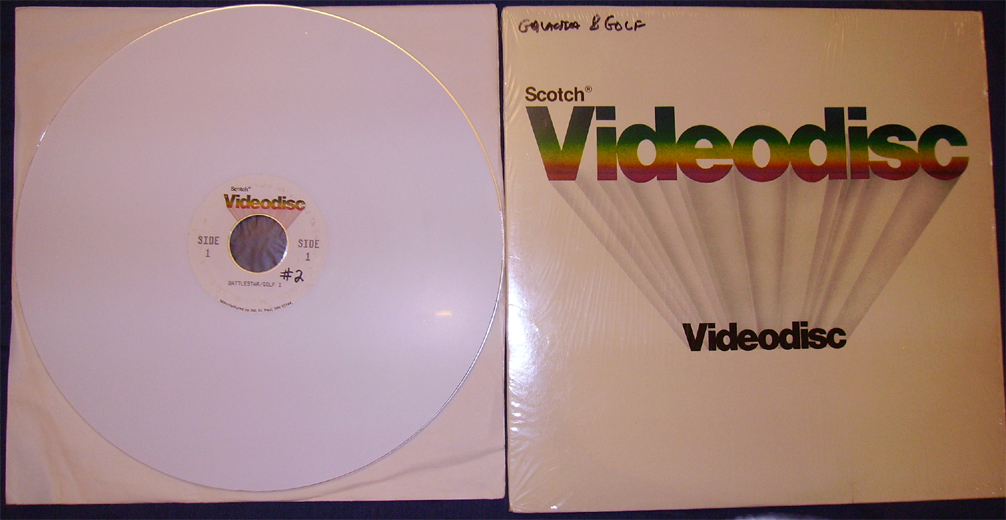
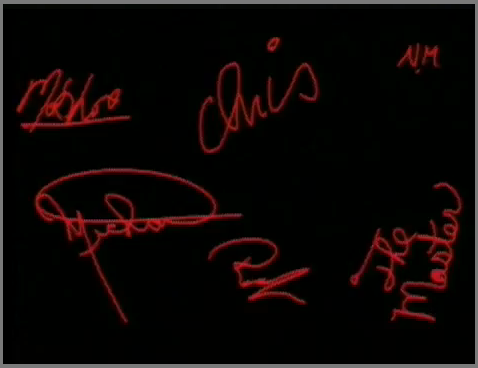
Near the end of the video is a frame of signatures from everyone who worked on putting this test game together (see pic). "MShoo" is very likely Moe Shore, who was the Senior Video Editor on Fire Fox. "Chris" could either Chris Crummett (who was Firefox's Video Technical/Lab Design), or Chris J. Horseman (who was the project leader for the unreleased Atari arcade game, The Last Starfighter) or. "NM" is unknown. This could also be "AJM", which would likely be for graphics artist Alan J. Murphy. "Michon" is Ted Michon (another former Last Starfighter team member). The next name could be "Ralston" (for Dave Ralston, who did Firefox's Game Design/Storyboards, or "Rubin" (for Owen Rubin). Unknown is "The Master".
Here's some interesting info related to this. A joint
venture between Atari and MCA was announced in 1982-83, under the name Studio
Games. Several movies and TV shows were announced as possible titles to be
developed into games. One announcement mentioned both home and arcade
games were planned, with another announcement mentioning use of laserdiscs was
being looked into. Although none of the announcement mentioned Battlestar
Galactica, the laserdisc footage credits both Atari and MCA/Universal Pictures
(MCA was the parent company of Universal).
The August 1982 issue of Video Game Update stated MCA announced it set
up a new division to develop and market game cartridges, called MCA Video Games
Inc., and planned to develop games based on characters from some of Universal's
successful movies such as Smokey and the Bandit and Bruce (Jaws).
Shipments were not expected until mid-1983.
The Spring 1983 issue of Creative Computing Video & Arcade Games
mentioned that at the Summer 1982 CES show, MCA (parent of Universal Pictures
and Universal Television) announced MCA Video Games Inc. would develop
cartridges "in all systems for the home market", but releases wouldn't arrive
until 1983. They also mentioned looking into game possibilities using
laserdiscs.
The August 1983 issue of Video Review stated a new joint venture between
Atari and MCA Video Games, called Studio Games, would have MCA licensing their
hit Universal movie and TV titles to become video games developed by Atari under
MCA's supervision. The A-Team, Knight Rider, and Magnum
P.I. were claimed to soon be on TV, with possible movie-based titles Jaws
3-D, Psycho, and Smokey and the Bandit.
The November 1983 issue of Electronic Games mentioned a company created
by Atari and MCA Video Games, Studio Games, would soon begin developing coin-op,
home video, and computer games based on previous hit movies and TV shows.
Knight Rider and Magnum P.I. were mentioned as potential titles,
but no definite plans had yet to be announced.
Now, why MCA decided to get involved with making video games is likely due to
the deal Atari made with Spielberg to make the E.T. games, as
Atari reportedly paid Spielberg some 22 million dollars to license the story and
characters. This deal was made in July 1982, and MCA made their first
announcement the following month about setting up their MCA Video Games Inc.
division. FYI Universal Pictures was the studio that handled the
production/distribution of the E.T. movie, with MCA handling early home
video (VHS) and soundtracks.
|
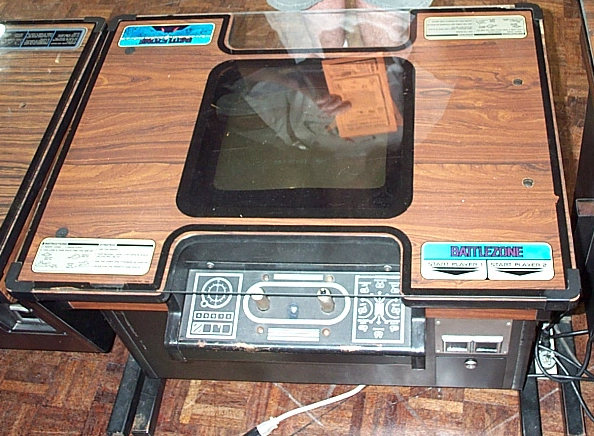
BATTLEZONE (1980) |
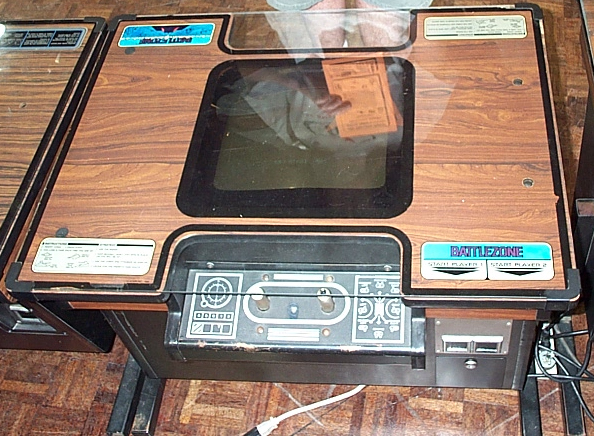
At least 1 (possibly up to 3) prototype was built but never went into production. A sit-down cabinet would have been a great idea, but for some unknown reason those were instead built for Red Baron.
|
BEAT HEAD (1993) |
Jump on the tiles that match your color or that have your color and your opponent's color. Jump on enough to fill your spaces before your opponent fills his. Beat Head has nothing remotely resembling Sprites or Motion Objects. The hardware is a fairly naive bitmap. Although it is implemented in VRAM, this allows for fast copies to reduce the CPU needed for static content. Beat Head is the only Atari Coin-Op game to derive its 'time base' from the audio, and to do so uses a rarely used feature of CPU/Audio communication. A bug there would not affect any other game, and would manifest in Beat Head as timeouts and 'jerks' as the video was re-sync'd to the audio.
- TRIVIA -
At the time, Atari were very keen to fund 'unusual' game concepts, such as "Toobin'"
and Beat Head was one of those chosen. However, the game mechanic was incredibly
repetitive and once you'd beaten 5 opponents, not much really changed. The
reason for the very limited number of 'waves' is that the game did not get past
a 'short field-test' stage. It was intended to be out only a few days. Atari had
a pretty bad rep in those days, which showed in the cash box. And Beat Head had
fairly powerful enemies within Atari, so it was killed at a very preliminary
stage of the program. It certainly was never intended to be so limited.
The phrase 'Stella on Steroids' on the POST screen is a reference to the old
Atari VCS, codenamed 'Stella'.
From Michael Albaugh:
|
The last game I really had creative input on, Beat Head, was actually conceived and driven by a graphics designer (Chuck Eyler) and a composer (Don Diekneite). I was the "code jockey", although I did contribute a fuzzy logic-based scheme for the computer player, which made it easier for them to tune the gameplay. I want to be clear that I was not the original programmer for Beat Head, but "parachuted in" late in development. As I had done a lot of the infrastructure (compiler and libraries, debug support, and some of the hardware) for the game, I was an obvious choice. Bonnie Smithson (Escape from the Planet of the Robot Monsters, RoadBlasters) was the original programmer. Bonnie actually came up with the basic idea, but it was pretty complex to use, so I revamped the process of checking and changing the tuning to make it easier for Chuck and Don to use. |
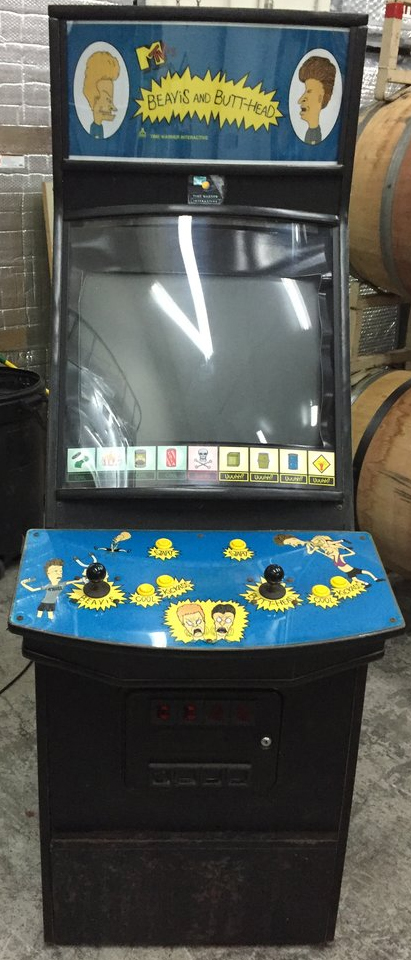
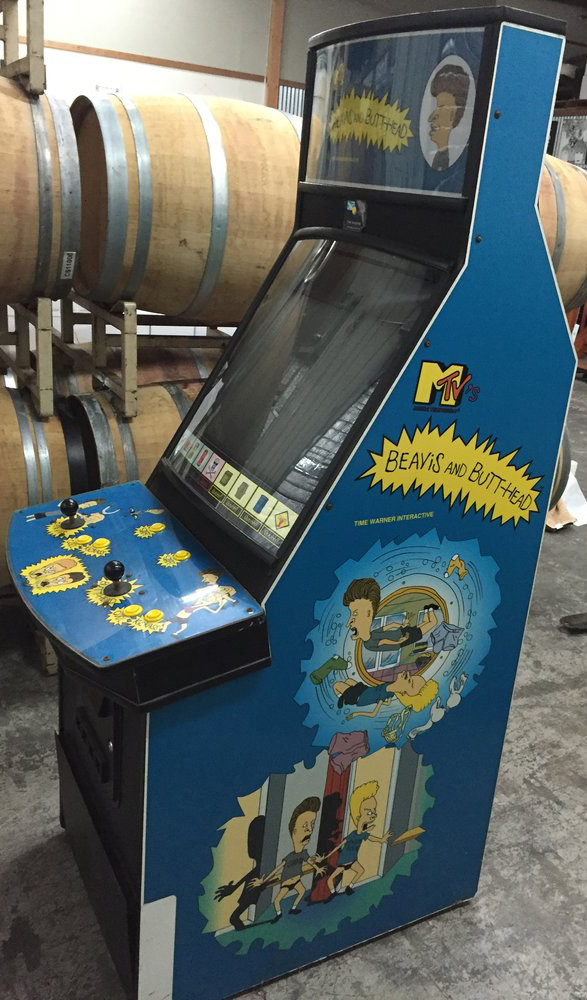
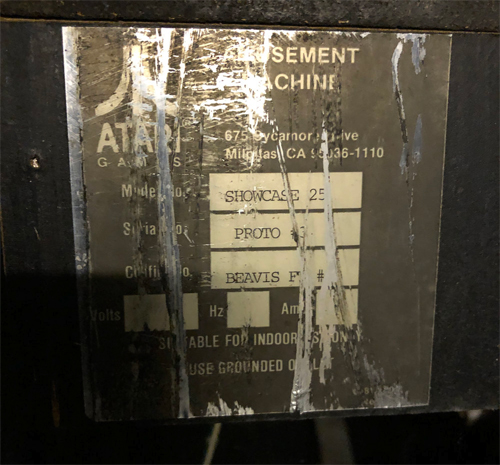
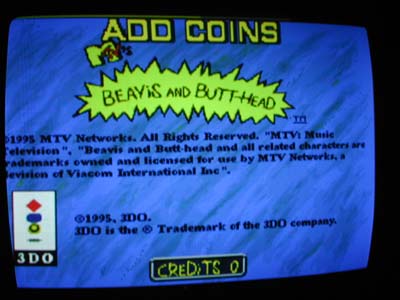
Based on the MTV series Beavis and Butt-Head. A couple of prototype games with only a few levels were made for MTV. It's a beat-em-up game (like The Simpsons) with some mini games between levels and was abandoned after brief testing. One machine was in MTV's headquarters reception until it was sold for charity. The hardware is based on the 3DO home console. It uses a CD-ROM drive to store the software. There are at least 9 prototype cabinets, with at least 2 different cabinets and 2 revisions of the software. The more complete version has 5 playable levels. From Kevin Page:
|
I was on the team at the Atari Games Coin-op division during production and helped develop the backgrounds for the game. This is #3 of 12 known Beavis and Butt-Head arcade game prototype cabinets. I acquired it directly from Atari just after it was canceled and have owned it since. The game was developed in 1996 and uses a proprietary version of the 3DO console. The game is almost complete, except for the game disk. |
Galloping Ghost has prototype #9.





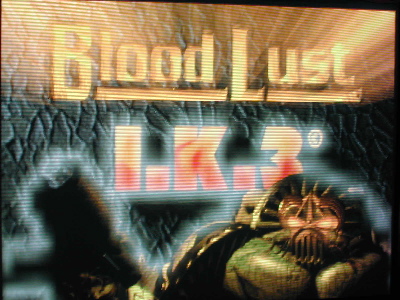
A fighting game that isn't 100% working. The I.K. stands for International Karate, the old game. The game runs on Atari Media GX hardware which is based on PC hardware. 16 playable characters were planned, inspired by Rare's Killer Instinct.
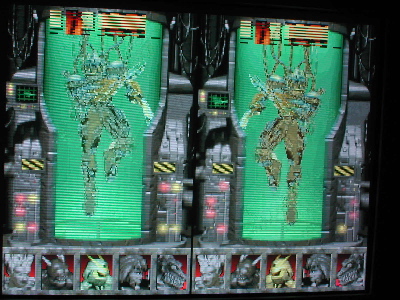
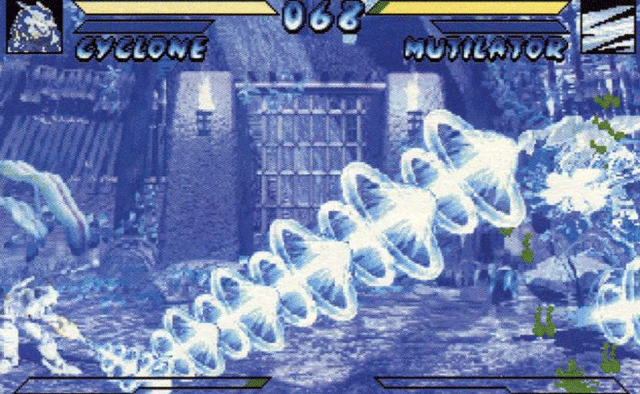
This was the early in-house name for Pit-Fighter.

|
BOUNTY HUNTER (1990s) |
This was the early version of what became Area 51. It was created by Ed Logg, who left Atari for Electronic Arts before the game was finished. It runs on similar hardware to Cyber Storm. Atari turned to Mesa Logic head Robert Weatherby about his team (Hector Silva, James Mestemaker, Guy Fumagali, and James Webb) to finish the game, but Weatherby found it underwhelming and asked Atari for a few months to develop his own concept.

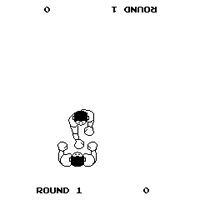
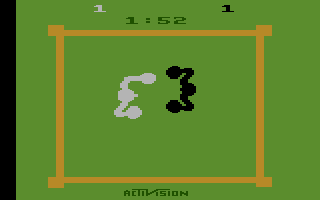
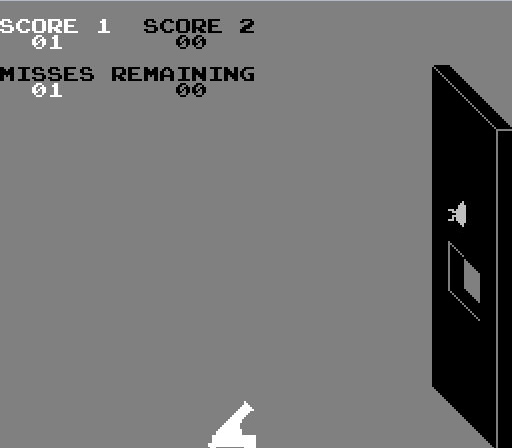
An old black and white overhead 1-on-1 boxing game. The titles Boxer and Boxing appear in the schematics of this prototype. The controls were a big pain. The players gripped handles that could be swiveled left and right to simulate punching. The problem was, they kept being broken by players. More and more was done to strengthen these controls until they were capable of finally being able to withstand public abuse. Unfortunately after all this the game didn't test well enough to be released. It was ripped off by Activision and released as Boxing for the Atari VCS/2600 in 1980 (picture #2).
From developer Michael Albaugh:
|
Boxer (Boxing? name changed somewhere in there) started out as part of what some of us saw as a need for a more physical experience, later to manifest in the Football game, whose cabinet was (in my opinion) derived from the Boxer one. I believe Jerry Lichac came up with the
original controller, although it may have been another mechanical designer. Picture the sort of control an R/C model might have, with a twist knob atop a standard analog joystick. Now imagine the "knob" being a pair of handles you could grip, at the ends of a 6-inch or so bar, and that bar atop a shaft that moved in X and Y - three axes. You moved your boxer with the X/Y position, and punched by rotating those handles. Now, imagine someone getting "really into" the game,
and breaking the control in a few minutes. Several revised designs followed, with the last few being variants where the Y axis (forward/back) was removed in favor of a beefier slider, and several software variants to "make it fun" despite the reduced physicality. I believe Ed Logg took a crack at doing Version 14. The rest is non-history. |
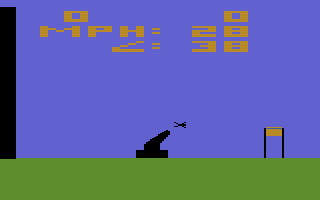
Cannonball was Owen Rubin's first game at Atari. It is not known for sure if this game was ever produced, as there is no documentation or flyers of the game that have surfaced. Owen Rubin seems to think that maybe it WAS produced; however, he is unsure. Owen wrote Cannonball while sitting in his small office at a Model 33 teletype connected to a Motorola MicBug 6800 processor, both of which were connected to simple videogame hardware. He hand-assembled the entire program--it was only 2K, but still took several months--including self-test, saving the code on punched paper tape. When his boss reviewed the game and asked for code listings, Owen said, 'What listings?' It turns out that Owen didn't know about the two computer operators, who took the listings that the designers/programmers wrote up, typed them into the PDP-1 computers, ran them to make sure they were error-free, then return a paper tape to the designer. A version of the game was released for the Atari VCS/2600 in 1979 under the name Human Cannonball (picture #3).
From developer Owen Rubin:
|
I have been asked about the very first game I worked on at Atari and how
my first creation took place. That would be the coin-op version of
Cannonball. The game was one of the very early microprocessor games
created at Atari in early 1976. I liked playing the game Stunt
Cycle, a hardware only game where you jumped a motorcycle over an ever
increasing array of busses, and wanted something that easy with increasing
difficulty. |

|
CAPTAIN SEAHAWK (1978) |
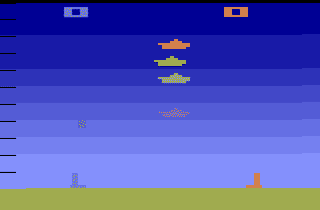
A planned arcade version of VCS Air-Sea Battle, game variation #7 that was developed using a modified Destroyer pcb. GamingHistory.com has this to say about it:
|
Captain Seahawk was basically a straight port of a 2600 game. One of the corporate guys decided instead of letting the programmers come up with game ideas, he'd tell them what to make. He said he wanted a version of game 7 from Air-Sea Battle since it was a popular part of the 2600 game. Mike told him that it's fun to play at home but wouldn't work in the arcade. Mike had to make the arcade game, anyway. So, he did a straight port, and as he expected nobody was interested in playing it in the arcade. It tested very poorly. Management decided to let the programmers design the games after that... |
From Michael Albaugh:
|
I don't recall what bright spark thought it was a good idea. You may be aware of the most terrifying action workers can take against management: "Work to Rule". I was actually surprised to be asked about that game. One of these days I'm going to organize and document my most notable failures, not just in games. |
From Michael Albaugh via Frank Gasking at GamesThatWerent:
|
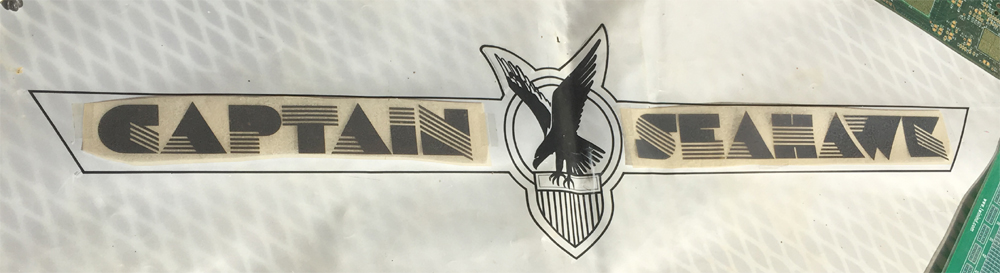
Mike managed to find the mock up produced for the banner art that was to be
produced for the cabinet. Mike explains that it was partly drawn and
pieced together from transparencies, and was to be passed on to the production
team for the cabinet design, had the game gone ahead for full production.
In addition to the recovered panel design mock up, Mike also recalled some
additional details about a push for "internationalisation" within games such as
Captain Seahawk: |
Designed by Dennis Koble. This was the early version (both cabinet and game) of what eventually became Avalanche.
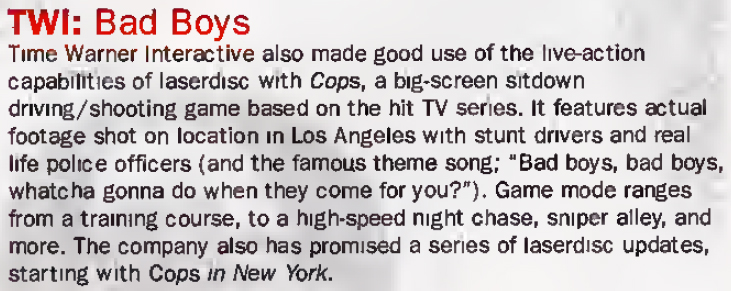
Planned to be a laserdisc-based shooter. The game was
mentioned mentioned in the November 1994 issue of Replay (pg. 46) and in
the October 1995 issue of Next Generation (pg. 27). Possibly
mentioned in an issue of Cash Box (1994-95). Also mentioned on the flyer for Cops as an update disk.

|
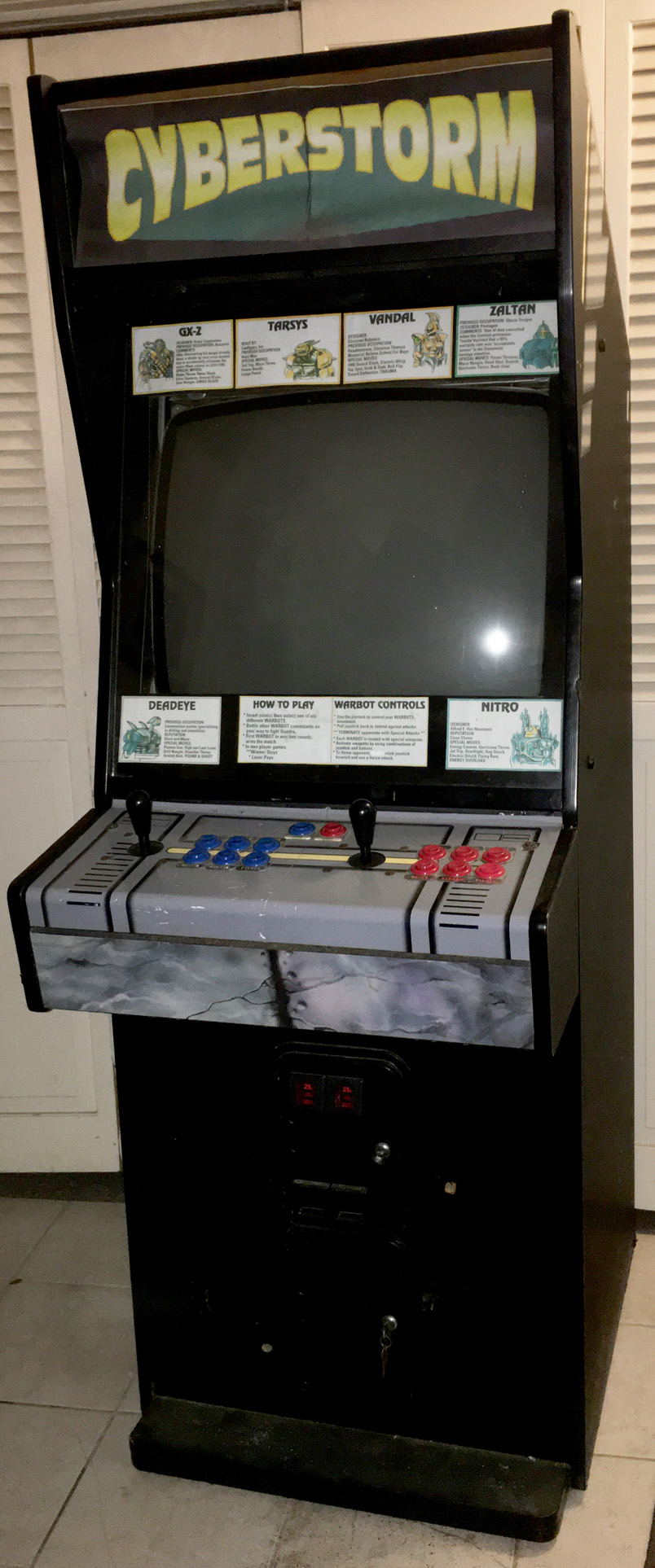
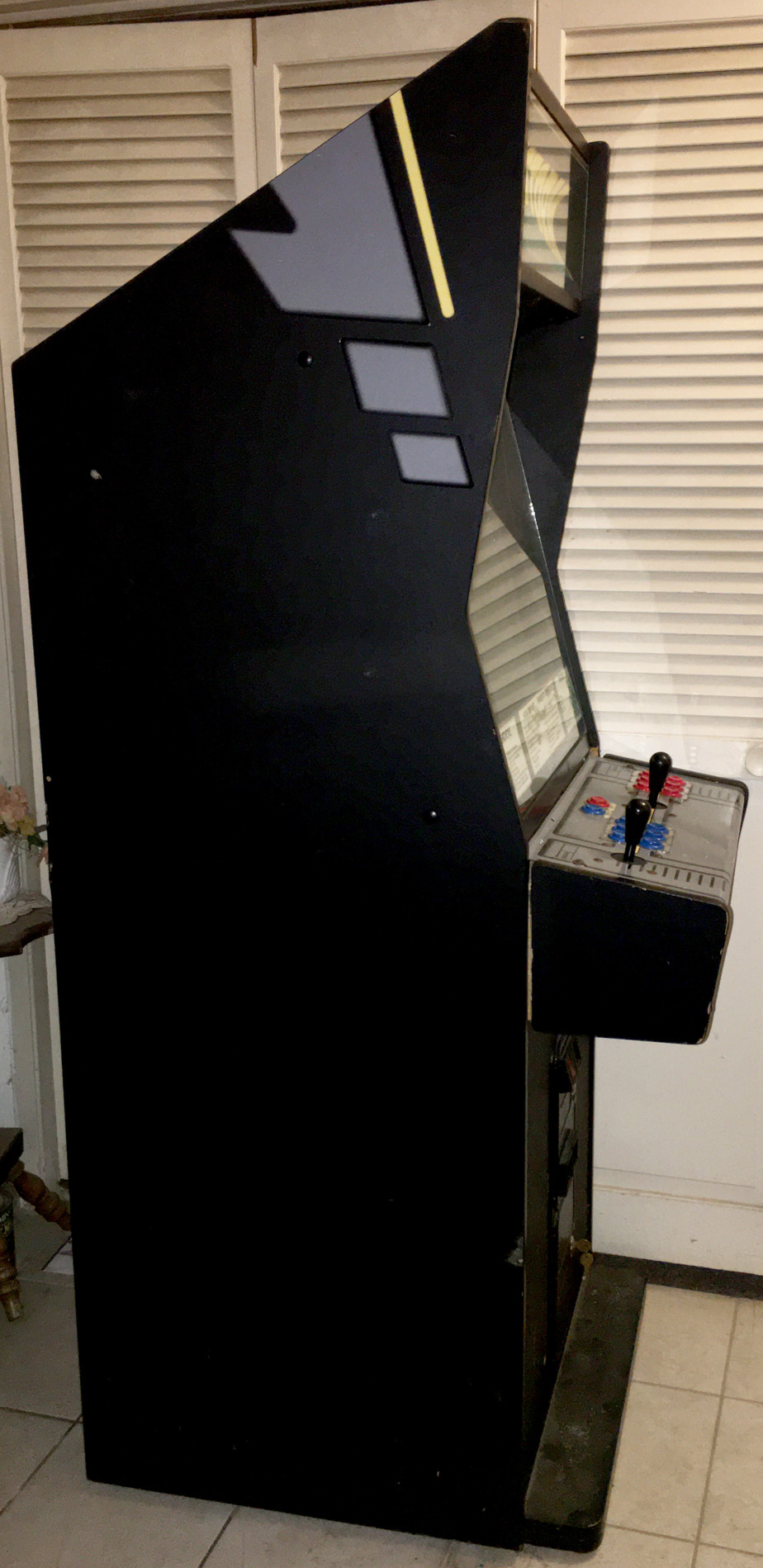
CYBERSTORM (1993) |
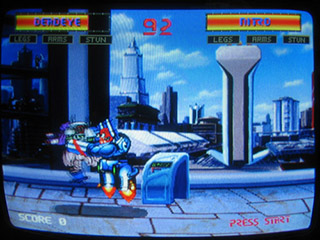
This is a fighting game with cool robot characters. The PCB is unique and was rumored to have cost over $1,000,000 to design. No games were ever released on this type of hardware. Apparently on 3 dedicated cabinets exist.
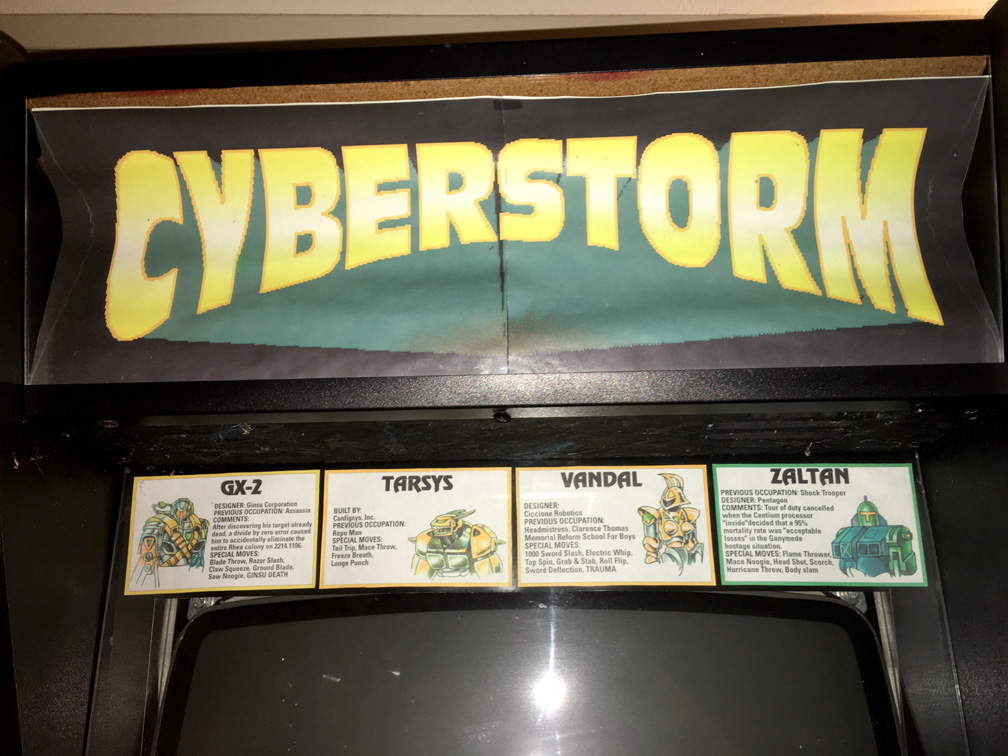
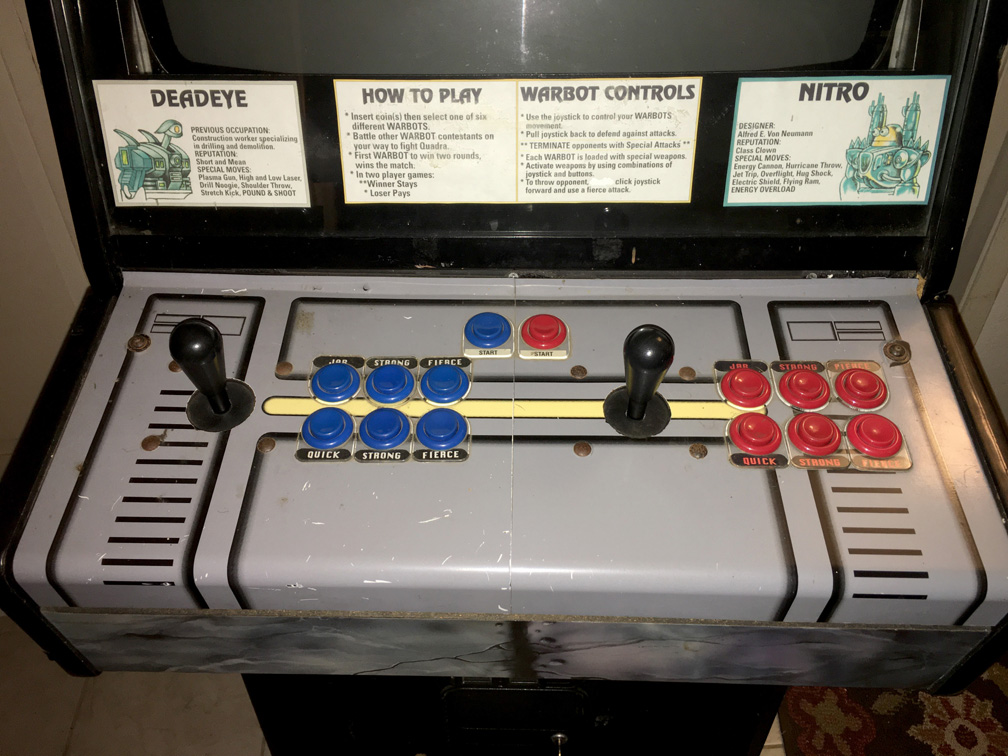
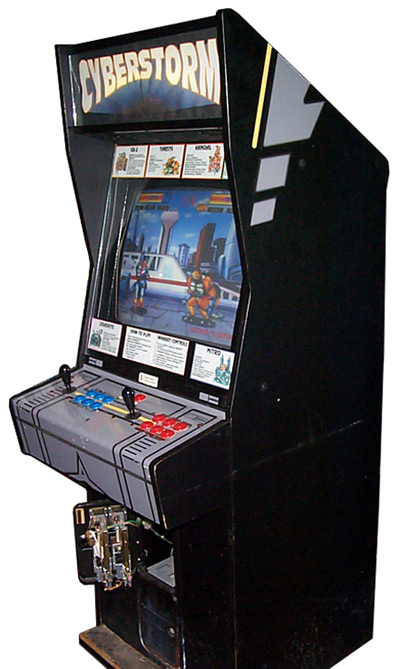
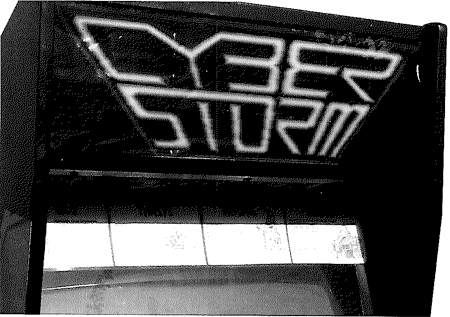
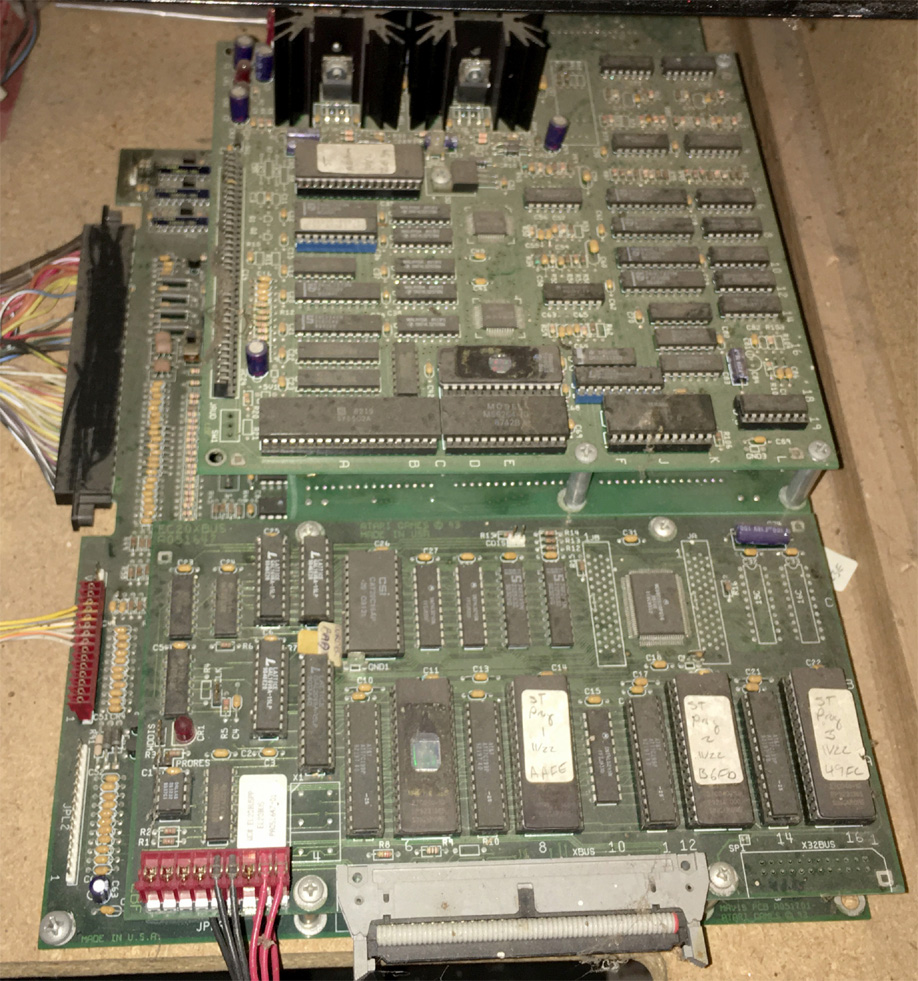
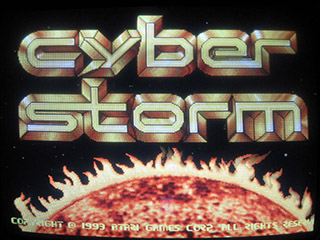
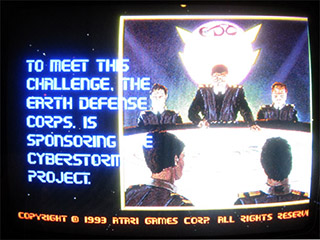
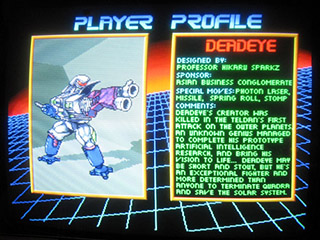
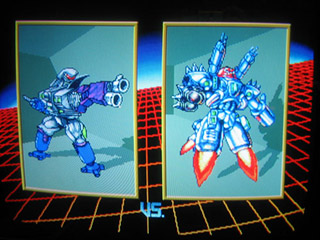
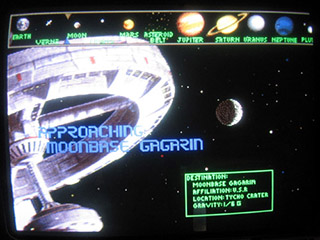
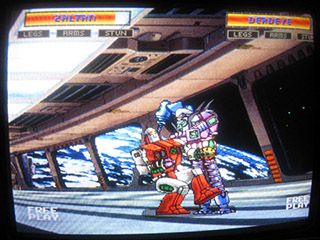
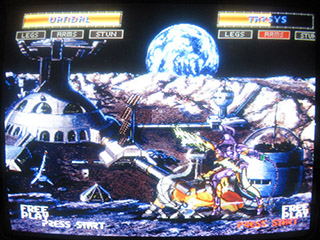
|
CYCLOTRON - THE BMX RACING GAME |
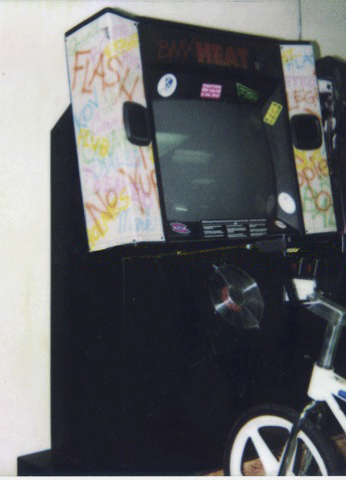
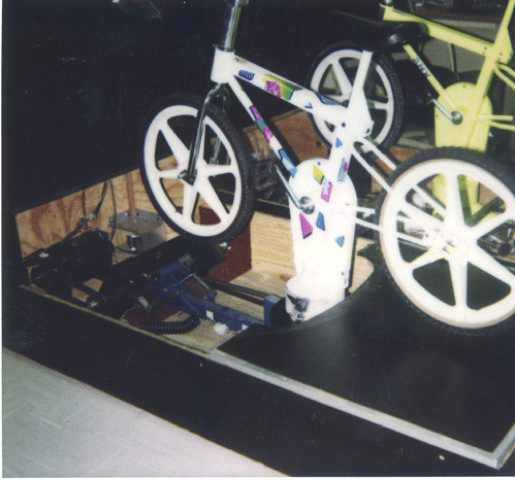
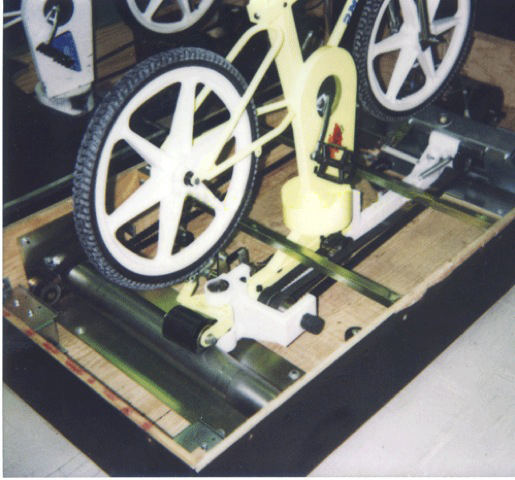
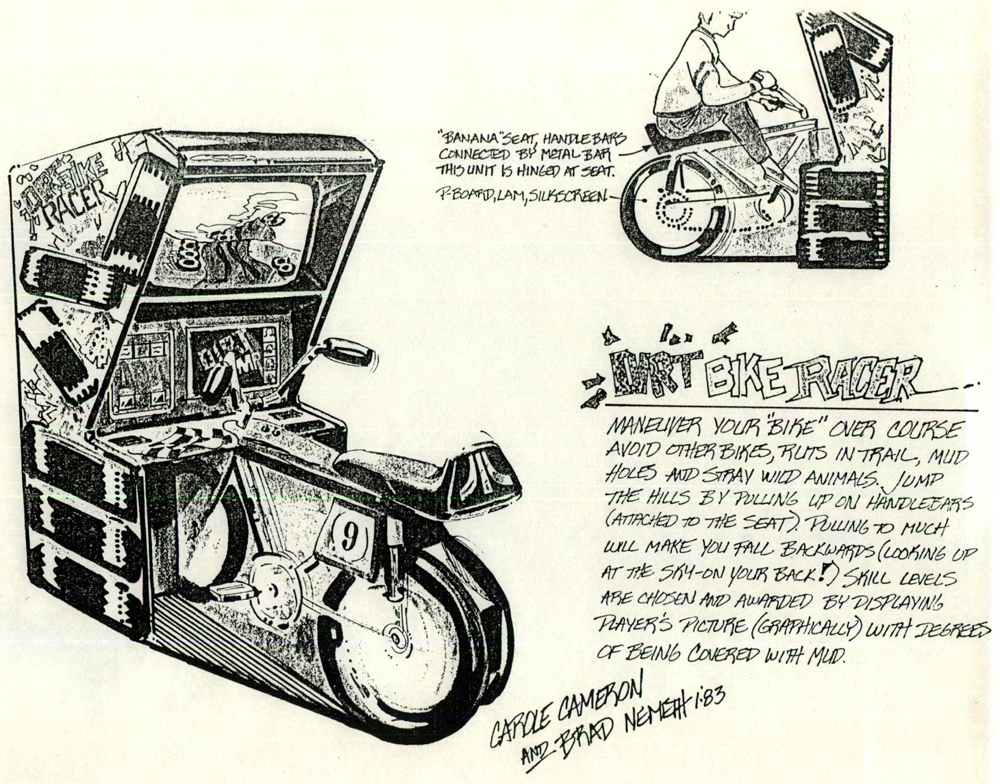
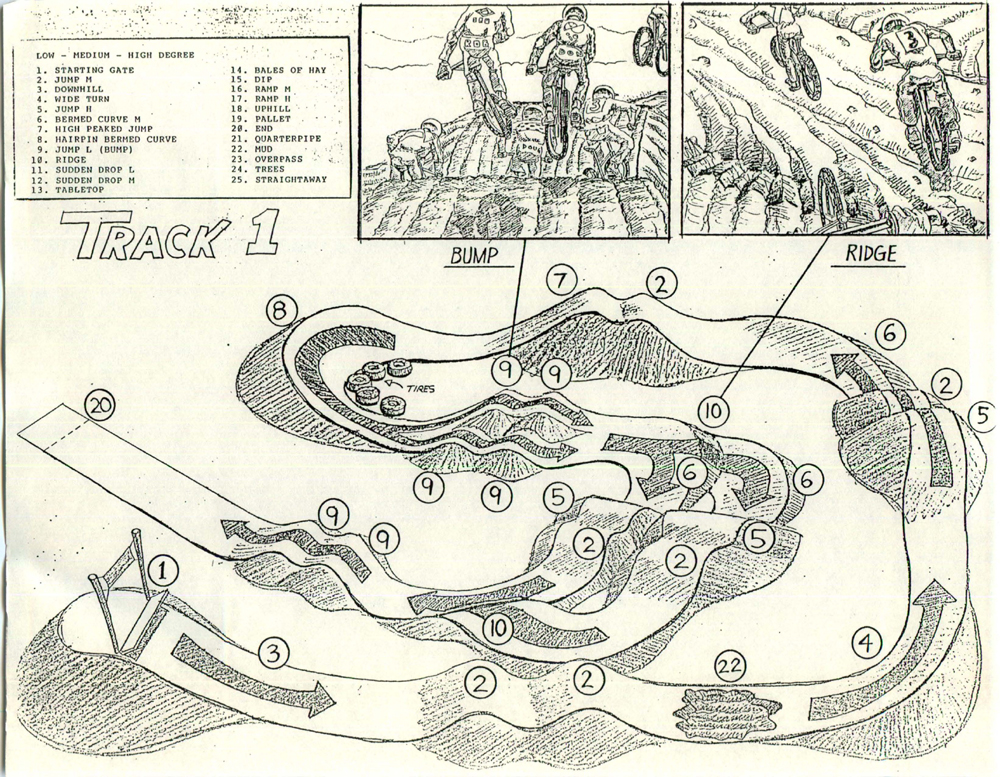
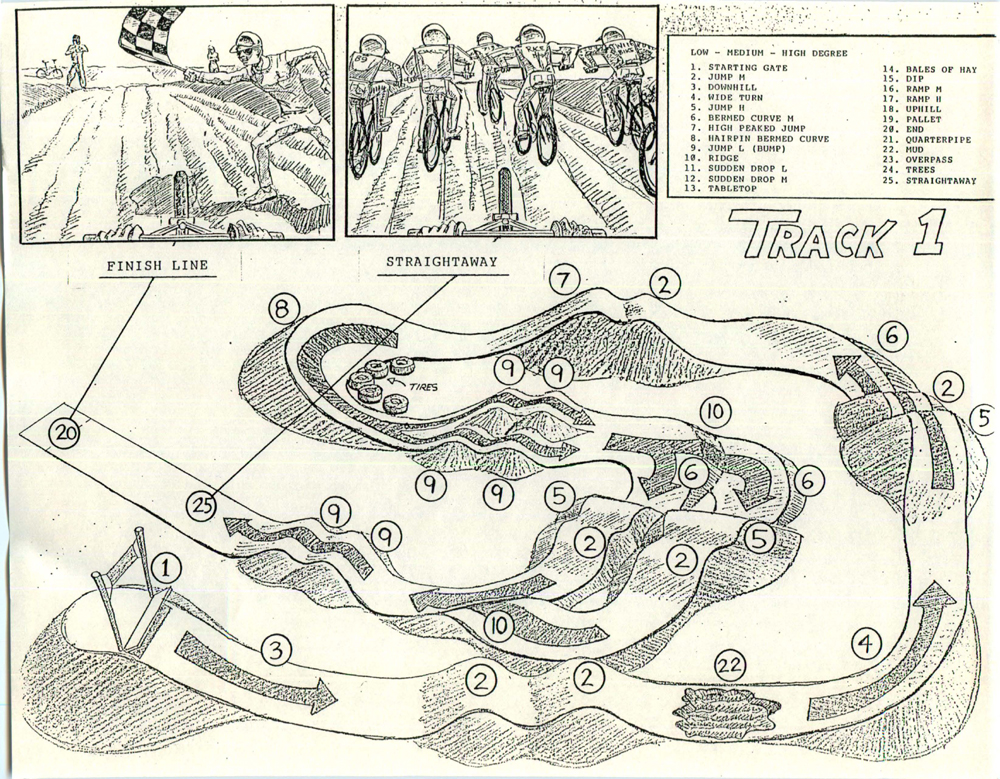
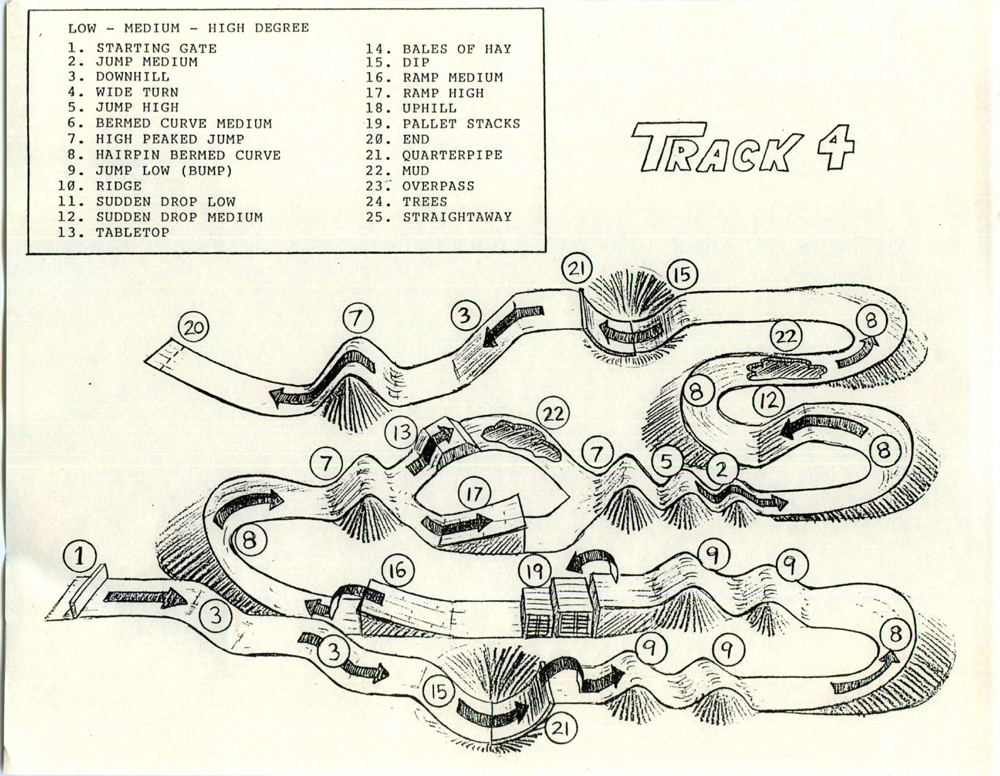
Cyclotron is a BMX Racing Bike Game using the Hard Drivin'
hardware in a scaled down configuration similar to what S.T.U.N. Runner used. The viewpoint
will be first person, not first person removed. The only part of the player
which will be visible is the front tire and possibly part of the handlebars. The
player controls his forward motion through the game by pedaling bicycle pedals
which have computer controlled resistance matching the terrain visible on the
monitor. All pedaling will have a power assist factor so that the exertion
required to play the game will always be less than actually racing a bicycle. A
system of performance sampling and handicapping will allow players of different
ages and athletic capabilities to enjoy the same gameplay. Performance may be
sampled again between heats to compensate for fatigue. The player can adjust the
game for the degree of physical effort with which they are comfortable.
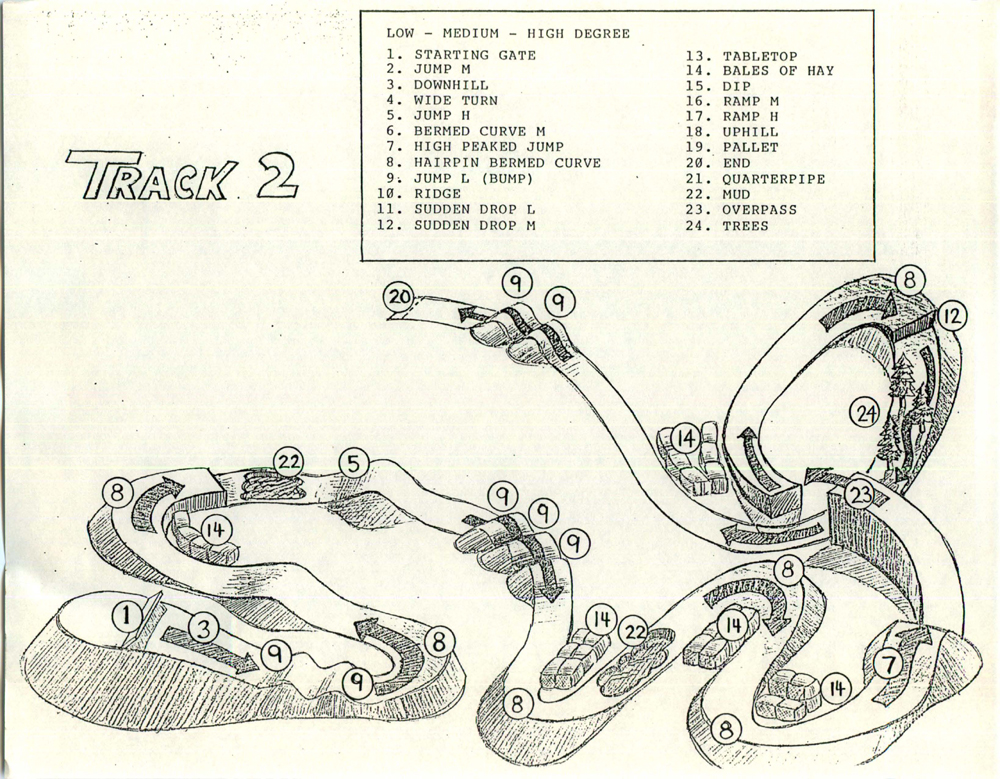
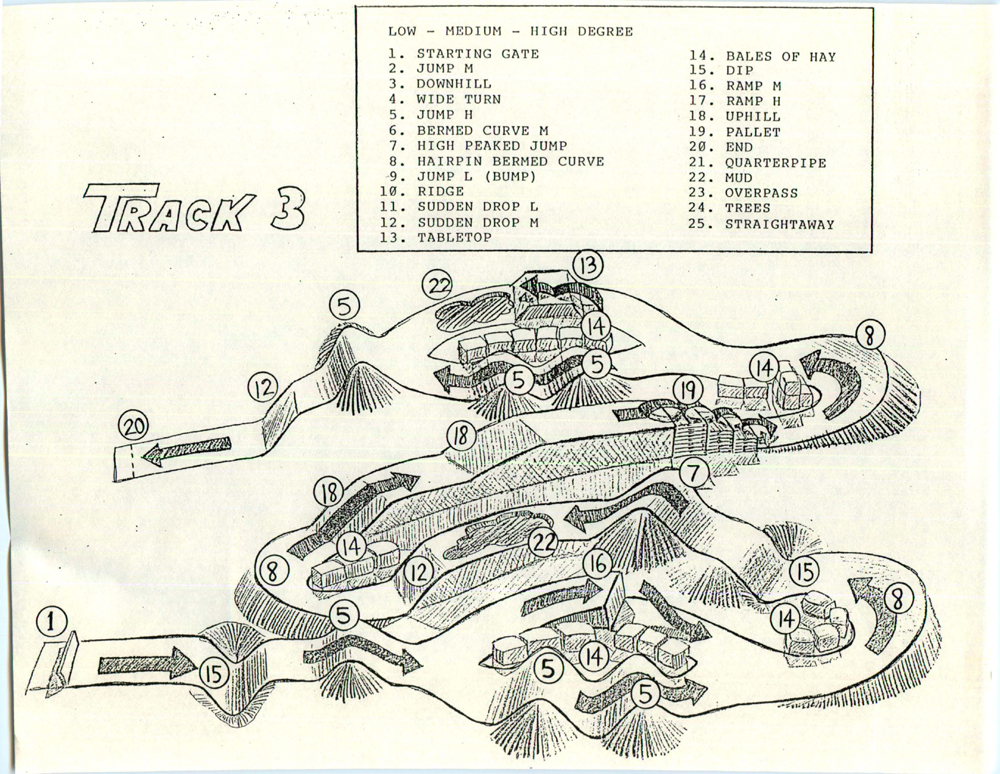
The player will begin in a starting line with 7 other BMX racers. There are 4
tracks to choose from, and each track will have 16 levels of difficulty. Each
heat is over when someone wins it - either the player or a drone. Score is
always for speed and the skill the player exhibits in each of the course
obstacles. The higher the heat number, the better the skills of the drones and
the more aggressive they become.
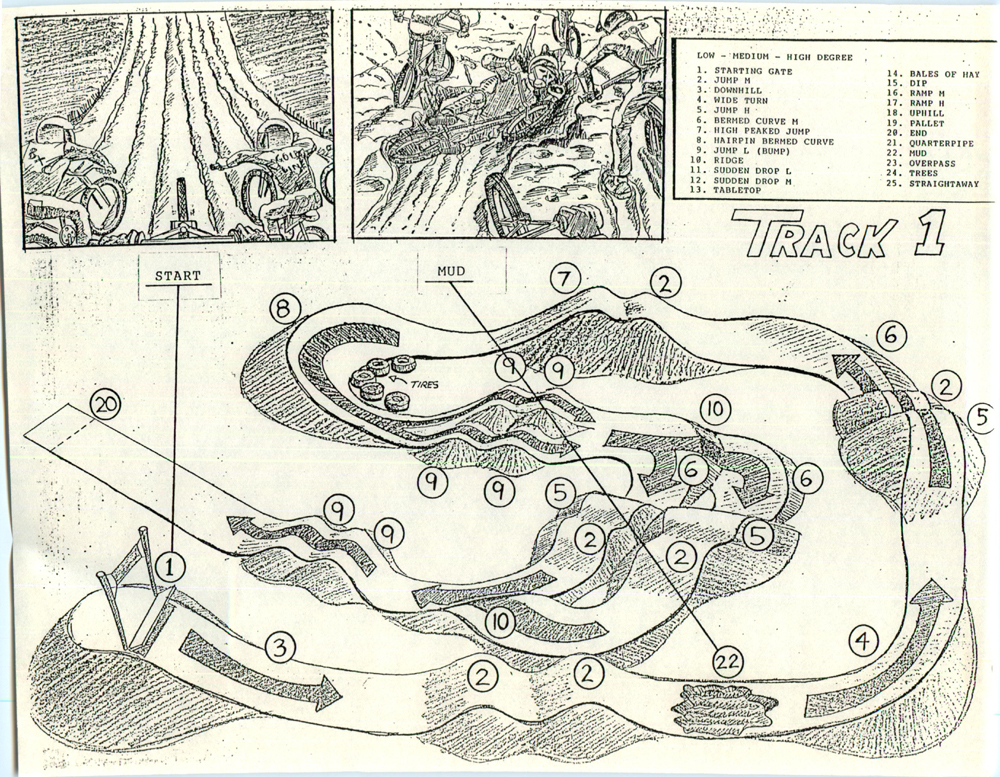
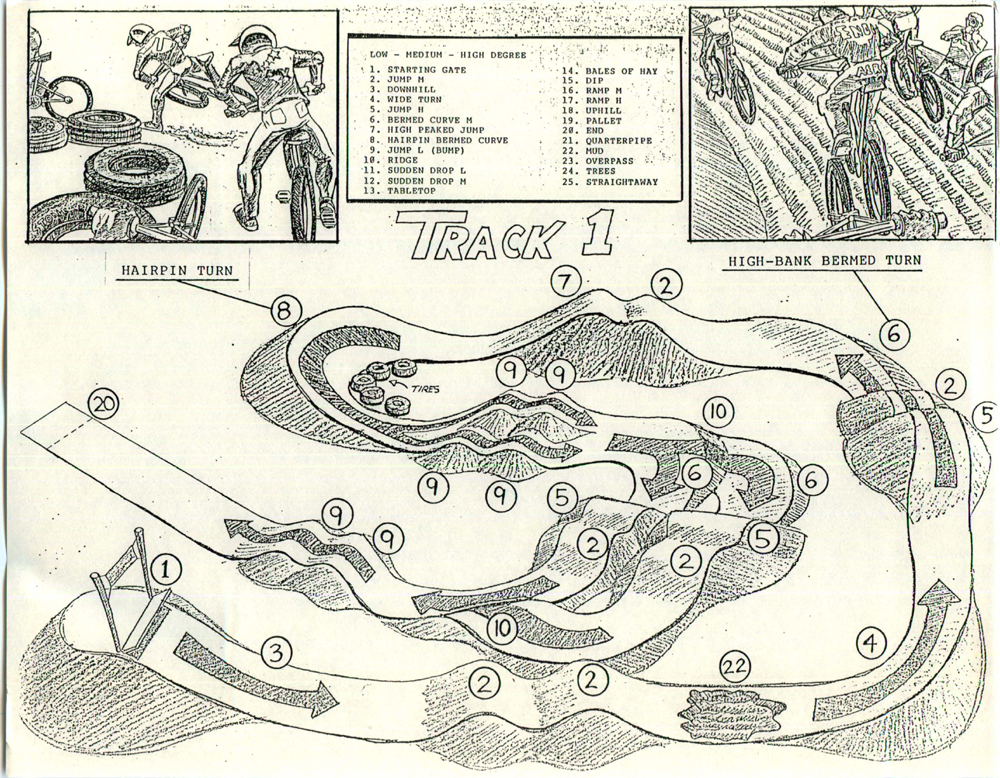
Each race begins with a massed start on a dirt track. Each track has multiple
turns. Some are hairpin turns and some are wide sweeping turns which don't
require slowing down. Some turns are steeply banked with high dirt banks
permitting riders to zip through at high speeds. Between the turns there are a
variety of obstacles: jumps, sudden drops, bumps, and mud. These obstacles send
bikes flying and test the rider's skills, strategy, and timing. Each track will
also have a straight portion for all out racing. Mud can cause the bike to slide
out from either the player or drones if they take turns too fast. The drones are
able to crash, so quick reactions are required of the player to prevent pile-ups
with other fallen riders.
The controls will include pedals, steering, push and pump (like Paperboy) and
both front and rear brakes. The push control is for shifting their body forward,
and the pump control is for shifting the body weight back. With these controls
the player can perform stunt maneuvers, control the amount of air they get on
jumps, and display a wide range of skill at handling the obstacles in a BMX
track.
|
DANGER EXPRESS (1992) |
|
DAVE'S DOZER (1999) |
This was a simulation game developed by Blue Shift for Atari. It ran on Seattle hardware.
|
DEMO DERBY (1980) |
Deemed a low priority, according to a 5-23-80 memo.
|
DIE ALIEN SCUM!! (1996) |
This game runs on the same hardware as Beavis and Butt-Head.


|
DIRT BIKE! (1970s) |
Designed by Dennis Koble and finished up by Ed Logg. Playtested but not released. Ian Baronofsky posted a photo of the bezel online in 2024. From Dennis Koble:
|
There were a variety of other games that I worked on that were handed off to other programmers, such as a variant of Dirt Bike that Ed Logg took over and finished, and another variant of Sea Wolf (a popular game by a competitor) that was never finished called Wolf Pack. The team members varied with the project, but I worked with Howard Delman and Dan Van Elderen and shared an office with them for a time. |
From Ed Logg:
|
The game was started by Dennis Koble ... it was a game similar to Sprint except you drove a dirt bike and the control was a set of handlebars that could be used to steer the bike instead of a steering wheel. We field tested the game and it earned enough money to make it good enough not to kill outright, but not good enough to make it into production. However, I had made Super Breakout at the same time I was working on Dirt Bike. No one at Atari had ever worked on two games at once before. Super Breakout had earned a large amount of money, and this probably led to the decision not to build Dirt Bike. I was not disappointed considering the success of Super Breakout. |

|
DODGEBALL / DODGEM (1974-75) |
Designed by Steve Bristow and the cabinet was designed by Pete Takaichi. The game was mentioned in the October 1974 issue of Vending Times. Dodgem was the Kee Games version of Atari's Dodgeball.
|
DOZER (1980) |
From Howard Delman:
|
I remember working on a game at Atari called Dozer. I was living in an old farm house at the time, and there was a huge empty field next to me where big eighteen-wheelers were parked. On the weekends, the truck owners would come out with their wives and kids, wash their trucks, have a picnic or BBQ, and make a day of it. One weekend, they showed up with a bulldozer, and spent the day taking turns digging holes and making mountains. As the sun went down, they restored the field to flat, hitched up their 'dozer, and left. It seemed clear to me at that moment that a bulldozer game should be a hit. I designed some hardware suitable for rendering hills and valleys with relative ease, and set about designing and programming the game. Unfortunately, no matter how much I tweaked and fiddled with the game play, it was never really all that much fun. |
|
DRAGON RIDERS / FIREBEAST (1982-83) |
Designed and programmed by: Ed Rotberg. Supposedly was going to be a game based on Anne McCaffrey's book series, Dragonriders of Pern, but there was a problem with licensing the name and was eventually renamed Firebeast. The original prototype was called Space Serpents, then either Dragon Master or Dragon Riders, and then finally changed the name to Firebeast. Only code for Firebeast was archived and available. The game was cancelled as a result of average test results.
|
DRAGSTER (1978) |
From Roger Hector:
|
Dragster was an early concept sketch that used rear-screen projection and a vibrating seat. We wanted to have it do a wheelie, but decided the screen was too small and never got to it. |
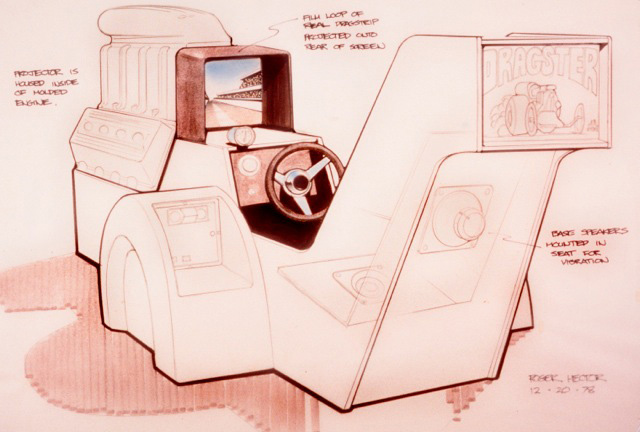
|
E.T. (1983-84) |
You wandered around dodging NASA badguys and collecting the pieces to "Phone Home". According to Howard Scott Warshaw, Lyle Rains was going to do the coin-op version, but it couldn't be completed in time. Michael Albaugh confirmed this and said Lyle was definitely involved with both the video and pinball E.T. games, as both were in his team. He also said Robin Ziegler was the main programmer on both arcade games. Someone else had contacted Dennis Harper, who was the principle designer for Return of the Jedi and was involved with several other arcade games (Toobin', Hydra, Primal Rage, etc.) and confirmed Robin was the programmer for the E.T. video game and also mentioned the game used the anti-aliasing "Pixie" hardware that Lyle Rains created for Return of the Jedi, and that E.T. shared a similar, visual look. Dennis went on to explain the Pixie board was difficult to develop for, as it used a memory-saving technique called "pixel averaging" that saved memory but ended up requiring weeks/months of work to figure out, and if an artist wanted to changed anything with a sprite, they had to start all over again with that sprite.
According to Michael Albaugh, E.T. used what he called "fully decoded color ram". From Michael Albaugh:
|
Lyle Rains was definitely involved in the arcade E.T. (video and pinball, both in my team). Robin Ziegler was the main programmer on both arcade games. Bart went by the name Barry in those days. Jack did most (all?) of the actual math-box code. I did the debugger and some proof of concept code. Also some of the hardware design, along with (maybe?) Lyle Rains. Ted Michon did the bulk of the hardware design, on contract as I recall. Karl was (probably) "second Programmer". Atari's original Pinball Division had been dead (for arguably the second time) for several years when the E.T. (later 4x4) pin was started within the mainstream coin-op group. It was also plagued by Atari micro-(mis-)management, as we were forced to use a custom chip designed by the inept-but-well-connected Atari Semiconductor group, which led to a major redesign of the PCB, plus a ritual of standing by with a fire extinguisher when the (pre-modification) prototype system was powered on. The Pixie board in question did interpolate to produce pretty much what happens when someone on a police procedural says "Enhance", but IIRC it applied only to the "Play-field" (the plane furthest from the observer), not Motion Objects (what T.I. got everybody calling "Sprites"), the middle layer, or "Alphanumerics" score and message, closest to the observer. I could be mistaken, but don't recall either M.O.s or Alphanumerics being processed by it. Perhaps some confusion with the "fully decoded palette" RAM, where every bit of the three sources/layers was fed to an address line of RAM, rather than previous practice of some sort of hardware priority decide "Z axis" (i.e. layers). This was a handy feature for, e.g. E.T.'s flashlight effect. I only recall E.T. and Jedi (and possibly also Road Runner) on that (pixel interpolation) hardware, but the history of that one is pretty "twisty". |
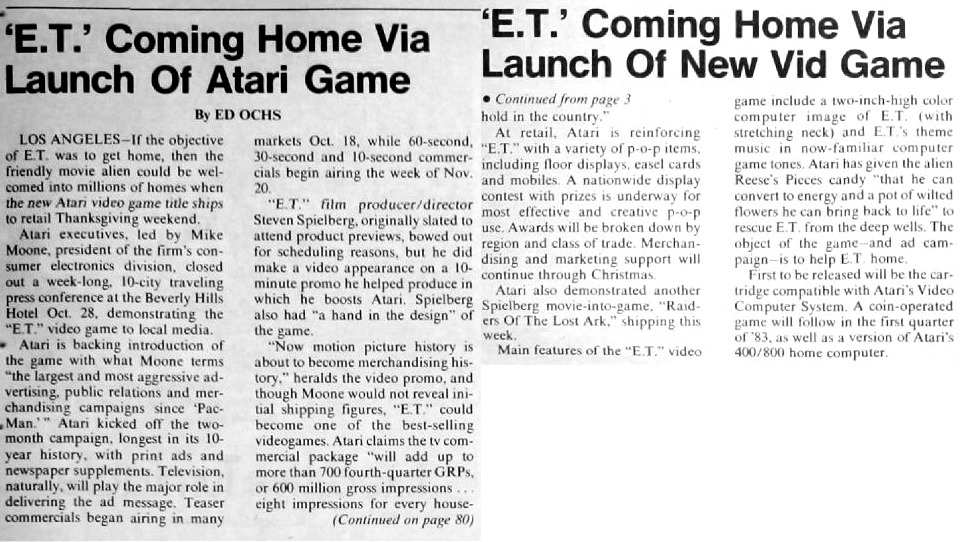
Article in the November 13th, 1982 issue of Billboard magazine (pg. 3).
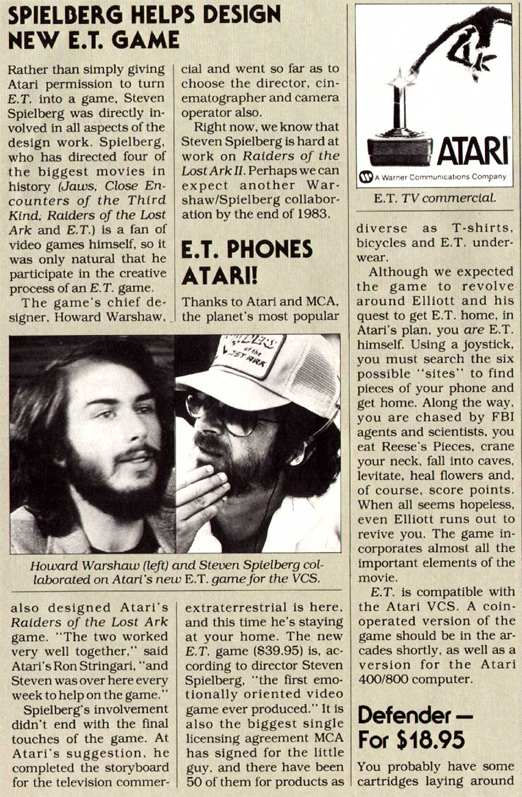
Article in the January 1983 issue of Electronic Fun with Computers & Games (pg. 35).
|
E.T. (pinball) |
This was later re-themed to 4x4.
|
ELIMINATION (1985) |
This was a quiz game that was location tested on 02-11-1985. This was possibly System I port of Quink.
|
EVOLUTION (1980) |
The game's description found in an Atari VAX email makes it sound like a forbearer of Will Wright's game, Spore:
|
EVOLUTION, a new game from Team II, will allow a player to add talents to his character in the game as the creature evolves through the ages. The Creature will be able to grow arms, legs, wings, a stinger, claws, and others in response to choices made by the player. THIS IS YOUR CHANCE to become a real live genetic scientist. Simply send your suggestions for talents we can add to the creature (offensive, defensive, transportation, relationship). If it turns out to be viable (we will try it in the LABORATORY and see if the creature dies or not), WE WILL USE IT IN THE GAME! The game is played over several million years in the sea, on land (forests, deserts), and in the air. The creature's subgoals are to eat enough food in the playfield to evolve. |
|
FAST DRAW (1977) |
This was developed from Arcade Engineering and licensed to Atari. Atari might have assigned a different name internally for it. From Jack Pearson:
|
Fast Draw was a video game - it was like Gunfight except you pushed a button instead of pulling a trigger. It was a flat game, like Atari's Football. Two people stood facing each other and whenever the light came on you had to hit the button. |
Given the other games Arcade Engineering created at the time, it was probably a B&W 8080 game with discrete audio. The "flat game" quote implies it was cocktail-only, and two player.
|
FISHIN' FRENZY (1995) |
Runs on the Cojag hardware. You goal is basically to catch as many fish as you can without getting caught by one of the enemy creatures.
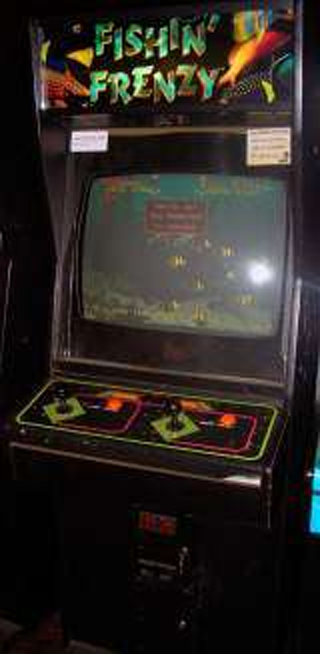



|
FORCE FIELD (1981) |
|
FREEZE (1996) |
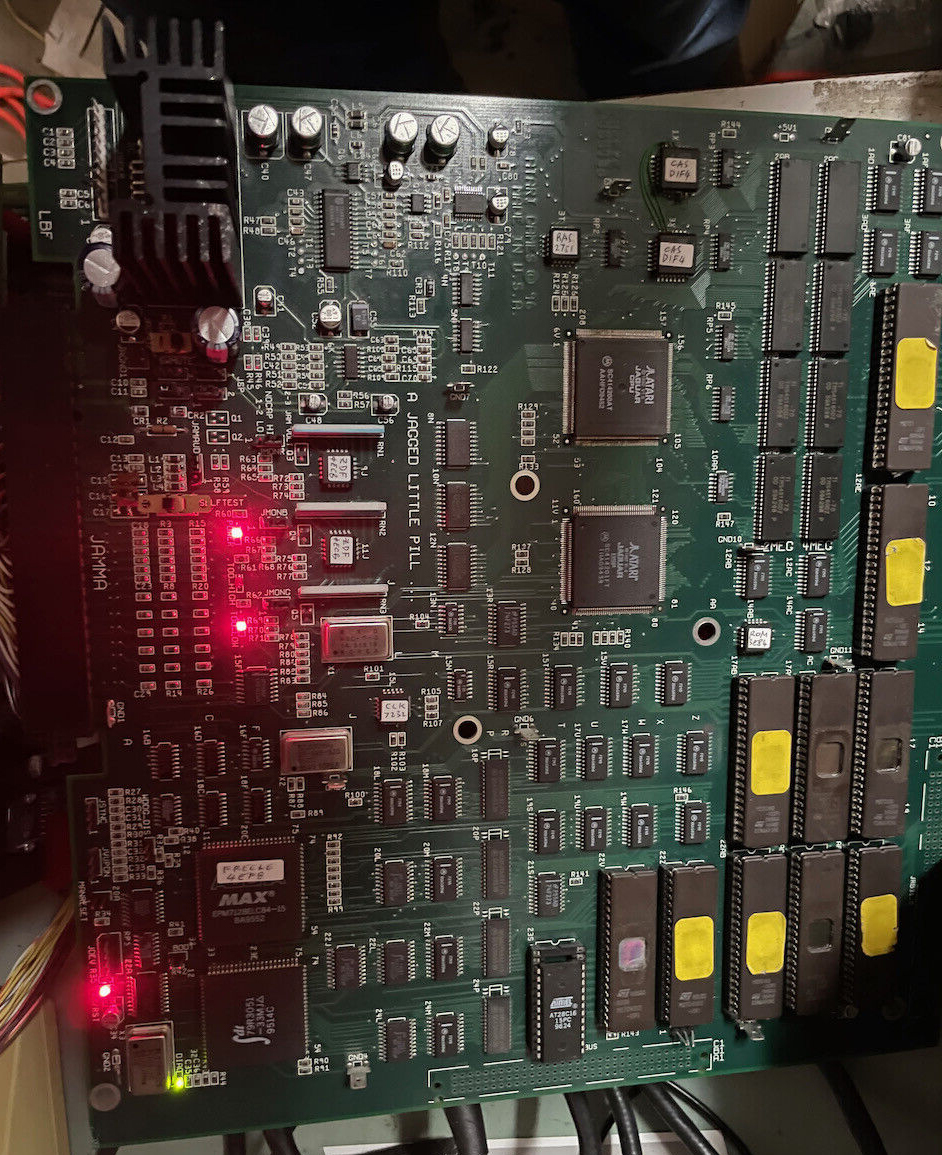
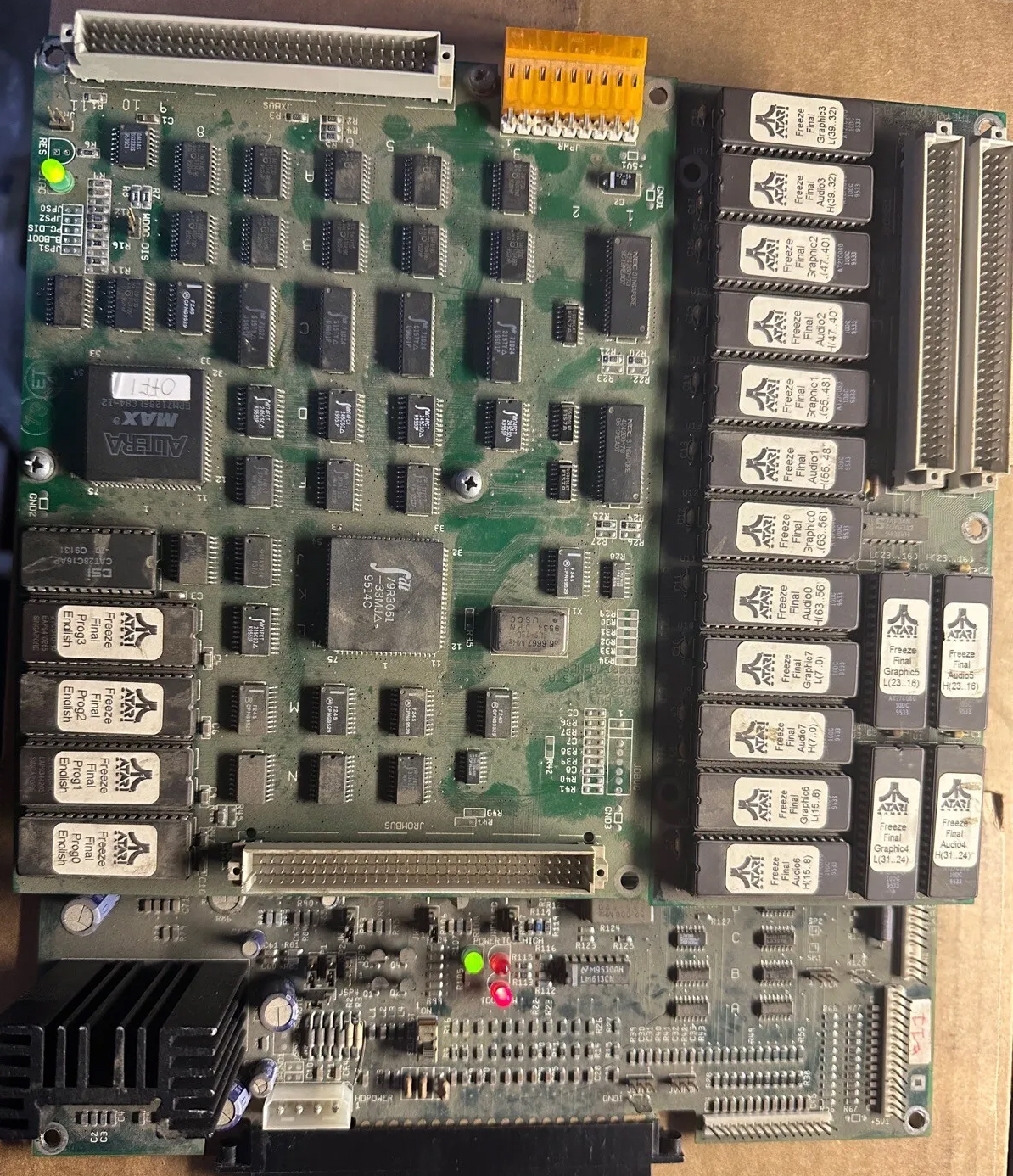
Runs on the Cojag hardware (but doesn't use a hard disk). Two Freeze machines was showed up at the 2003 classic arcade games show 'California Extreme', San Jose, California. Patrick Hubbell was the Sr. Engineering Tech. Freeze is a highly addictive, head-to-head, 3-D action-puzzle game where players join a wild cast of characters on an underwater fish sorting adventure. Players sort combos out of cute little fishies that swim, smile and wink. Challenge and strategy build as players learn different characters each possessing a unique special weapon. An exciting quiz game offers players an opportunity to race against time solving a multitude of colorful fishie puzzles. Combining these playful characters with the simple addictive gameplay will have players sorting fish in their sleep. The true challenge of any puzzle game.
The game's description found in an Atari VAX email makes it
sound like a forbearer of Will Wright's game, Spore:
|
EVOLUTION, a new game from Team II, will allow a player to add talents to his character in the game as the creature evolves through the ages. The Creature will be able to grow arms, legs, wings, a stinger, claws, and others in response to choices made by the player. THIS IS YOUR CHANCE to become a real live genetic scientist. Simply send your suggestions for talents we can add to the creature (offensive, defensive, transportation, relationship). If it turns out to be viable (we will try it in the LABORATORY and see if the creature dies or not), WE WILL USE IT IN THE GAME! The game is played over several million years in the sea, on land (forests, deserts), and in the air. The creature's subgoals are to eat enough food in the playfield to evolve. |
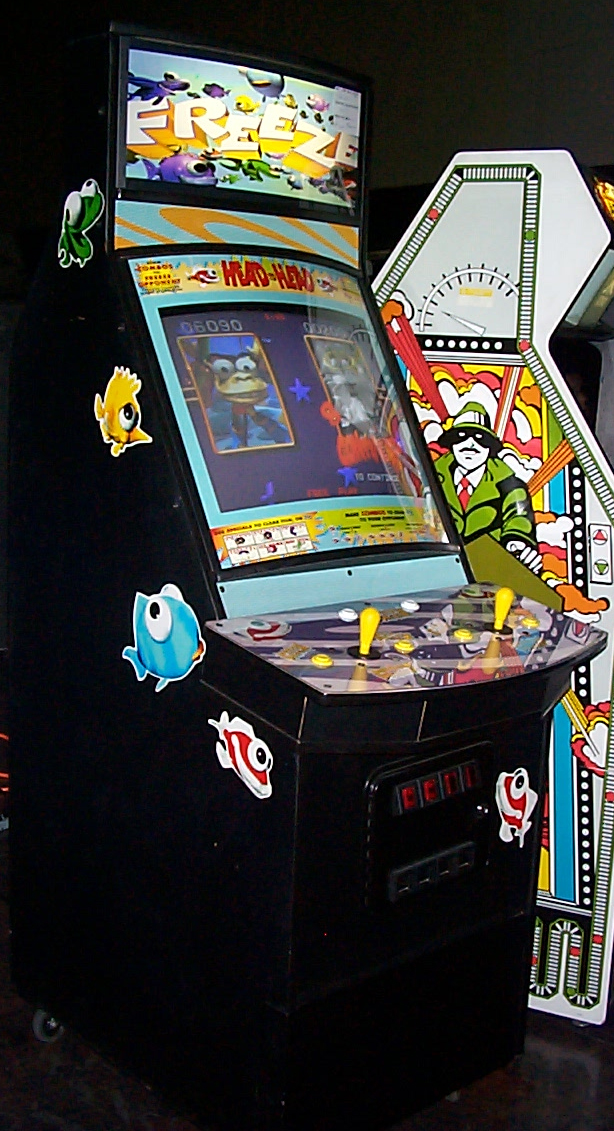
|
FRUSTRATION |
From Ed Rotberg:
|
I believe the working title was Future Tank. There couldn't have been more than 2 or 3 made under that name. By the time we got to AMOA (Amusement and Music Operators Association - the main trade show) it had been given its final name (Battlezone). At one time it looked like it was going to be called Moon Tank, so when I was told to put some vectors together for a planet, I looked in my Almanac and did a crude picture of the East coast of Australia. |

|
GARFIELD / GARFIELD'S QUEST / FAT CAT (1983) |
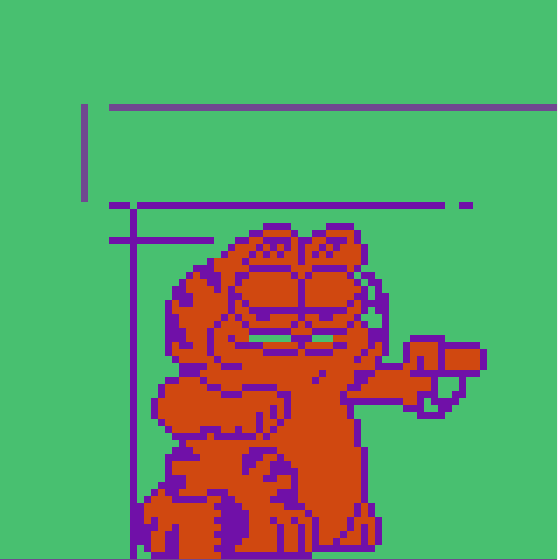
This was to be a System II game. Garfield's Quest was an alternate name. Fat Cat was the unlicensed name. Hidden in the prototype Road Runner laserdisc footage is a “Coming Soon!” picture. Some game code has been recovered from Atari VAX backup tapes, from which Max "SynaMax" was able to retrieve some game graphics (below).
USE JOYSTICK TO MOVE GARFIELD
PRESS ACTION BUTTON TO GRAB FOOD
PRESS JUMP BUTTON TO JUMP UP
COLLECT GLOWING OBJECTS
COLLECT RED OBJECTS FOR BONUS
AVOID SHOPPERS AND OBSTACLES
HAVE FUN!
PROGRAMMER: EDDIE BABCOCK
ENGINEER: PAUL WATMORE
TECHNICIAN: JOE CODDINGTON
ANIMATORS: DEBBIE HAYES, SUSAN MCBRIDE, BARBARA SINGH, WILL NOBLE
SUPPORT: BARBARA RICE
SPECIAL THANKS TO: RICH MOORE, STEVE ENGLEHART




|
GOLF TRAINER / GOLF SIMULATOR (1984) |
From Owen Rubin:
|
After finishing Major Havoc, I then moved to Rick Moncrief's group (now an officer at LBE) and worked on a golf simulator. That was cool because you really hit a real ball into a net and we projected the ball flying on the screen. We had lessons (it had a laser disk) and swing analyzers as well. I quit in the middle of the project when Warner laid off a bunch of people. I asked to leave. They offered me almost a year's pay to leave in 1984. I did on a Friday and joined Sente on the following Monday. |
|
I also did a Golf Simulator game where you actually hit real golf balls at a projection screen and the ball was projected the rest of the way. We recorded thousands of pictures of the Los Gatos golf course on a LD. When you started, we would project the view from the tee. You would hit a real ball with a real club, we had sensors that measured your swing, your weight balance, and where the ball hit the screen, and we would calculate and project the ball on the screen onto the real course. After each shot, you could get a lesson from a Pro on something the system analyzed you might have done wrong, we measured so many things, and had about 200 lessons from golf pros. A graphic top down view would display where your shot went, and then we would display the next view. It had silly things like going into water hazard footage as well. |
|
GRAVITAR (1982) |
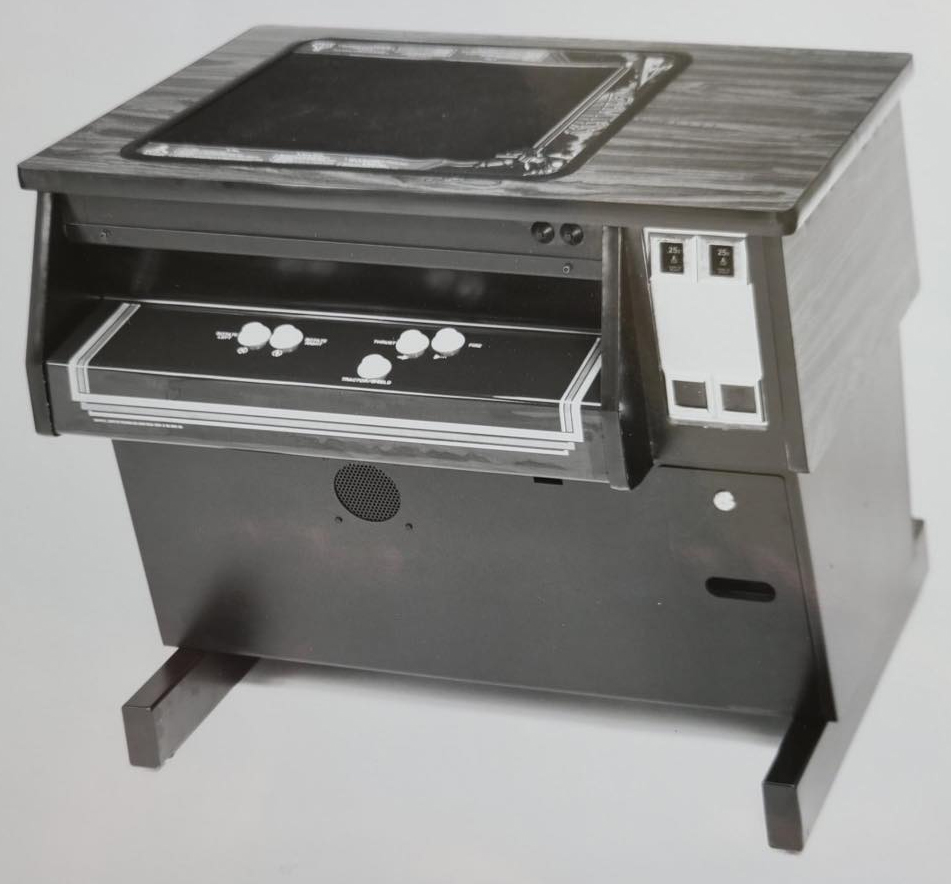
Cabaret and table models were planned but likely dropped from the weak sales of the full-size upright.

|
GREMLINS (1984) |
Based on the 1984 movie. Ran on Atari's System II hardware. The game was programmed by Franz Lanzinger, of Crystal Castles fame.
|
GUNSHIP (1977) |
Used the same Triple Hunt hardware and closely followed the game gameplay but having a different theme, but it was never completed.
|
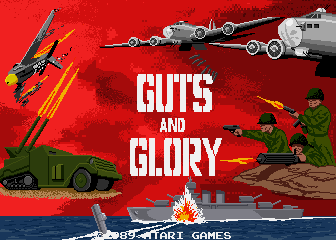
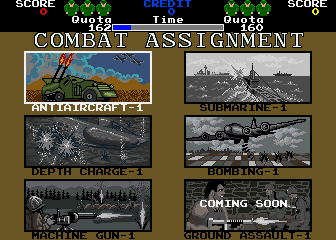
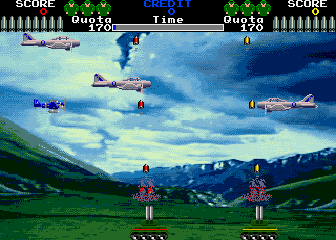
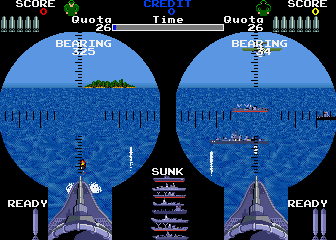
GUTS AND GLORY (1989) |
A two players shoot'em up war game. This game include a series of mini games from different styles of gameplay based on war themes, the players must shoot down a quota of enemy targets, before the timer expires. Programmed by Ed Logg and Dave Theurer. Video graphics by Mark West, Bridget Erdmann, and Nick Stern. Audio by Don Diekneite. Electrical design by Pat McCarthy. Technical support by Cris Drobny.
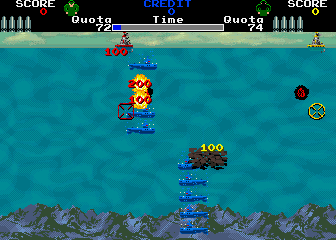
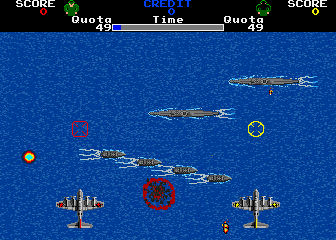
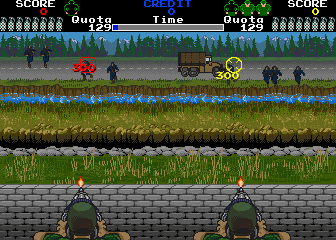
|
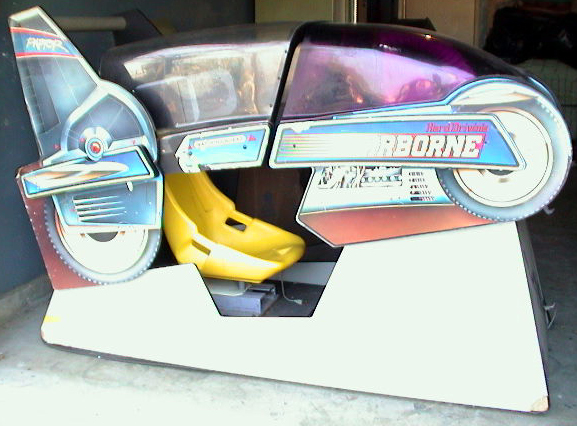
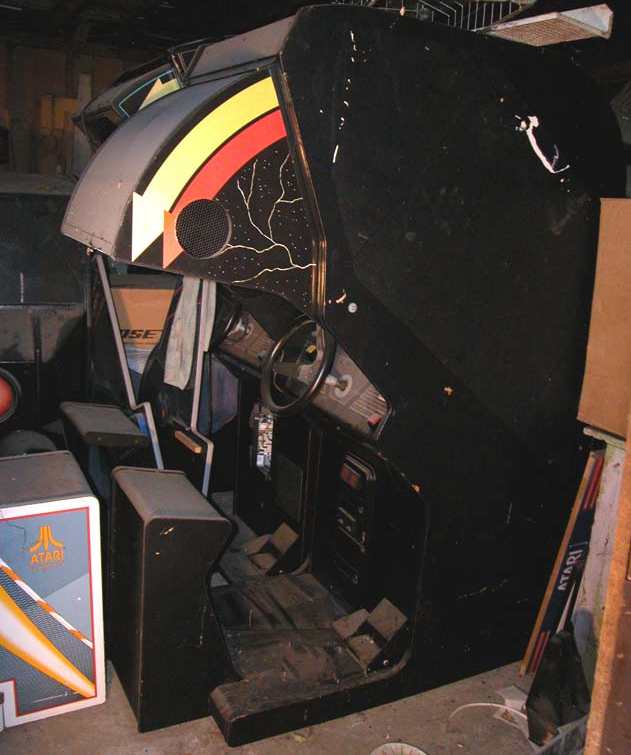
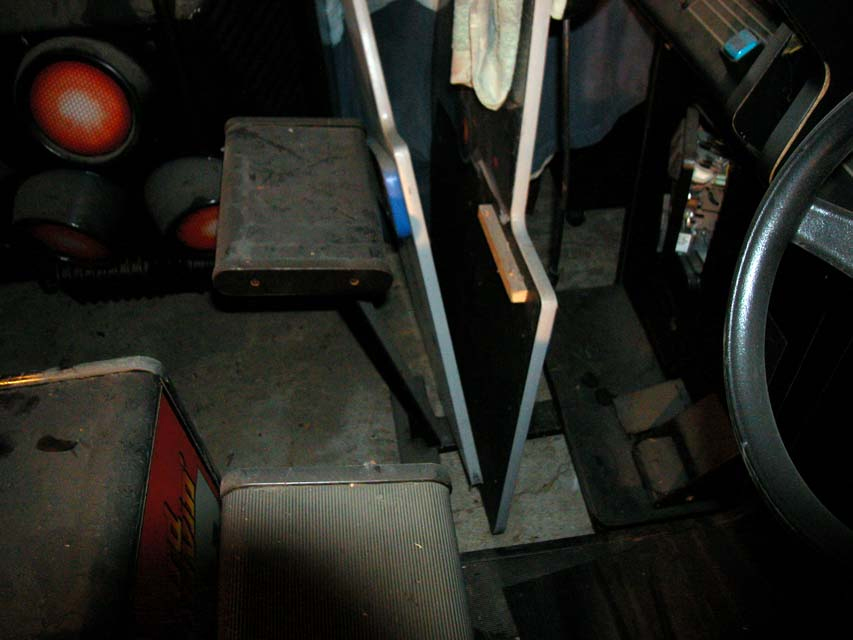
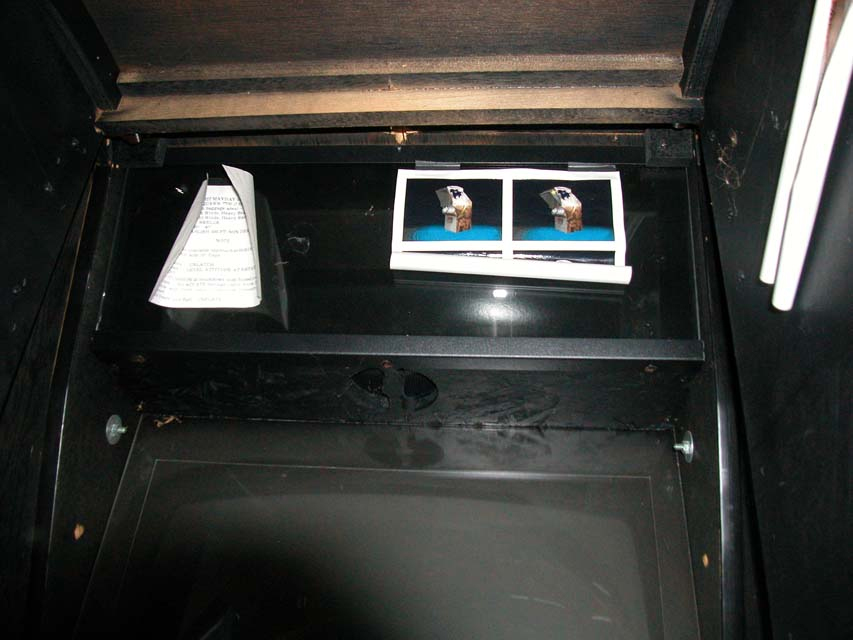
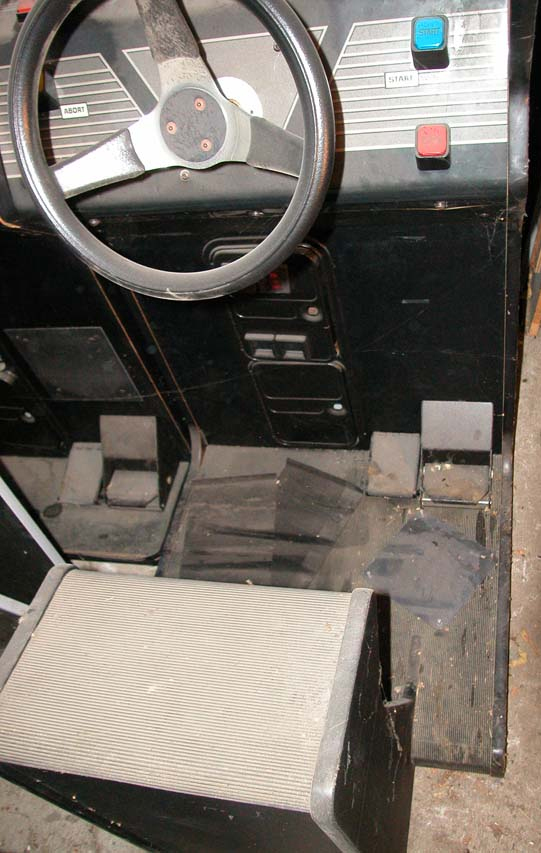
HARD DRIVIN'S AIRBORNE (1993) |
There originally were 3 sit-down models (with 2 different versions) and 5 upright models (with at least 2 different versions) at the time Atari shut down. One sit-down was essentially destroyed. One upright was really early and was designed to have boards outside of the cabinet. It was also destroyed.
The first set of sit-down photos probably had a motorized canopy that was converted to an open-style cabinet. It has a paper instruction sheet on the rear, where others had a map sticker. A later production model has a marquee where there is a round bar.
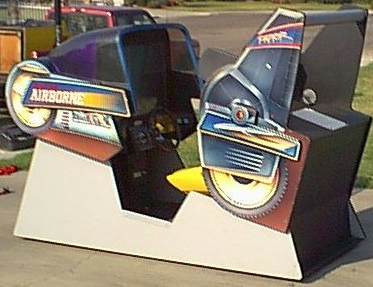
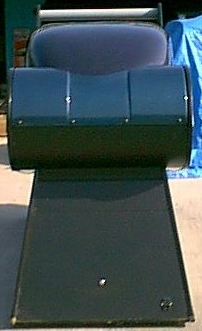
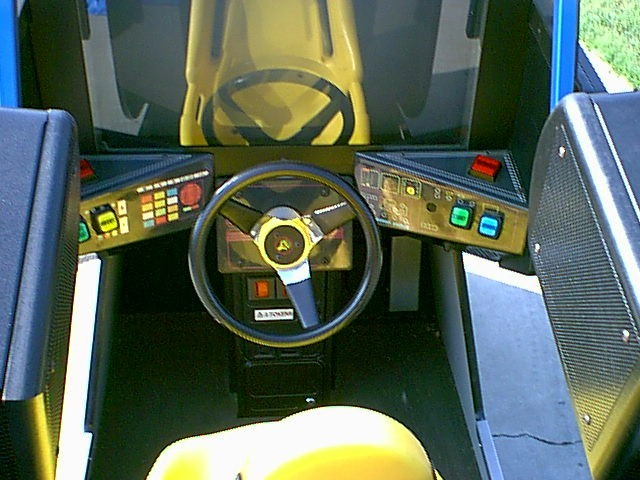
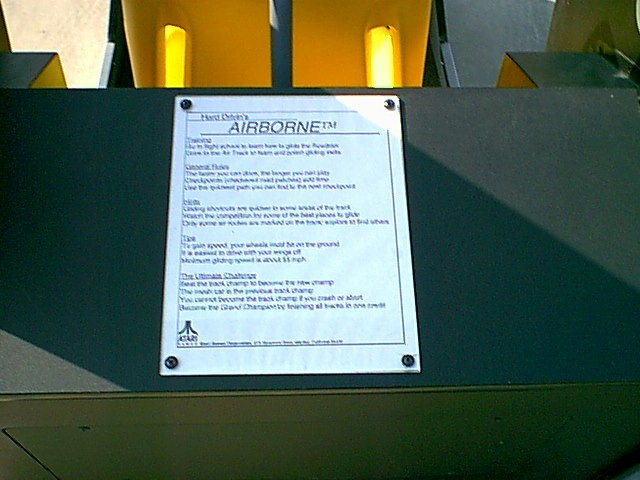
The first set of sit-down photos probably had a motorized canopy that was converted to an open-style cabinet. It has a paper instruction sheet on the rear, where others had a map sticker. A later production model has a marquee where there is a round bar.
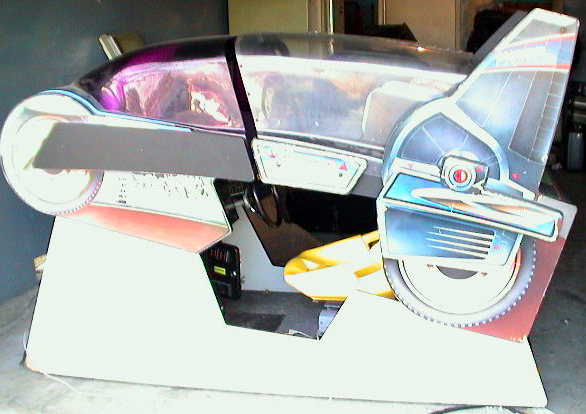
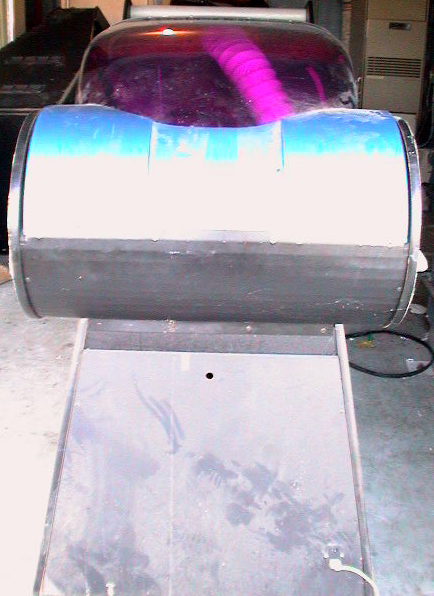
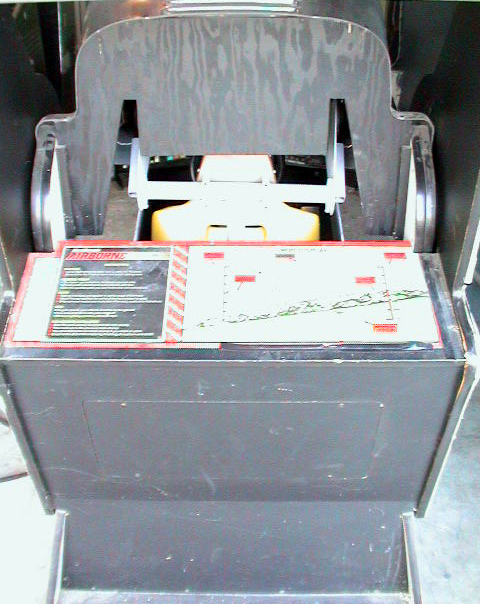
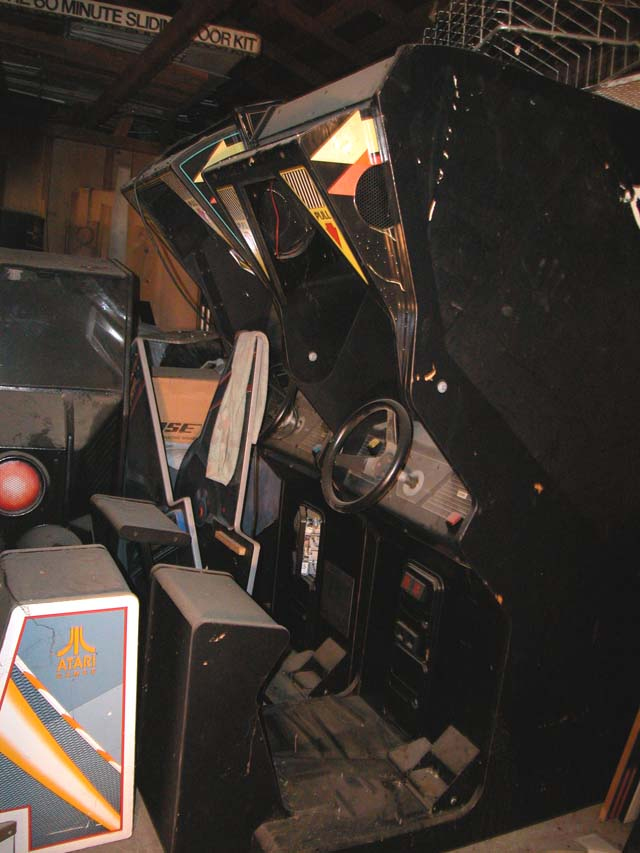
The uprights have a motorized canopy that closed around your head. Note the 2 different seats and 2 different canopy tops. Also 2 cabs have medium rez monitors in them and 2 have standard rez. None of the uprights were working at the time and were using very early hardware, with hand-wired boards that had been poorly cared for.
|
HARESCARE (1980s) |
|
HEART OF ICE (1982) |
From
Michael Albaugh:
|
At the time (1983-84), I was the Team Leader (AKA, manager) of "The Village", one of four "normal" coin-op game development teams (that is, not counting various "special projects" groups). So in a sense I "worked on" all the games from that group, and a few (i.e. Mark Cerny's Heart of Ice) that didn't get off the ground. |
|
HOOP FIGHTER / 3 ON 3 BASKETBALL (1994) |
Runs on the Cojag hardware.
|
HEIST (1982) |
|
HOT ROD REBELS (2000) |
Sequel to San Francisco Rush 2049 which
was cancelled before it was finished.
There are 8 tracks to choose from. Only three of the tracks are complete.
Three other tracks are incomplete. You can race those tracks, but there
are no textures so it's like Hard Drivin 2000! The last two tracks are
unplayable and the music and sound effects are unfinished. The drone car
logic is also not complete as they get lost while driving.
|
HYDROPLANE (1978) |
Described as Sprint on water. The developer was Michael Albaugh.
|
HYPERSPACE (pinball) (1981) |
Pin Dual might have been the early name for this.
|
ICE WORLD (1981) |
Dave Sherman was the developer. An initial proposal describes the gameplay was intended to be some sort of first person view flying game, with the player flying through a canyon and attacking enemies. At the end of the canyon, the player would battle a fortress that could emit "death rays". From Dave Sherman:
|
We actually had a flying game called Ice World which was going to be a rip-off of Star Wars. |
Early PCBs exist in the field which have the discrete IC equivalent of the ICY chip. These boards are labeled "ICE WORLD VIDEO BOARD".

|
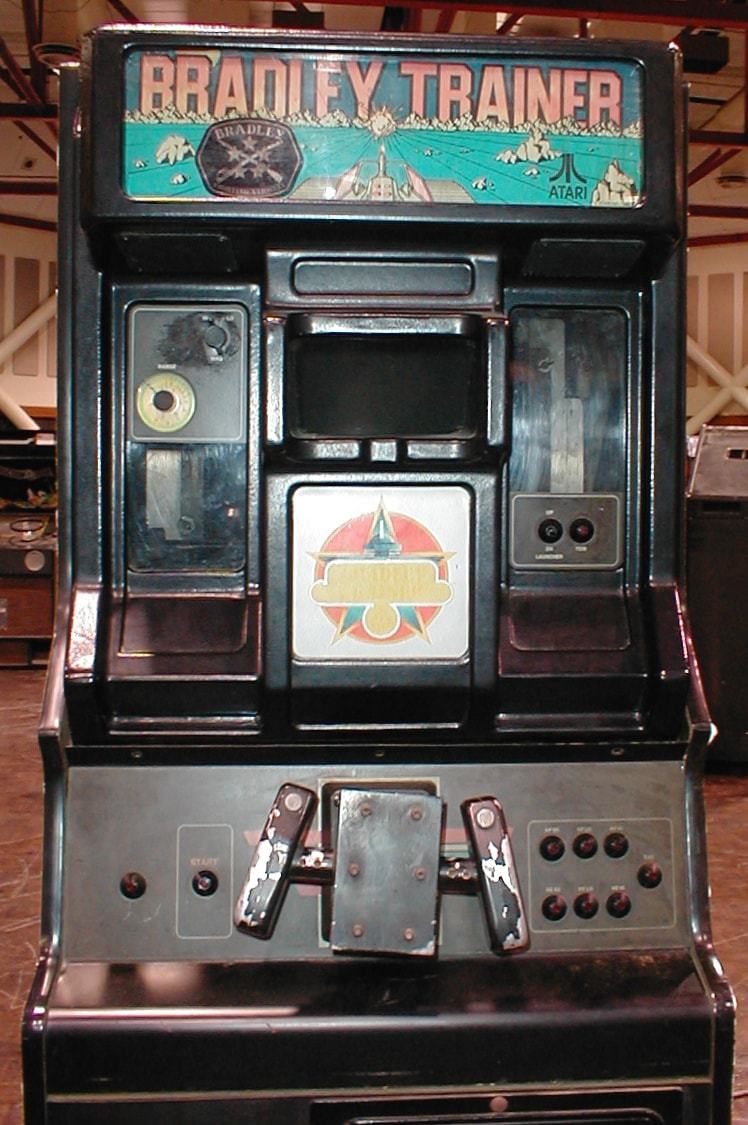
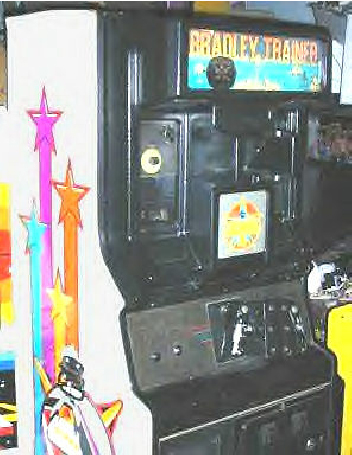
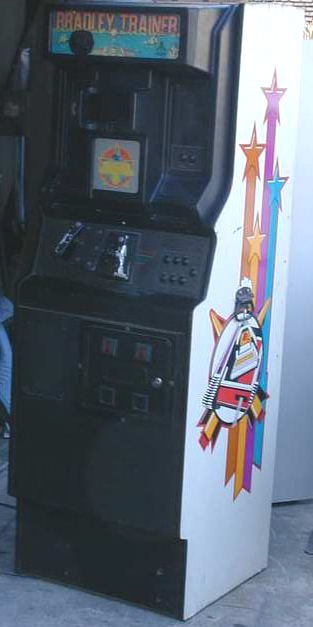
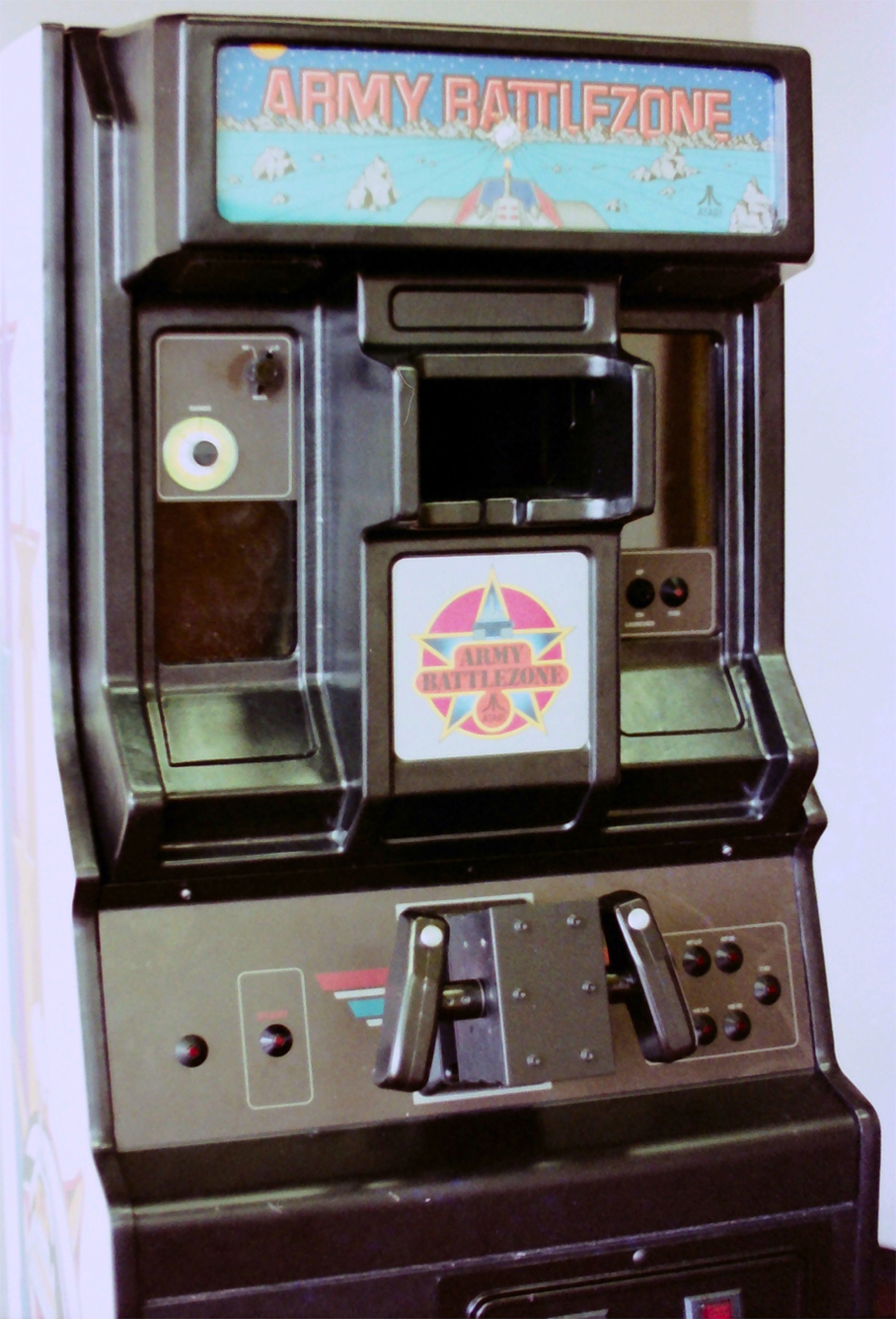
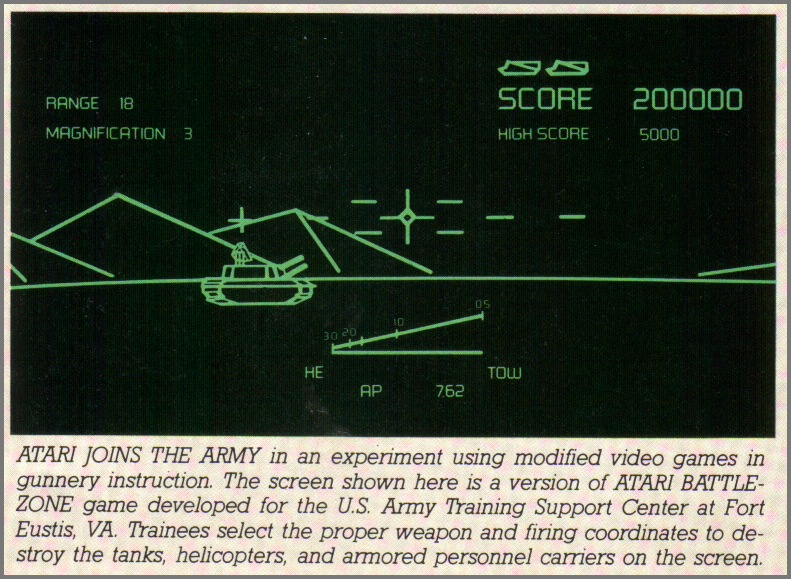
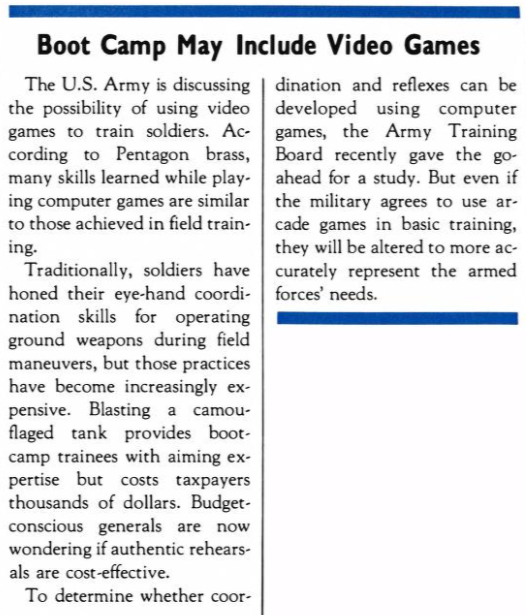
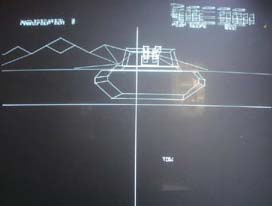
IFV (INFANTRY FIGHTING VEHICLE) / BRADLEY TRAINER / ARMY BATTLEZONE (1981) |
In December of 1980, a group of
consultants from the US Army approached Atari with the idea that the game
Battlezone could be made into a simulator for the then-new 'IFV' Infantry
Fighting Vehicle (or the Bradley Fighting Vehicle, as it is known now).
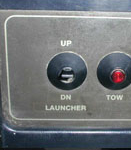
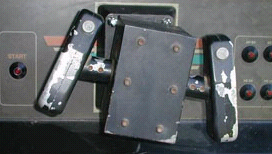
Many physical and gameplay changes were made to the original game, such as a new
control yoke, friendly and hostile vehicles and helicopters, more weapons (7.62
mm machine gun, a cannon with armor piercing or high-explosive shells; and a
tube-launched optically-guided missile launcher, or TOW), and view selection
(normal or magnified). The key was to guess the size of the target, use
the on-screen gauge to align it, and dial in the distance to the object, to hit
it with the first shot. A prototype of the simulator was rushed out in
March 1981, and was introduced at the worldwide TRADOC conference that year.
It was a hit at the conference.
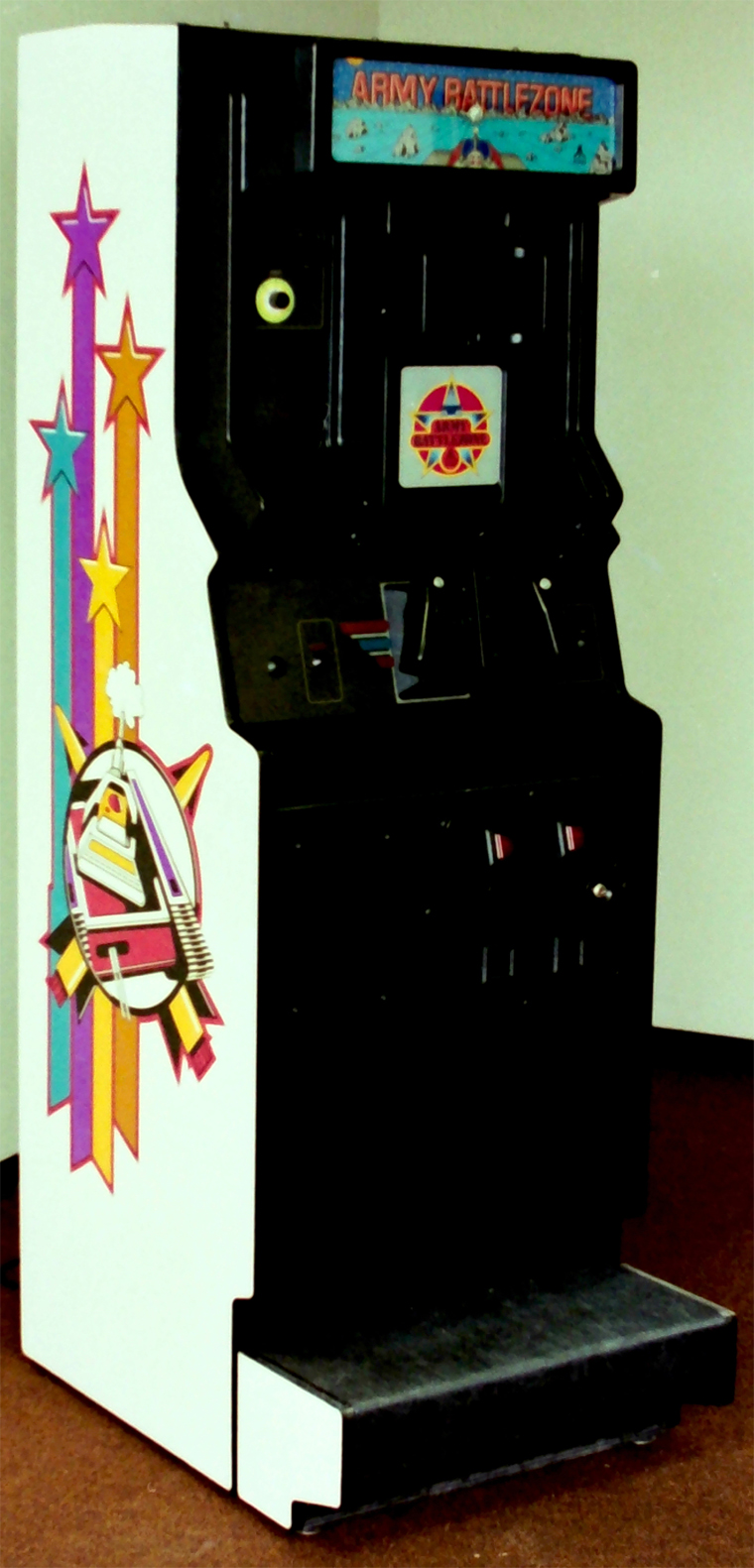
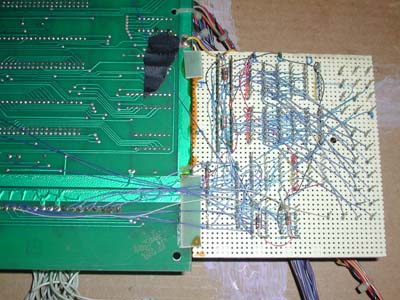
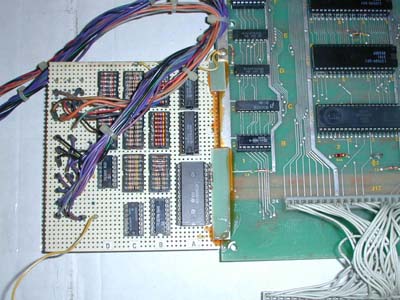
A special version was designed for the U.S. Army, commonly referred to as “Army Battlezone”. Only 2 were made. The first version is called the IFV (Infantry Fighting Vehicle) and was sent to Ft. Eustice, VA. It used a down-sized controller that was adapted from an actual Bradley. The second version is
called the Bradley Trainer (or the Bradley Fighting Vehicle), and
the controller was slightly redesigned, which was later used in Star Wars and a
few other games. The game is more a simulation, solely designed
for the purpose of training tank gunners. The other tanks do not fire at you
(although their turrets will *flash* to show they are), and the only way to end
the game is to run out of ammo or shoot a 'friendly' tank or helicopter. A small
blurb about the game appeared in the first issue of Atari Age (picture #7).
STAFF
Project leader: Rick Moncrief
Programmer: Ed Rotberg
Engineer: Jed Margolin
Mechanical engineer: Otto De Runtz
Technician: Erik Durfey
Ed Rotberg, the project programmer, was very opposed to doing the project, mainly due to the principles of such a project. He felt that technology used to produce Battlezone and video games in general shouldn't be used for bad purposes, such as weapons research, and cited the conversion of automobile factories into tank and airplane factories in World War II. Rotberg spent two months on the project, and resented it the entire time.
From Scott Evans:
|
The gameplay is very much a simulation. The other tanks do not fire at
you, and the only way to end the game is to run out of ammo or shoot a
'friendly' tank or helicopter.
--------------------------------- |



|
INDIANA JONES II (1983) |
According to Peter Lipson, he was planning on doing a laserdisc game based on the mine cart chase scene from the movie. From Peter Lipson:
|
Another one we almost did was the Road Runner game that Ed Logg ended up doing, and I was going to do an Indiana Jones version "game 2", with the mine cart chase, but all of those things, we realized the video footage was just ridiculously expensive. When I talked to the guys at ILM about the footage that we would want, and they were pointing out they did like 3 minutes worth of mine chase in the movie, and we wanted like 40 minutes for the laserdisc. We did not have 15x the budget for the movie to do, so that pretty much kind of killed it right away. |
|
INDY TURBO |
From Roger Hector:
|
I managed the Advanced Products Group that worked across all areas of the company, from Coin-Op to the Consumer division. I remember building the first large projection screen coin-op racing simulator. It was called Indy Turbo (the early name for it was "Indy Racer"), and it actually looked like a Formula 1 race car with a big projection screen in front of the driver. Our racing game built in the Research & Development labs was similar, but different from the Namco game. I led the design along with Harry Jenkins. Harry was a very creative mechanical engineer, and we made a good team. We had this very special "hot rod" video projector given to us by the manufacturer for evaluation in R&D. It was an early (Electro-Home?) water-cooled video projector (Ed.: Jeff Anderson of Videotopia had some information about the projector - "It's an Electrohome EDP-58. They were in production for at least a couple years, and used a single green Sony SD187 CRT. It was designed as a "data" projector, to be hooked up to computers like the Apple II."). We couldn't let it just sit around, so we built it into a special beefed-up race car body and put an old game (Night Driver) into it, projected onto a five-foot screen, just to see what it would do in the field. It looked pretty cool as it resembled a real formula racing car and it had a special seat that leaned into the turns as you drove. The player’s seat was rigged to rock a couple inches tied to steering wheel inputs, and this physical movement during play would add to the sense of being in a moving/leaning car (not sitting on a fixed bench). We used a whole racing car (front to back) and mounted the video projector behind the driver and projected it over his head onto a larger projection screen mounted over the front axle of the car. Before going out in public, we wanted to make sure it would hold up to abuse, so we called on the biggest guy in Engineering, Dave Stubin, to check it out for durability. We presented our beautiful shiny new race car to him, confident its construction was worthy, and he promptly raised his foot and stomped it on our car, breaking the gas cap off, and breaking our hearts! Now, Dave was a really BIG guy, and this became known as "The Stubin Test". It was pretty useful for making sure coin doors and controllers would hold up in the field. After some further rebuilding, Indy Turbo went out on location in a local arcade and amazingly (despite having an old low-tech game in it) became an instant hit and the all-time top earning coin game at this local amusement park. The unique cabinet design is what really drew in the players, as it looked like a complete race car, and not just a box, screen, and steering wheel. But it was using a prototype video projector that never went into production, so we could never produce it. We would not have used it past our prototype Indy Turbo anyway, as it was pretty fragile and would not have held up well in a real commercial coin-op location. Here's some photos of the prototype out in our parking lot: |
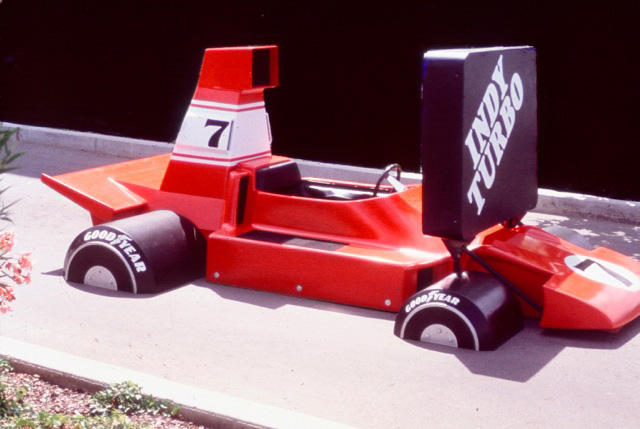
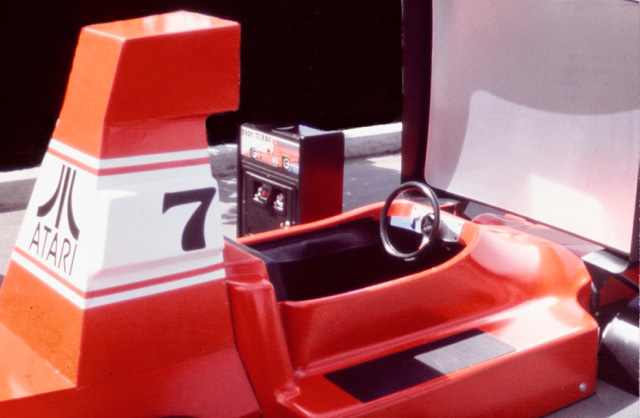
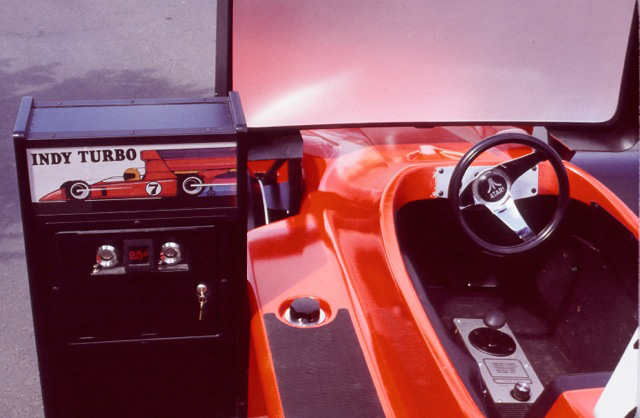
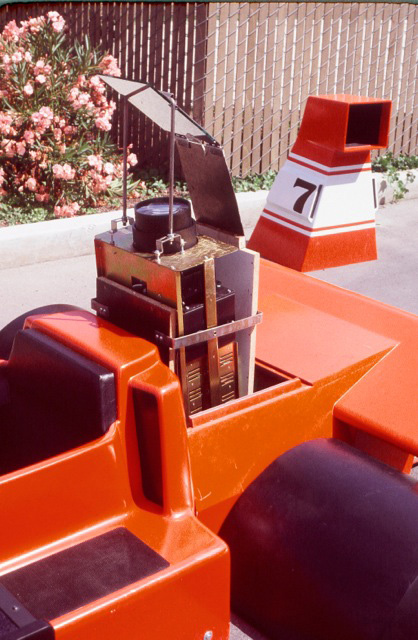
|
INTERCHANGE (1982) |
Was field tested before being cancelled.
|
JAMMIN' (1984-85) |
The only known prototype that exists is currently owned by Scott Evans. In 2025, Ken Ven Mersbergen recovered the code for it from a vintage Atari VAX/VMS backup tape. The game was planned to use System II hardware. Robert Weatherby was the programmer. Deborah (Debbie) Hayes did pixel art for the game and also worked on Peter Packrat and Gauntlet (which was known as Dungeons at the time). She left the company in February 1985 while these games were still in development. There are ten songs in the game, 3 of which were later reused (and likely re-sequenced by Hal Canon) for Super Sprint.


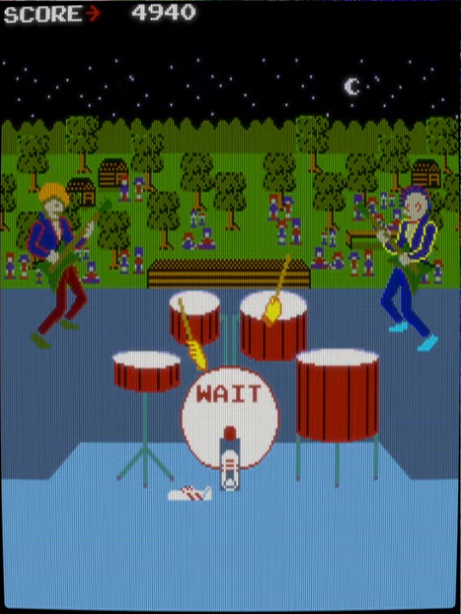

|
KINGS IN THE CORNER / CASTLES & KINGS |
These were the early names for Warlords.
|
KNIGHT RIDER |
Atari had a few different ideas on the laserdisc game drawing board. Knight Rider was one of those ideas. Unfortunately a Knight Rider laserdisc game never saw the light of day.
From Owen Rubin:
|
On Knight Rider and Battlestar Galactica, we went to Universal and got to look through a LOT of footage (some aired some not) of shots from the shows. On Knight Rider, the game was going to be a driving game where you had to use KITT's special features to catch the bad guys. Jumping, speed, guns, electronic jamming, etc. It would be a combination graphics and video game (NOT like Firefox) with graphics better than most driving games and live video mixed in, and the voice of KITT helping you along in the game. When you did a stunt with KITT, you would see an instant replay of the stunt in live video from the show. We also had some great footage that was never seen. Like what REALLY happened to the cars after they made a jump. It really crumpled the front of the cars a lot, but that was edited out. If you missed a jump timing in the game for example, you would see the car land and crumple and you lose a life (or whatever). There were lots of outtakes that would have made great game play error footage. We never got much further than that as we killed all laserdisc games shortly after Road Runner. |
|
THE LAST STARFIGHTER (1984) |
Based on the 1984 movie The Last Starfighter. This was to use Atari's System IV hardware. Although the hardware is long gone, some code was recovered from a VAX backup tape; unfortunately the 2D overlay data was missing. In 2007, Jim Morris posted video of the game running on YouTube. He mentions the names of a few people who worked on it (Bart Whitebook, Jack Ritter, and Michael Albaugh. From my notes, I have Karl Anderson and Ted Michon attached to this as well, but I don't know how accurate that is. I also had Bart's first name as Barry.
From Michael Albaugh:
|
Bart went by the name Barry in those days. Jack did most (all?) of the actual math-box code. I did the debugger and some proof of concept code. Also some of the hardware design, along with (maybe?) Lyle Rains. Ted Michon did the bulk of the hardware design, on contract as I recall. Karl was (probably) "second Programmer". |
From Michael Albaugh via Frank Gasking at GamesThatWerent:
|
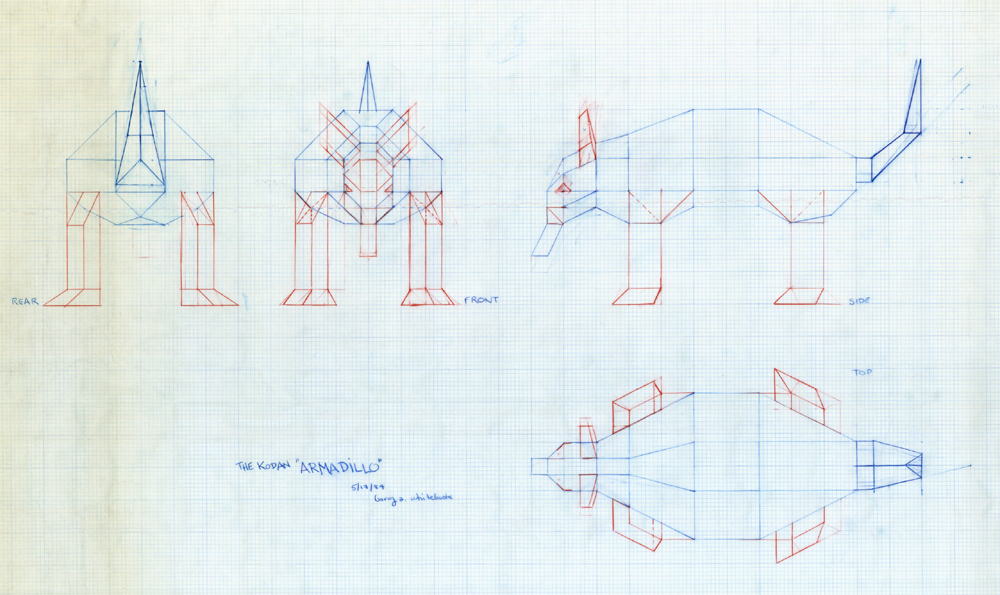
The "boss level" was meant to be the Kodan Armada. It so happens that one
of my co-workers had a stuffed Armadillo in his cube. I borrowed it so
that animator Bart could draw up what you see in that image.
|
BASIC GAMEPLAY:
Player controls weapons on Gunstar and orientation of Gunstar chair; he is not
piloting ship. Player's head-up display shows information on weapons system and
coolant (shields), as well as on currently targeted enemy, surrounding enemy
positions and Gunstar chair orientation. Not all information is available in
each round.
Each of the enemy ships takes a different amount of energy to destroy. Enemy
condition is shown by the 'Target temperature gauge'. When the enemy temperature
hits max, it will explode. The rate at which the gauge rises is determined by
the type of ship. Temperature rises while player's lasers are contacting enemy
ship and may fall if this ceases before destruction.
The condition of the Gunstar is shown by the 'Hull temperature gauge'. When the Gunstar is being hit by the enemy fire, the hull temperature increases. When the
hull temperature gets high, coolant flows in (around the gauge on screen from
the on-screen reservoir) to cool the hull. This depletes the reservoir of
coolant. If no coolant remains, the hull temperature will reach maximum and the Gunstar is destroyed. A coolant recharge is given at the end of a complete
round.
LASERS:
Player's laser energy is shown for each side laser. Laser energy decreases with
time of laser use and increases far more slowly. This encourages short bursts of
fire from one laser at a time. If both lasers are fired simultaneously, a third
laser also fires from below without additional depletion of energy, but with
additional effect on the target. This contradictorily encourages use of both
lasers simultaneously. As players increase in skill, they will learn to use
short, single laser bursts on small targets and twin laser bursts on large
targets. This combination will ensure best energy usage and maximum destructive
effect. It is possible for a player to be stranded with inadequate energy and be
destroyed of insufficient ability to retaliate, but this cannot happen on
beginner rounds where energy drain is very low.
Death Blossom (laser blossom) is fired with rear buttons on Star Wars
controller. The central circle will light up on screen to show when Death
Blossom is charged and usable. Activation causes the screen to be blanketed with
laser fire destroying (or greatly heating up if mother ship) all targets on
screen. Does not destroy Control Tower and Xur's transport.
The production of the game started in Atari's arcade division.
The original project team was made up of Chris J. Horseman (Project leader),
Jim
Morris (Project engineer + software), Jack Ritter (2nd project engineer
+ software),
and Barry Whitebook (Animation). Ted Michon and Mike Albaugh came onboard this
project later in development. Prior to this game, 3-D arcade games used only
vector graphics. Atari had for several years worked on a general purpose 3-D
arcade system, but it was always 'a few years away' every time they wanted to
use it (an arcade game called I, Robot was released in June 1984 despite
having a 1983 onscreen copyright date, and this
game had solid 3-D polygons, but it was hard-coded and was very different from TLSF; this was actually the first game developed by Atari to be programmed with
C). This is where Ted Michon comes into the picture. Ted worked as a consultant
for Atari and developed a super high-bit-mapped system with a polygon-filling
engine. Atari decided to use this to on the TLSF arcade. They also had to use
the system's expanding capabilities to implement a math box that could handle
the 3-D transformations. The programming of the math box was done by Jack
Ritter.
Programming for the arcade game was done mainly by Jim Morris. The additional
programming with the cave sequence in the game was done by Jack Ritter. Jack
came onboard from Cinematronics.
In the programming process Jim used a Motorola 68000 CPU, the first to ever be
used at Atari. The programming language was C. They also used several 3-D tools
that were later used in other games. TLSF became a pioneer in using the 68000
CPU. Back then, most games were made with the 6502 CPU. The arcade games
Hard Drivin' (1989) and S.T.U.N. Runner (1989) have a very similar graphics engine with TLSF game, even though another graphic engine was used with those games.
The gameplay in the game was taken right from the gameplay in the movie and
scenes from the movie; this was often done with spinoff games like this. The
game was actually very similar with what was seen in the movie, at least
regarding the graphics. The controller for the game was a controller from the
Star Wars vector games that Atari made. When Atari chose to drop the game, it
was about 75% finished. There was no cabinet for the game, but the game worked
and it could be played on a test bench. They also made some simple sound effects
for the game.
There were several reasons behind Atari's decision to cancel the game so far
into production. Atari had for some years paid a lot of money to the movie
studios for the rights to produce licensed tie-in games, with themes taken
from the movies. This cost Atari a lot of money over a long time. Atari gambled
on the movie to become the success that everyone predicted, but this did not
happen. The film didn’t fail, but it wasn't a success either. In the production
of the arcade they found out that the machine would have a selling price of
$10,000, and this was a lot of money back in the 80's. If the movie had been a
big success this price could have been defended. The vice president of Atari
thought that no one would buy a game for $10,000. Not long after that, the
project team got the message that the game was cancelled. At the same time,
Atari was in deep financial problems caused by Atari's consumer division. On top
of all this came the big video game crash. The result was that Atari started to
fall and fall, until it closed down in the end. The original arcade division of
Atari was shut down in 2001 when Midway chose to shutdown Midway West (Midway had
bought Atari Games (Atari's arcade division) and changed its name to Midway
West). Prior to this Atari had been sold to a couple of other companies, and
they frequently changed leaders. But Atari never became the company it was prior
to the crash. Some years after Atari cancelled TLSF, the arcade game Hard Drivin'
was released. This game sold for the same price that TLSF had ($10,000).
Project leader : Chris Horseman
Project Engineer (Software) : Jim Morris
3-D Hardware : Ted Michon
Math Box Programming : Jack Ritter, Mike Albaugh
Animator: Barry Whitebook
|
LED SCRIMMAGE (1980) |
Deemed a low priority, according to a 5-23-80 memo.
|
LUNAR BATTLE (1982) |
This is the early name for Gravitar. There are ONLY 2 Solar Systems (three in Gravitar). * Different Planet, Bunker and Fuel Cell icons. * Different bunkers' and planets' shapes. * No planet animations. * Stronger and more intense Gravity (Game-play is much harder). * Some sounds are different during the game. * There is an additional 'Low on Fuel' warning if the fuel level drops below 2,000 fuel units that is not present in Gravitar. * Rammer ships are present in the south planet of the second solar system - Not in Gravitar.
|
LUNAR LANDER (1979) |
Programmer Rich Moore mentioned in RetroGamer magazine #79 that a cocktail version was planned for release and 2 were built, but plans were dropped when production of Asteroids took priority.
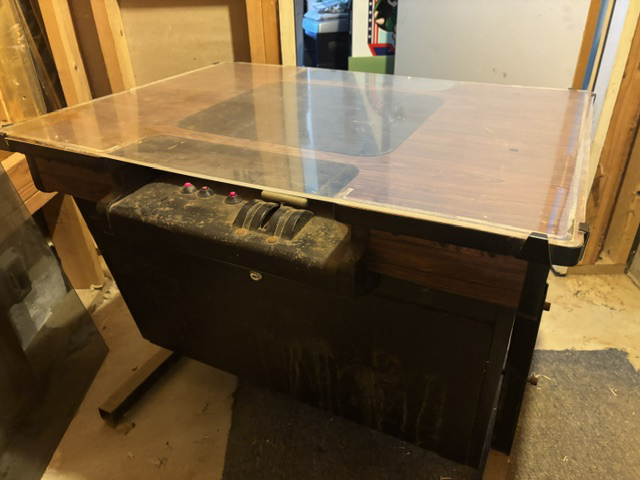
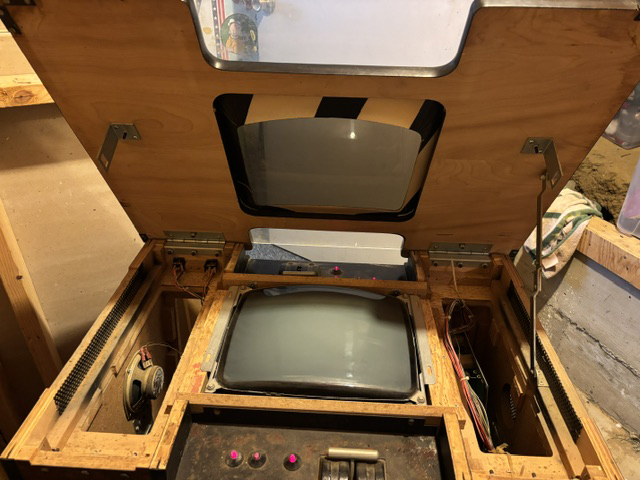
|
MAD BOMBER (1983) |
Original name for Cloak & Dagger prior to Agent X.
|
MALIBU GRAND PRIX (1980) |
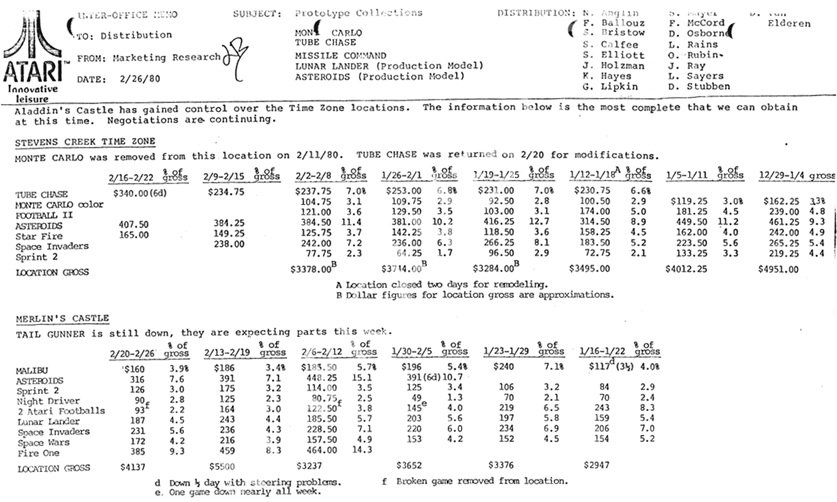
According to Michael Albaugh, this was an early b&w 1st-person driving vector game. An Atari memo dated 2/26/80 shows the game was tested at Merlin's Castle in CA. Atari's Mathbox was originally created for this game; it was also used for Battlezone, which was the first released game to use it. Deemed a high priority, according to a 5-23-80 memo.
|
MALIBU GRAND PRIX (1984) |
Below is a direct copy of the Malibu Grand Prix arcade game laserdisc footage I archived several years ago. The race course footage was done at the Malibu Grand Prix driving center in Redwood City, CA, in 1984. Some of the people who appear in the video are Paul Mancuso and John Ray. Do you recognize any others? And what is the significance of the telephone keypad "the future" sequence (3795*) in the beginning?
|
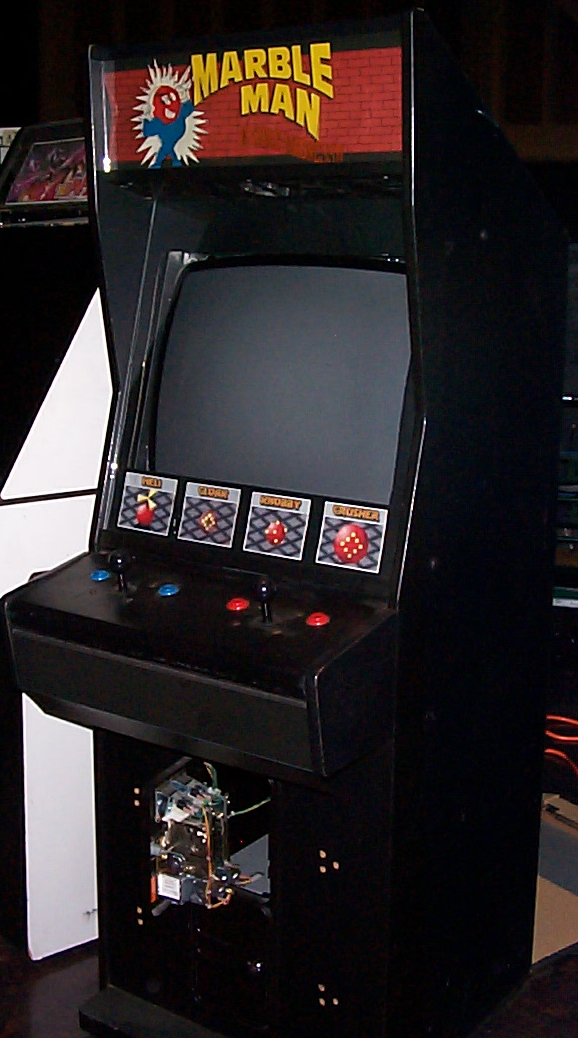
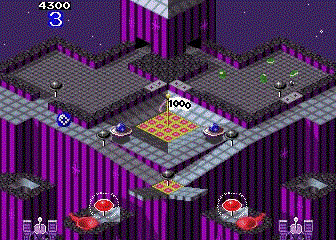
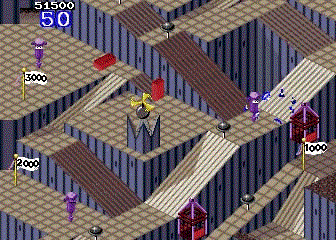
MARBLE MADNESS II / MARBLE MAN (1991) |
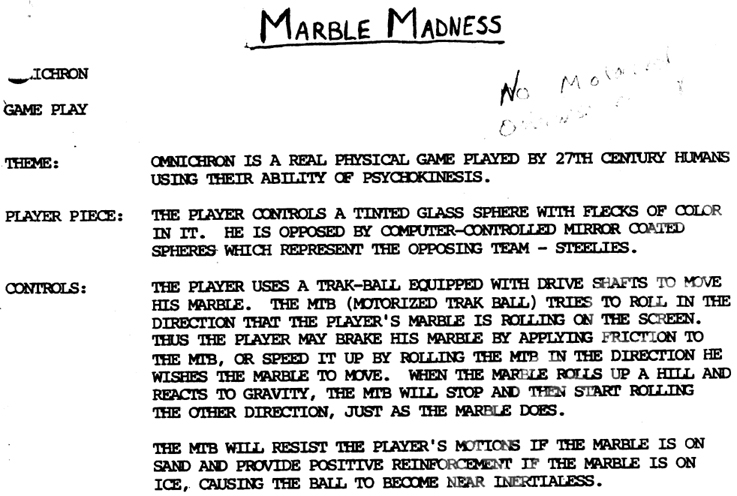
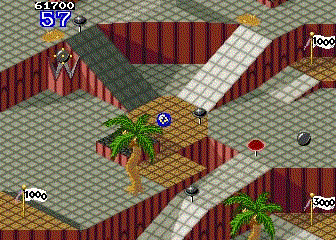
The game collected well while on field test, but was built during the Street Fighter era. Atari decided to produce Guardians of the Hood instead (a fighting game). Paperwork exists that shows Marble Man was actually approved for production, but the order was cancelled a few days later. The paperwork shows that 750 kits dedicated units were to be produced, followed by 3,000 kits.
From Michael Albaugh:
|
Side note: Marble Madness was originally proposed to have a force feedback (and illuminated) trackball, and I have seen the prototypes, but again 'Too costly' ruled the day, as it did with Marble Man, which I believe suffered from the switch to joysticks. |

|
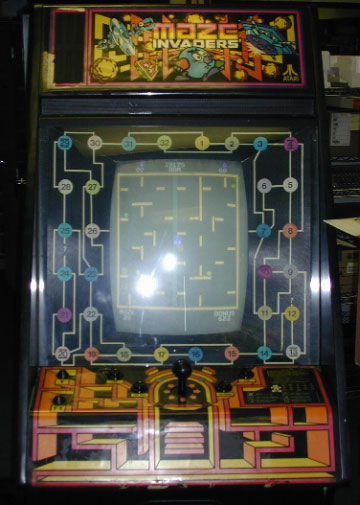
MAZE INVADERS
(1981) |
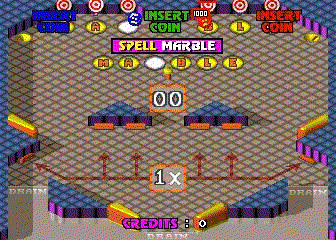
A cross between a maze game and a shooter. Collect all of the fruit in mazes with moving walls while avoiding various enemies. Some enemies can be destroyed with shots while others are only stunned. Even if copyrighted 1981 (MCMLXXXI), this game got to field test (June, 1982), but obviously failed field tests. 2 machines exist. Test screens from Maze Invaders were in the movie Cloak and Dagger. According to Ed Logg, the game was inspired by Pac-Man in a way. From Ed Logg:
|
It was a cute puzzle-like game. It was a maze-like game but the maze changed dynamically. The main character was very Pac-Man like; he was cute. There were some parts that I found frustrating, such as when the maze would temporarily block me off. I could not resolve this frustrating aspect, which is probably why it failed. I was not sad it didn't make it; it did not earn enough on field test. My son loved the game though and I still have one of the two prototypes in my garage. The other was purchased by an operator in Texas, I believe. He loved the game so much he talked Atari into selling it to him. |
Designed and programmed by: Ed Logg (ED)
Default High Scores table :
39175 BBM
38254 ED
37830 DUG
36520 ED
35478 LOG
23084 DUG
22227 SNY
21916 DER
|
MEAN STREAK (1998) |
Steve Ritchie was the project manager. This was to be his next game after California Speed. It ran on a PC-based boardset. It was cancelled around ‘98/‘99 and never even got location tested.
|
METAL MANIAX (1994) |
A demolition derby-style game. The game comes in a twin sit-down cabinet that is truly massive. The seats move with the action and slide around when hit. There are two speakers mounted on each seat plus the rumble sound of a subwoofer under your seat. There are speakers in the top of the cabinet giving you four points of audio, creating a 3-D surround effect. Interestingly enough, the name Carmageddon is written on the side art, but this prototype was developed quite a while before the hugely successful PC game of the same name. The machines were linkable. There was an extra stand that went in between the linked machines (four drivers total) which had massive starter lights (like a drag racing 'Christmas tree'). These units were simply comprised of lights in a tall box molded to the shape of the cabinets.


|
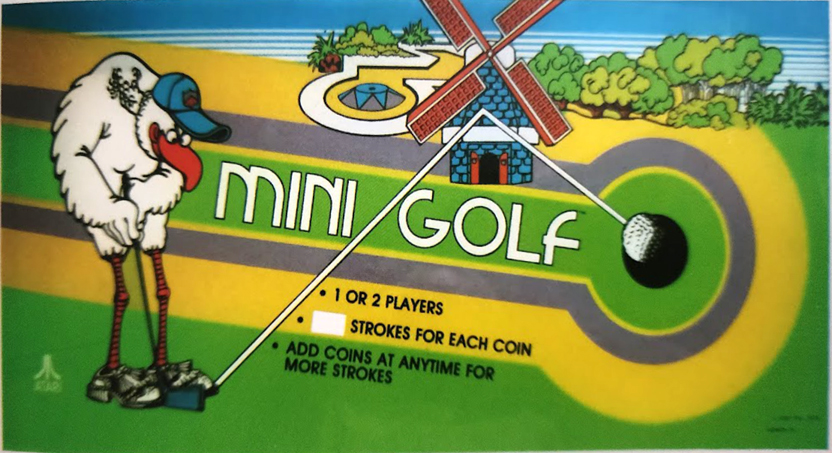
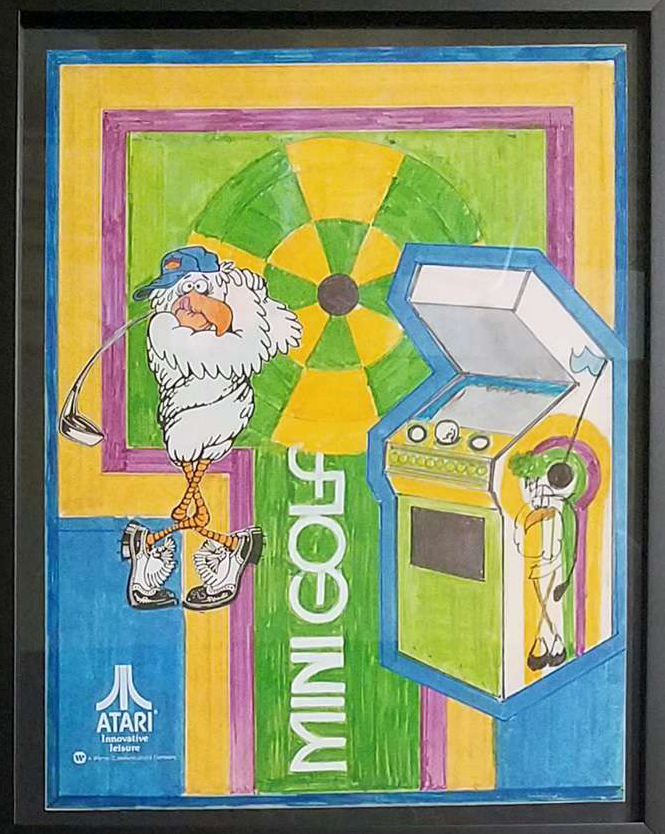
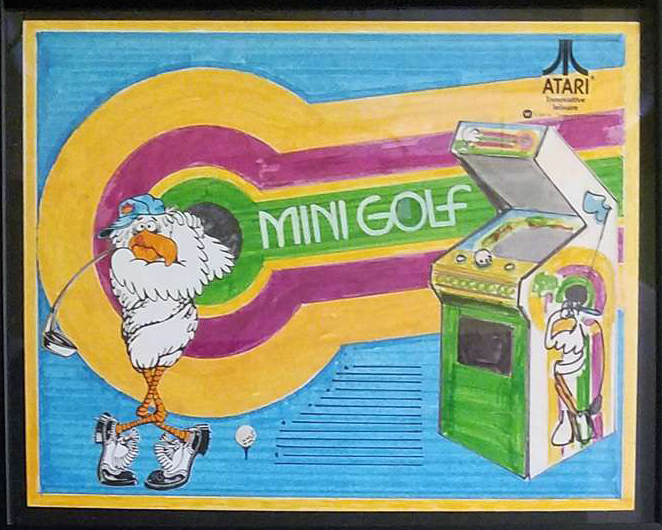
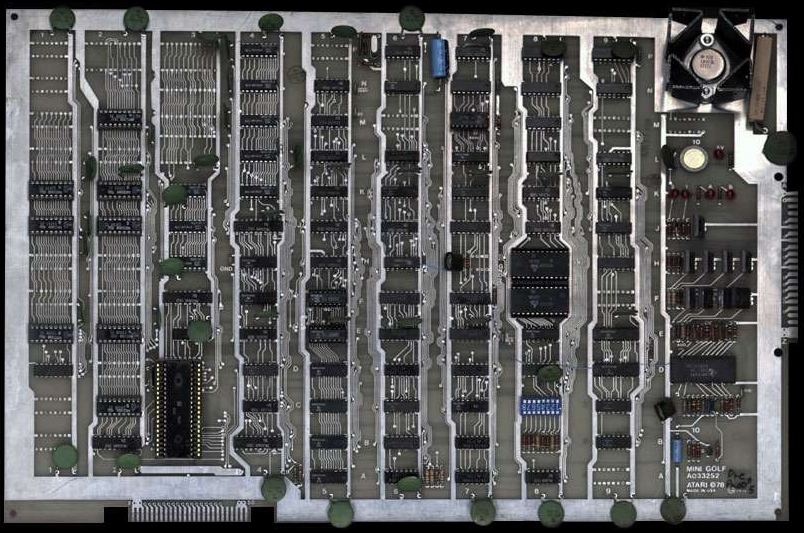
MINI GOLF
(1978) |
A completely developed game that featured unique controls that was unfortunately never released.


|
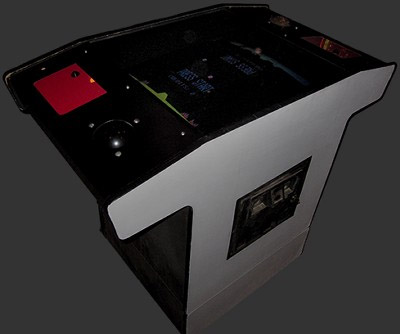
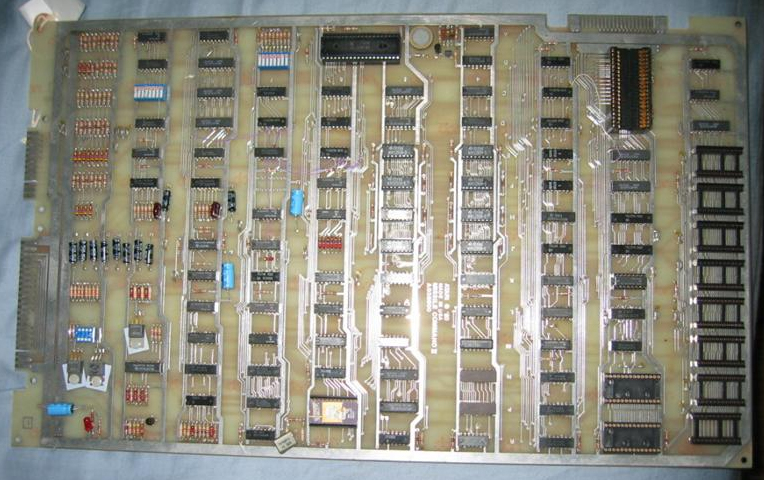
MISSILE COMMAND II / MISSILE COMMAND DELUXE (1982) |
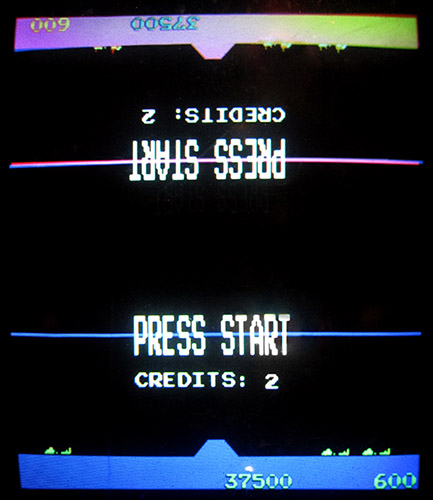
2-player co-op version of the original where you have to defend your cities, and if you have any missiles left over, you can help defend the other player's cities.
|
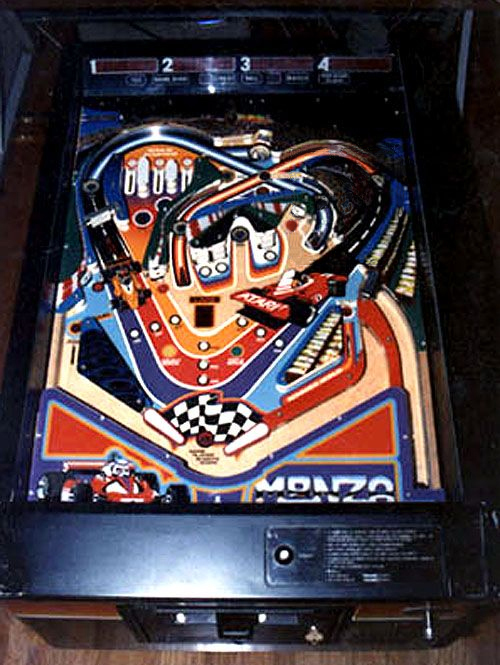
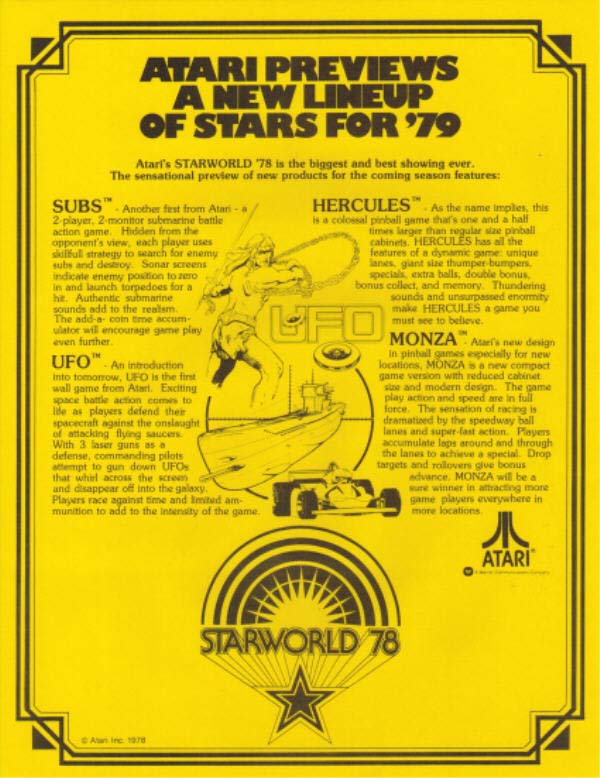
MONZA (pinball) (1980) |
Game existed only as a prototype, but no longer exists. It was reported to have been converted to 4x4, but how this was done is not known since 4x4 is an wide-body upright and Monza is a cocktail table game. It's possible it was just stripped for parts.

|
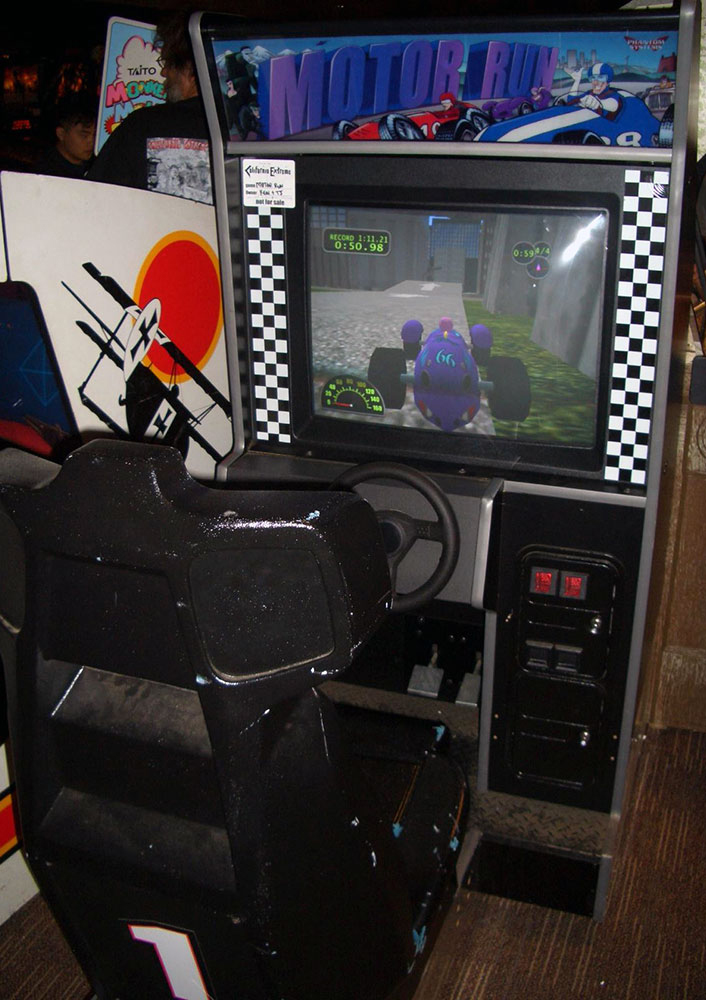
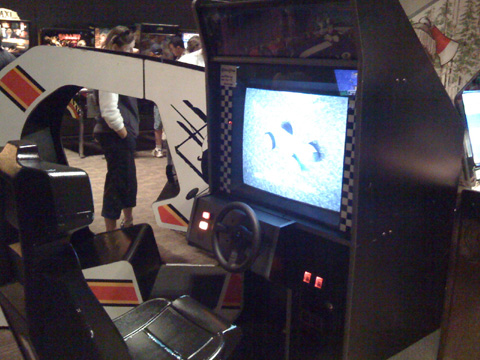
MOTOR RUN (1990s) |
A polygon-graphics racing game with early 20th-century open-wheel race cars that don't have realistic physics. Apparently there's only 1 prototype in existence, and it was shown at California Extreme (CAX) 2008.
|
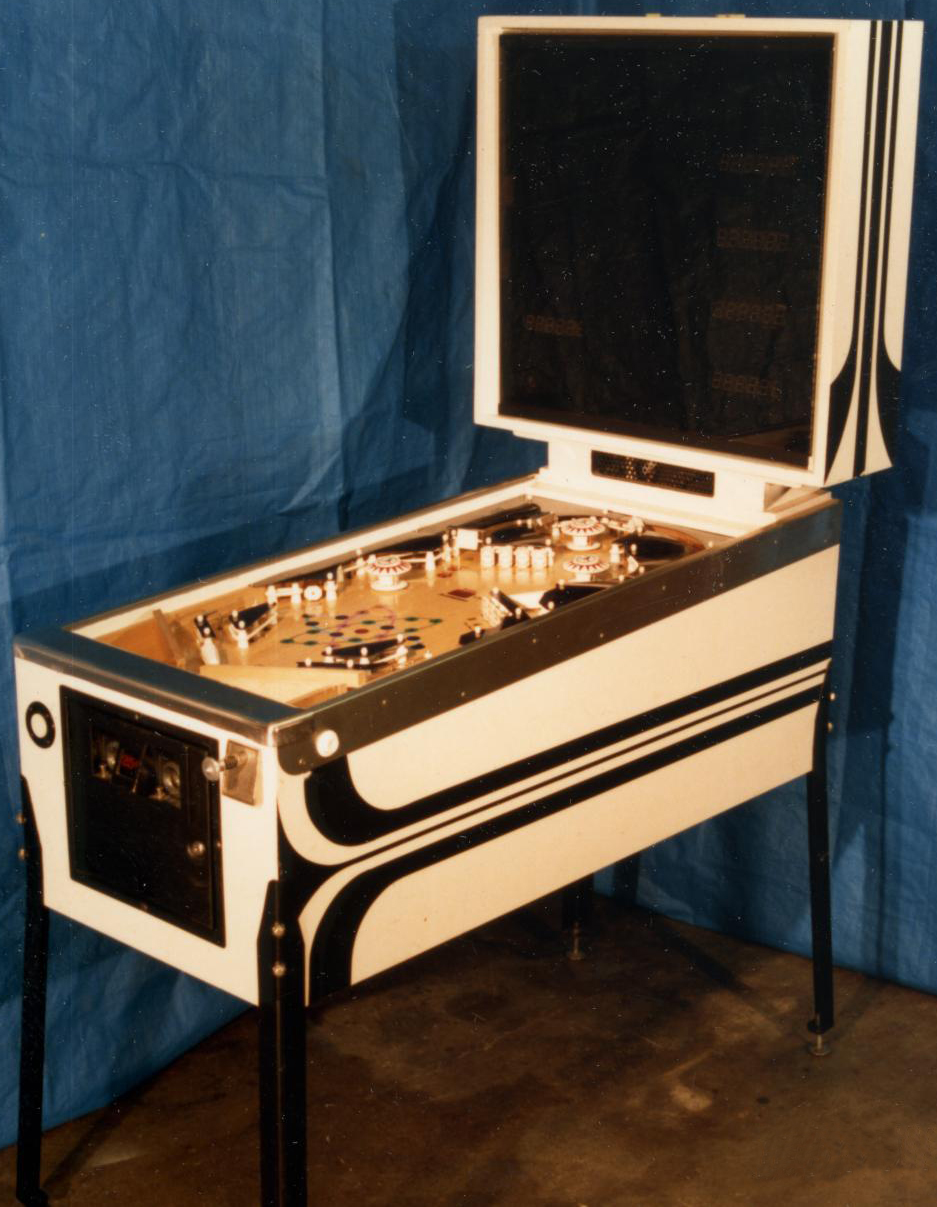
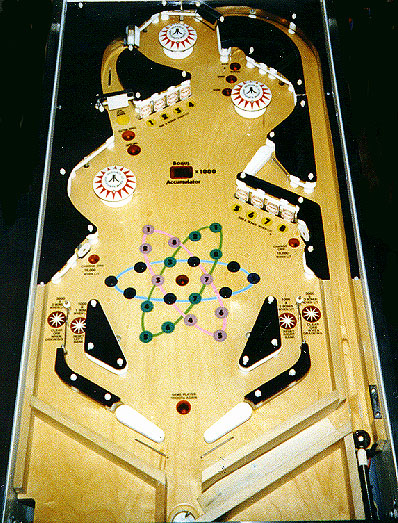
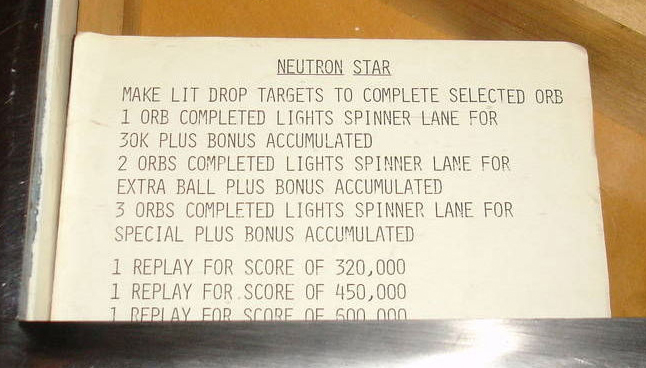
NEUTRON STAR (pinball) (1981) |
This narrow-bodied game did not proceed beyond the prototype stage, pictured here. It was fully developed operationally. Milt Loper took over the game design after Gary Slater, the initial designer, left the company. The dark playfield plastics and the backglass were made by the game owner. Former Atari employee Dan Kramer owned this prototype and brought it to the World of Atari show in 1998.
|
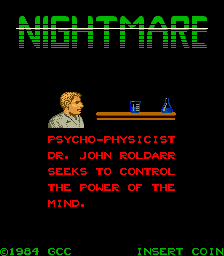
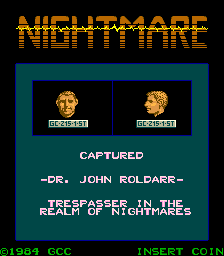
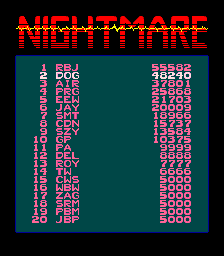
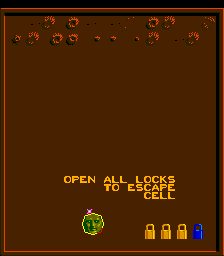
NIGHTMARE (1982) |
This was GCC's third original game (after Food Fight and Quantum). The pcb is a heavily modified Food Fight board with a large daughtercard. The controls are believed to be like Tron (triggered joystick and a spinner) so it may have been a conversion attempt that never made it.
|
NUCLEAR REACTOR |
Deemed a medium priority, according to a 5-23-80 memo.
|
OFFROAD |
This was a System I game being programmed by Jack Ritter.
|
ONSLAUGHT (1982) |
|
PARKING LOT (1982) |
|
PIN DUAL (pinball) (1980) |
A combination video game and pinball game; the two player version of Video Pinball. Also known as Dual Pin. May have been the original name for Hyperspace. Deemed a medium priority, according to a 5-23-80 memo.
|
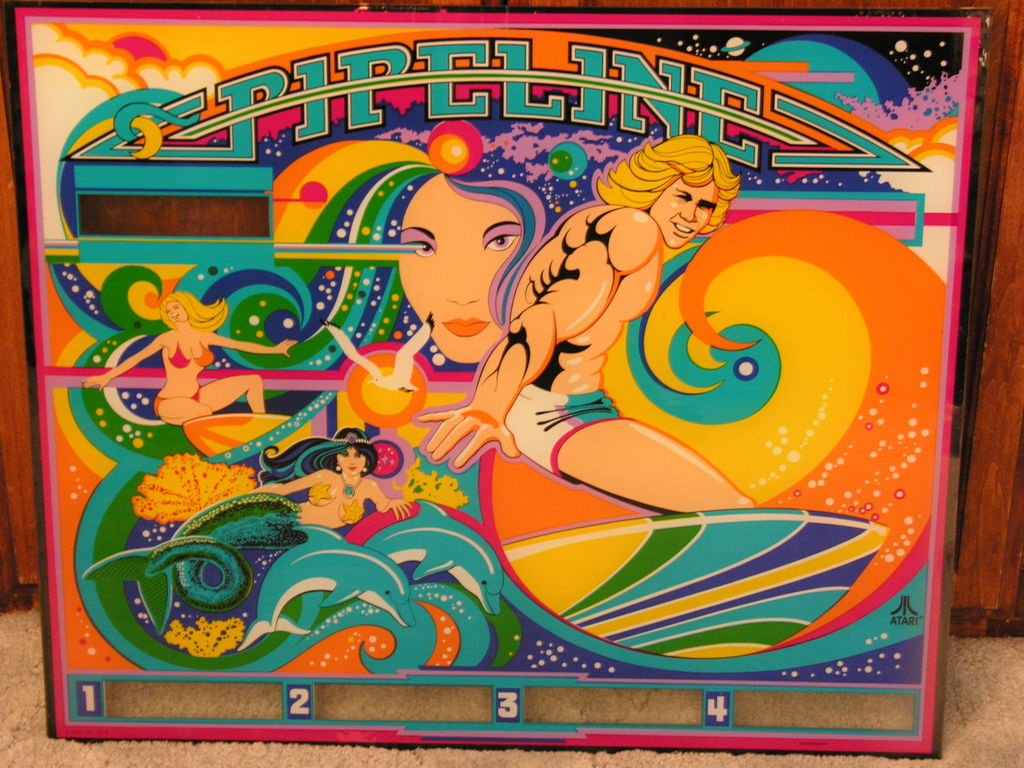
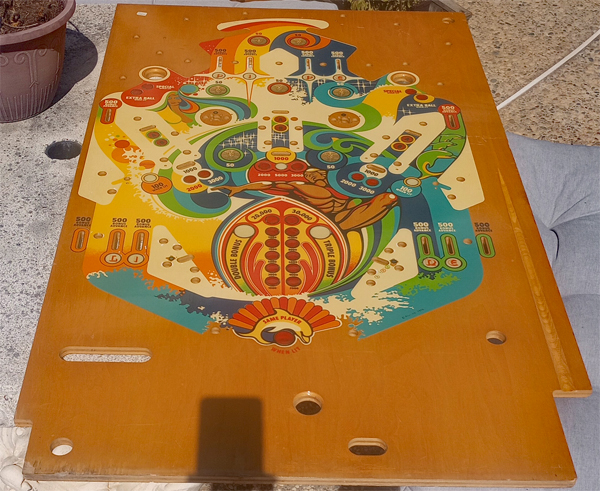
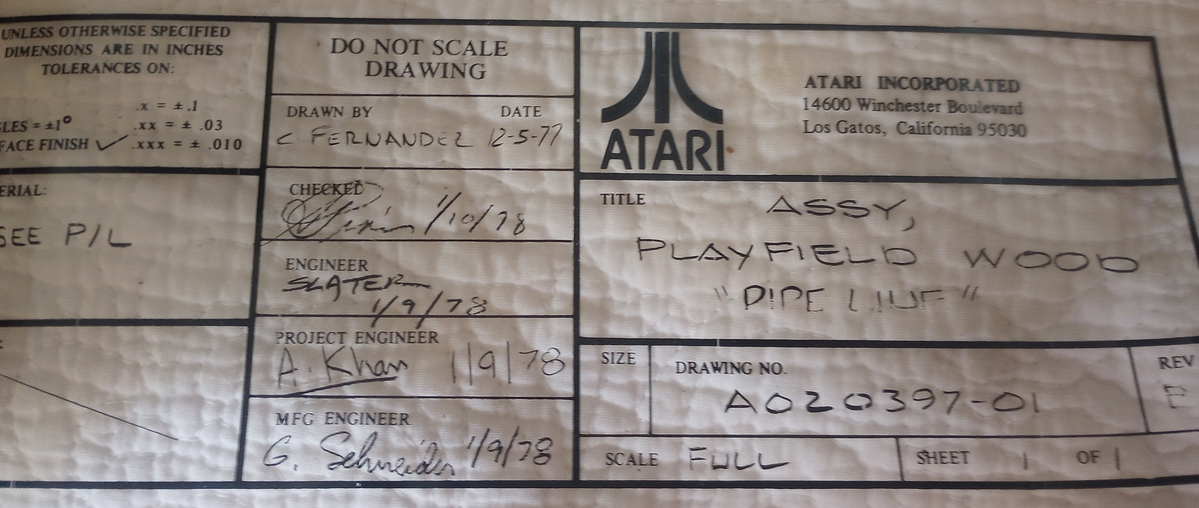
PIPELINE (pinball) (1978) |
The engineering drawing pictured here indicates it was drawn by C. Fernandez and the Engineer was Gary Slater. It's possible C. Fernandez was Claude Fernandez, who was a designer for Williams and Bally starting in 1980. The playfield layout of this game is nearly identical to Atari's Space Rider, which Gary Slater designed. From Dan Kramer:
|
I got this backglass from another former Atari employee in the late 1980s. Actually, I was told that a pilot build of 50 units was planned and parts were allocated. I tracked down a [different] guy around the late 1980s who had saved for ten years everything to build one, except a backglass and cabinet. A month before I ran across him, he got tired of hanging onto the stuff and took it to the dump. He gave me a single drop target with the imprint of a naked foot ("Hang Five"), which I still have. |

|
PIT-FIGHTER II |
Deemed a medium priority, according to a 5-23-80 memo.
|
PLAYLAND (1983) |
Developed in 1983. The Return of the Jedi hardware was used for the initial development. Peter Lipson was the main person involved with its development, and he noted when he left the project in December 1983, the cost and technical difficulties left to solve pretty much doomed the game from being completed. The game was based around a rollercoaster and features a jester character (picture #1). Some source code exists. 2 U-matic tapes and one Beta tape exist showing footage of the game, which are in The Strong museum.

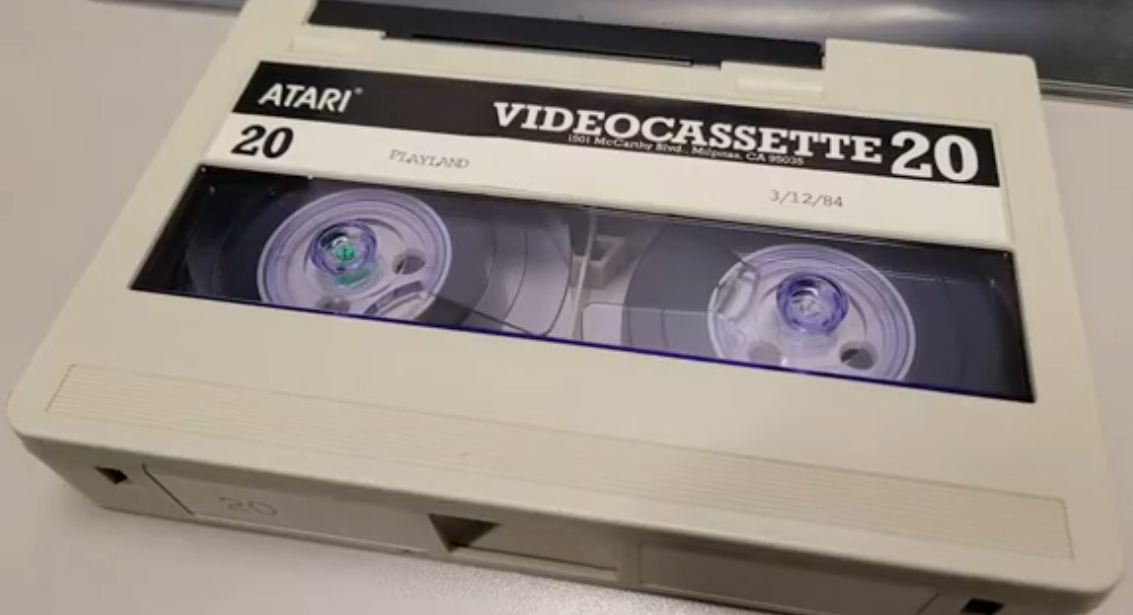
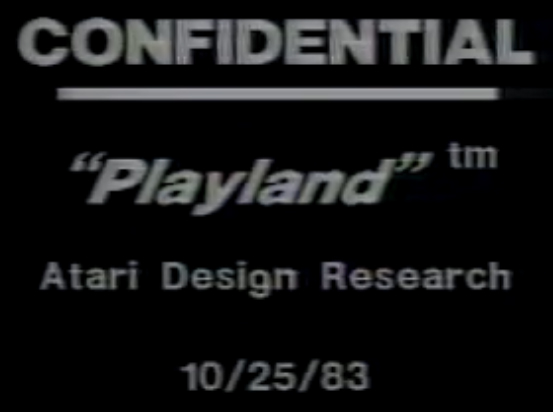
Hidden in the Golf Trainer laserdisc footage is a picture of Carrie Fisher in her iron bikini outfit from the Star Wars: Return of the Jedi movie with the same jester character behind her (picture #2)!


|
POWER GEM (1982) |
|
PRIMAL RAGE II (1996) |
|
PT COMMANDER (1978) |
From Owen Rubin:
|
This 1978 game was never released. If I recall, this game was started by someone else, I cannot recall who it was however. The game idea was two "PT" boats on opposite sides of the screen, who would drive out and either attack each other or attack the other person's dock. But you could only hold two torpedoes and had to return to the dock to get another. Unless of course, your dock was blown up. I recall we used some graphics for the dock, illuminated with a half sliver mirror, so the boats appeared to rise over the graphics. We had incandescent lamps that could be controlled by software, and used them to show off the explosion of the docks. As you can imagine, the game was not much fun! |
|
QUINK (1985) |
Source code has been recovered from one of Atari's VAX systems. The game derives from another company and was planned to be converted for use with Atari's System I hardware. Along with the source code was a text file with notes from Rusty Dawe:
|
To: Distribution
The source code and text files for the game "Quink" have
been transferred to the VAX and reside in KIM::[RUSTY.QUINK]. I have also
examined the files and source code in an attempt to gauge how long it would take
to translate this game for System I. |
|
QWAK! (1982) |
According to Michael Albaugh, this was a touch-screen puzzle game that never made it past focus group.
|
RELIEF PITCHER (1986) |
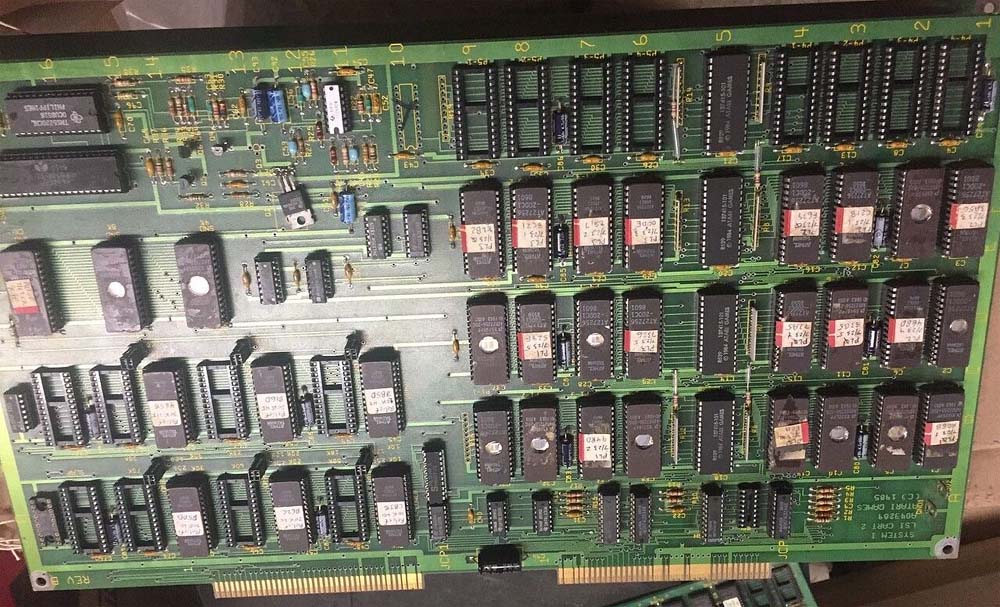
The original Relief Pitcher was originally designed for the System I hardware and would have probably been released sometime in 1986, but it most likely field tested poorly so it was never released. There's apparently 2 different styles of the control panel overlay. There was also no marquee for the game; the one shown in the first photo was custom-made. In 1992, Atari released a different Relief Pitcher game with different (JAMMA) hardware and gameplay.


|
ROAD RIOT'S REVENGE RALLY (1993-94) |


|
ROAD RUNNER (1983-84) |
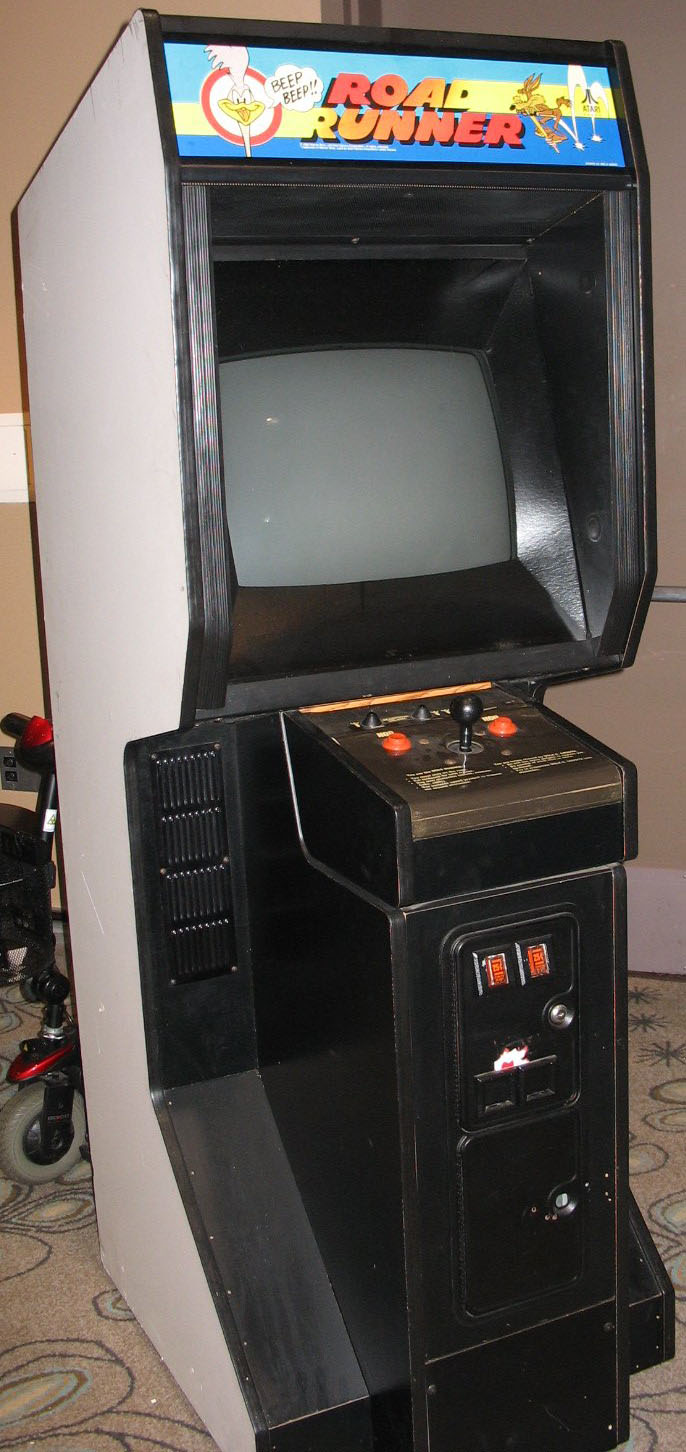
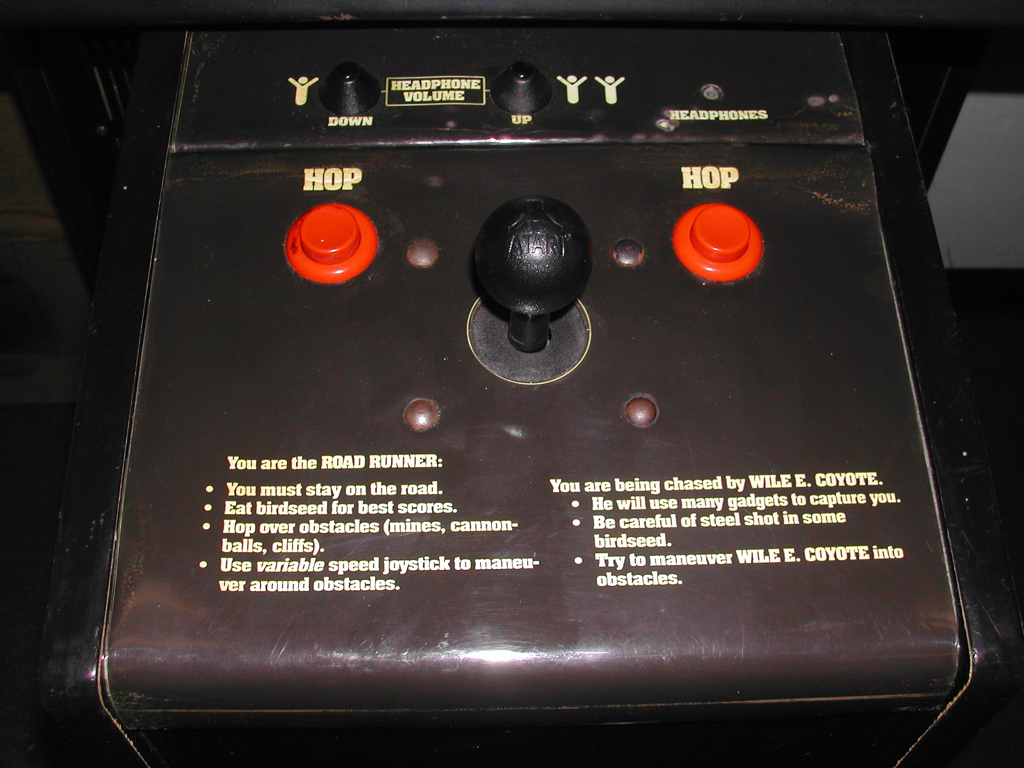
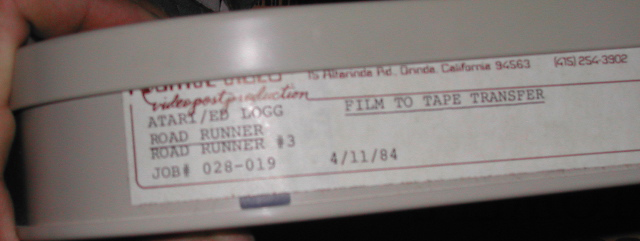
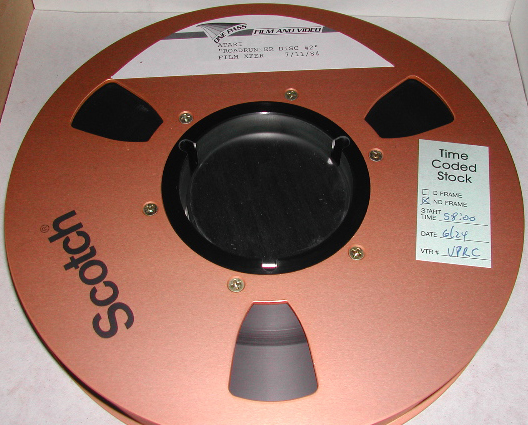
This unique laserdisc game used footage from Warner Bros. Looney
Tunes cartoon series. The Road Runner, Coyote, and other objects/obstacles
in the game were CG, while the road and background images were from the
laserdisc. When you died, the game would cut to a scene from the cartoon
series of the Coyote getting killed in one the many humorous death scenes.
Before the game was released, Atari decided that laserdisc technology was not
the way of the future so Road Runner was shelved. A year later the game
was released as a conversion kit for their popular System I cabinets, but as a
CG-only version. The road and background images were now CG and all of the
cut scenes were removed.
From Ed Logg:
|
It was based on Road Runner created by Chuck Jones. The player played the part of the Road Runner who would try to have Wile E. Coyote fall prey to some trap. I had Time Warner send me all of the Road Runner cartoons. I watched every one and selected the best shorts to be included on a laser disk. So when you succeeded in getting Wile E. destroyed, the game would cut from the action to a similar scene from a cartoon where Wile E. met his usual fate. I always loved the Road Runner and I thought I could bring him to a video game. When I started I had a vision of something unique. The game certainly met that criterion but it was not as fun as I had hoped. I certainly enjoying seeing all the old cartoons and meeting Chuck Jones but laserdisc games were failing in the coin-op world because of reliability problems. The game actually earned enough to warrant interest but not as a laserdisc game. So when they asked me to port it to their new System I hardware, I declined, saying I had another idea I wanted to pursue. I am glad they let me pursue this new idea because this idea became Gauntlet. Road Runner was converted over to System I and actually was released. |
From Owen Rubin:
|
It used video game graphics for the game play almost identical to the game that was released except that it used LD video instead of graphics for the background. Very cool to have the game graphics go in and out of cartoon footage. When the Road Runner would "get" the coyote (like making him fall off a cliff or hit a truck) the game would pause and a LD "video replay" would show a real cartoon segment with that same thing that just happened. For example, in the game where the coyote has to avoid stepping on the land mines, when he does, the game shows him getting blown-up in graphics, and then (not always) a video would show a real cartoon excerpt from a Road Runner cartoon of the coyote getting blown up. It was very cool. |


|
ROAD RUNNER (pinball) |
|
ROBOT REBELLION (1984) |
Created by Vidmax in 1984 and to be distributed by Atari .
|
ROCKET LAUNCH (1980) |
|
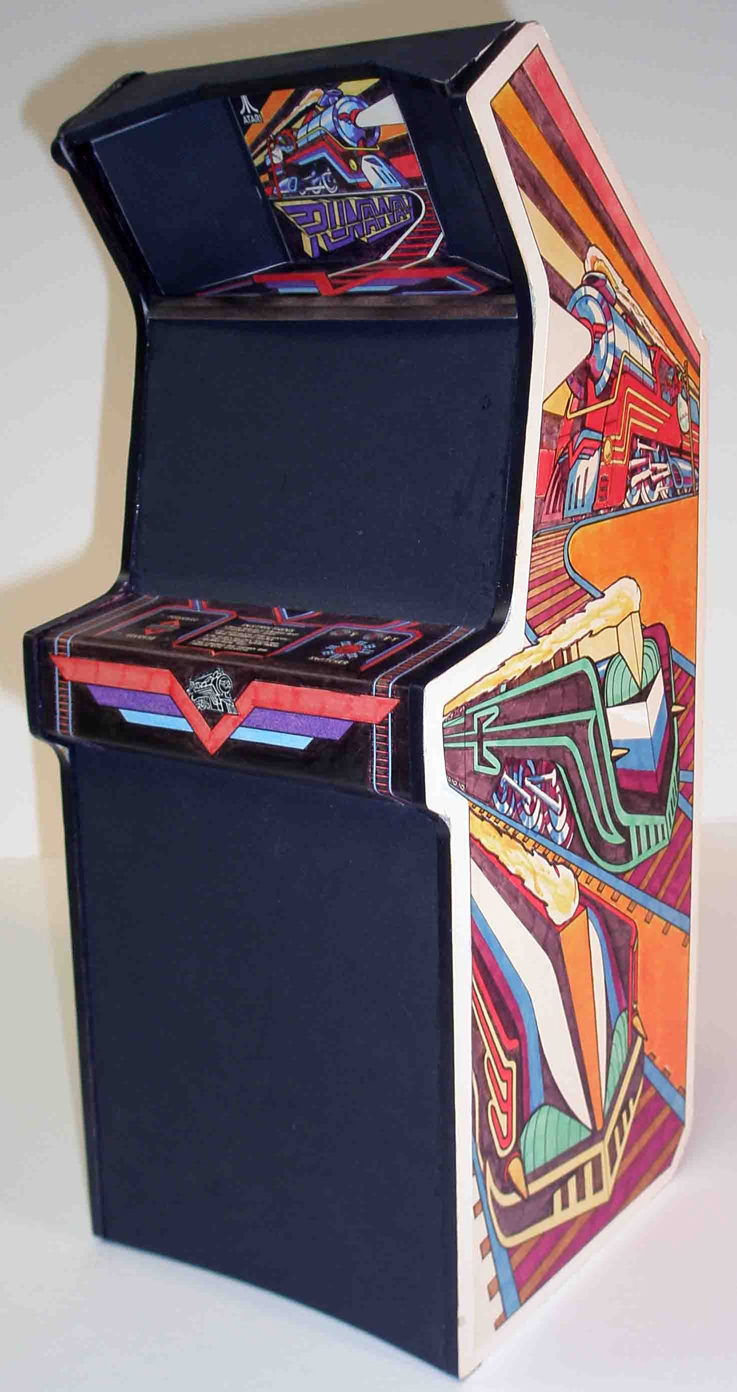
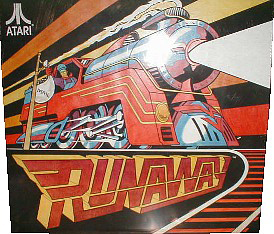
RUNAWAY (1982) |
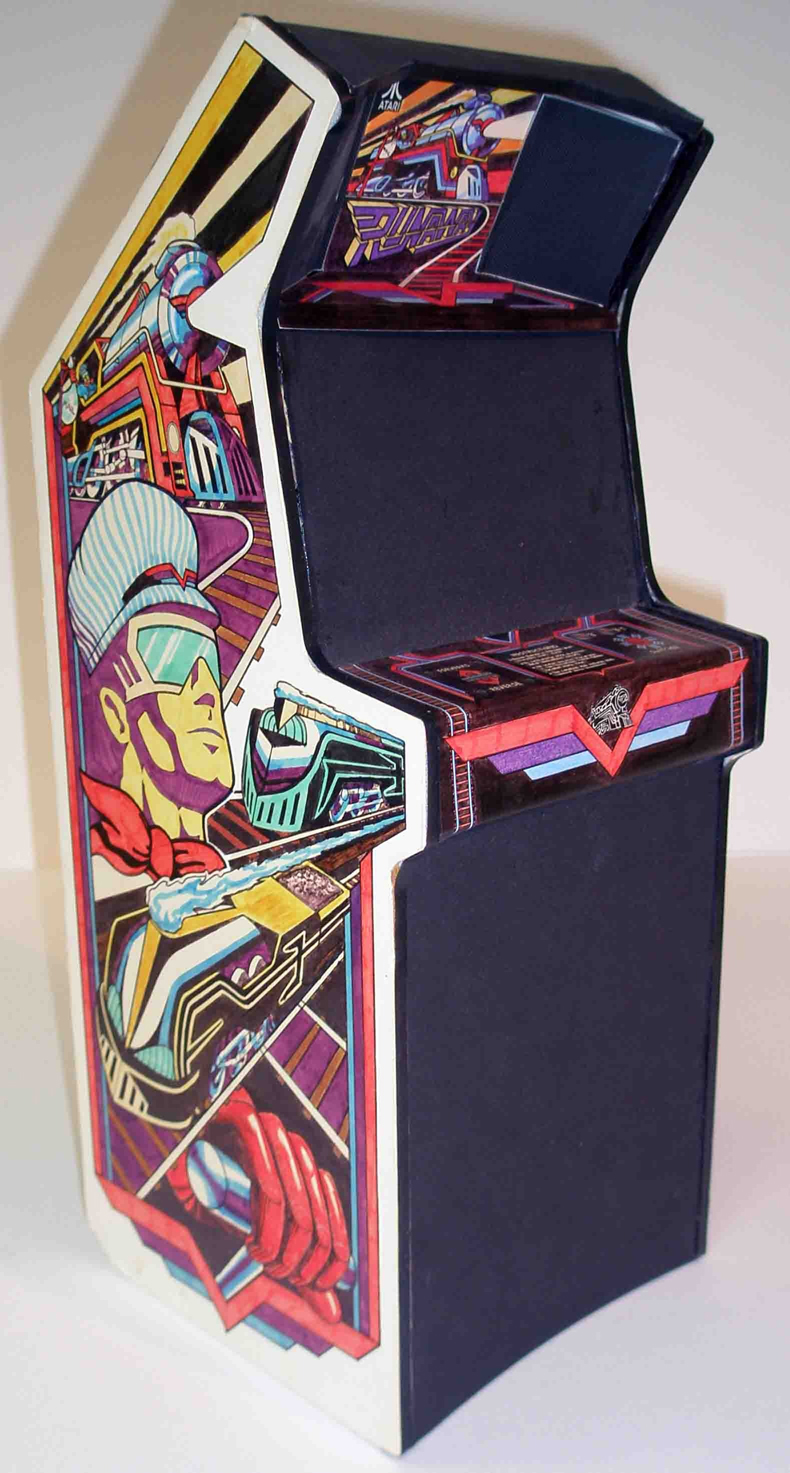
A train/maze game. Field-tested in early 1982 to below-average results, mostly due to the reversed controls.
|
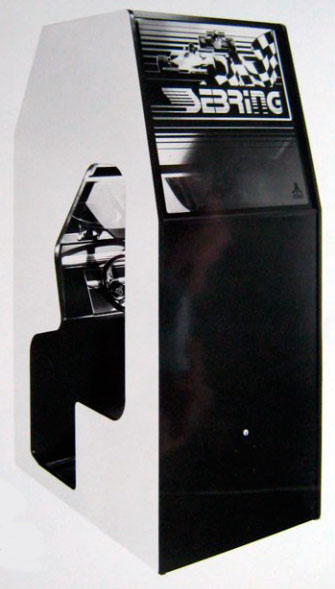
SEBRING (1979) |
Owen Rubin and Michael Albaugh worked on this. From Owen Rubin:
|
Ah politics. Sebring, I forgot that game. There was a company (Namco) that had just come out with a mechanical game called F-1. This was a driving game where they projected a circular track and your car at the bottom. You had to drive the track and not hit the sides. Other cars would come around the corner and you had to avoid them as well. OK, we did this as a video game. We had a 25" monitor in a VERY large cabinet. The monitor was actually ABOVE the player and reflected in a mirror that added a 3D like feel. It was great. We put it out on test and it did great as a 50 cents game. New for that age. But Steve Calfee, my boss, was also working on a driving game and Atari marketing only wanted one driving game. It was kind of like Super Bug, an overhead view driving game. His was cheaper but never earned above 3rd place in the arcades. But guess who got to choose? |
From Michael Albaugh:
|
Owen and I realized that we had some leftover ROM space in Sebring, and arranged for it to work (after a fashion) with the two ROM chips swapped. Most games at the time started with a brief self-test, that displayed "RAM OK" and "ROM OK" (or, of course "RAM BAD" etc) and then either started the game attract mode or the more extensive diagnostics. If the ROMs were swapped, the message would be "RAM OK" and "ROM KO", and if the test switch was off (to go to the game) would trigger an explosion sound and show "THE ROMS ARE IN BACKWARDS". |
From Jed Margolin:
|
Sebring was developed in early 1979, ostensibly to use up a supply of 25"
color monitors. It was a sit-down game with a curved projection mirror.
The monitor was mounted on top of the cabinet. It was a first person game,
using the stamp hardware that was used back then. |
|
SECRET AGENT (1980) |
|
SHOOTING WORLD (1990s) |
A shooting game that runs on Atari Media GX, which is based on PC hardware.
|
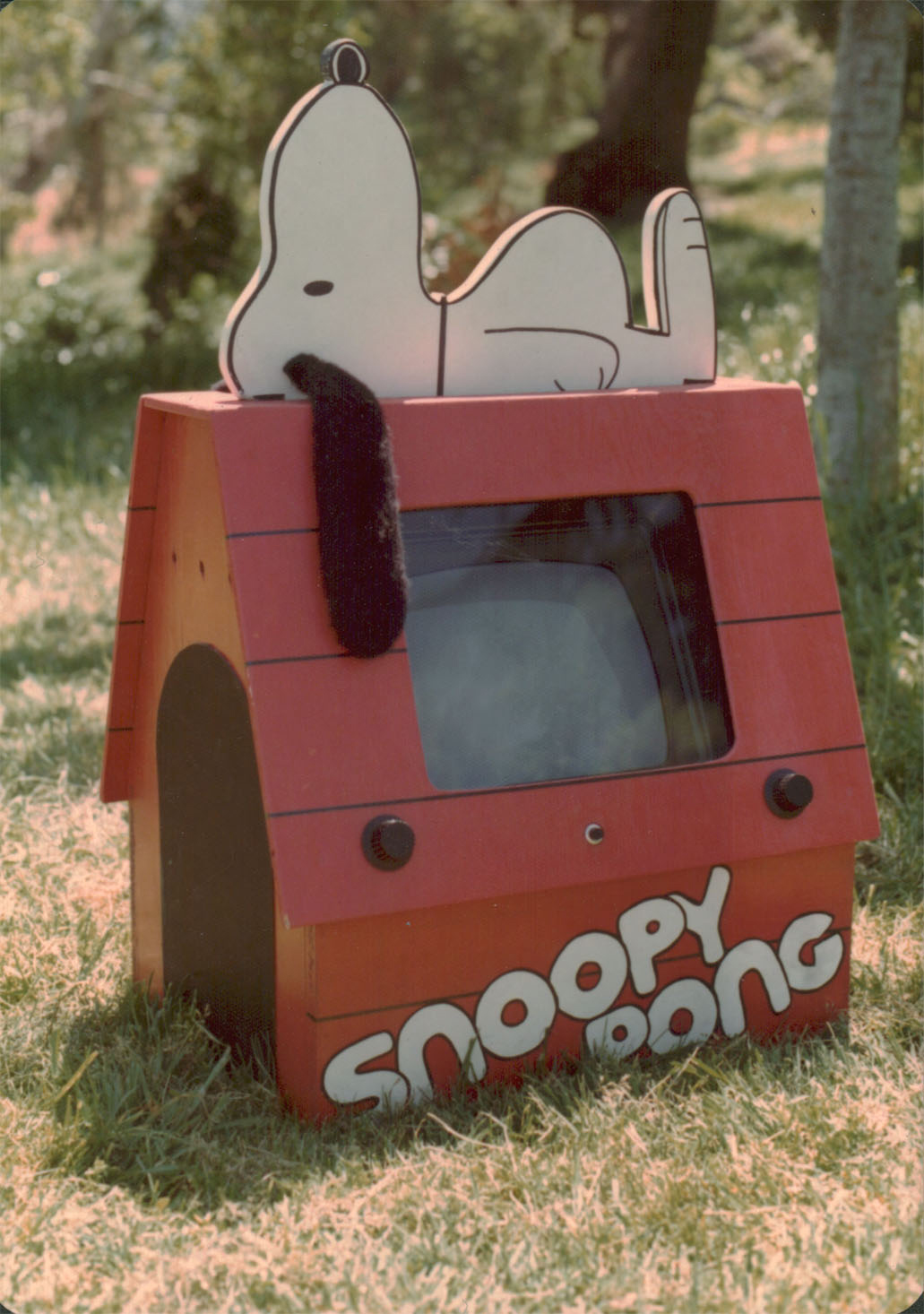
SNOOPY PONG (1974) |
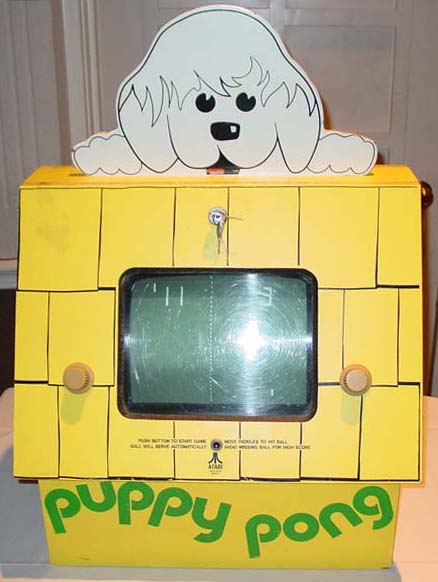
Created in 1974, though some incorrectly date it to 1973, Snoopy Pong was the original prototype for what became Puppy Pong. This is a tabletop game featuring the famous Peanuts character on his dog house. It's configured for free play; there's no coin slot or coin mechanism, and you simply press a button to start the game. Atari apparently never sought approval from Peanuts creator Charles Schultz to use the character, leading to Shultz threatening a lawsuit, and only one Snoopy Pong unit was ever developed. The game was redesigned and released as Puppy Pong.
|
SPACE DOCKING (1980) |
Deemed a low priority, according to a 5-23-80 memo.
|
SPACE LORDS (1985) |
A memo found on an old Atari VAX backup tape describes a game that was far different from the version released in 1992, as it was originally intended to be similar to Warlords:
|
Space Lords 1985
Project Team:
This new game is a take off on the old coin-op game Warlords. There are
some elements of this game which have been taken from Asteroids. This game
will be available as a 4 player version on the Gauntlet hardware and cabinet.
A 2 player version will be available for System I. There were 2 styles of Warlords built. The cocktail was a 4 player color monitor version. The upright was a two player black and white monitor version. About 3,100 Warlords were built: 1750 cocktail and 1350 uprights. There was also a VCS Warlords cart.
I will discuss below the game features for the 4 player version of the cabinet.
There is section later which discusses the differences between the 2 player
System I game and the 4 player version. The player will have a button called the action button which will have three different modes depending on the wave. The first mode is "capture" mode where it will act like the Warlords button where the player can capture a comet and hurl it at someone else. The second mode is the "stunner" mode where it will send out "stun waves" which will stun other players deflectors and perhaps modify the motion of the objects on the screen. The third mode is "laser" mode where it will act like a laser gun. The laser shot can destroy or split asteroids which are floating about the screen. This laser shot can also be used to reduce the size of the other players deflector. There is only one shot per player.
The player can also repel objects by using a shield button which will repel all
objects in his quadrant. The player will be given 2 seconds of shield
power on each wave just like Asteroids Deluxe. When the player has held
down the shield button for a total of 2 seconds then he will have no more
shields.
4.1 Deflector Mode
4.2 Comets, Asteroids, ...
4.3 Number of Ships
4.4 Different Computer Ships
4.5 Saucer
4.6 Wraparound
4.7 Momentum
4.8 Destructible Deflectors
4.9 Mines
4.10 Laser Shot Distance
4.11 Change Deflector In a 3 player game there will be a computer opponent added and the first two players eliminated are out. If first-one-out is set then only the first to be eliminated is out. If the computer is first one out then the computer will get harder on each level until a player has been eliminated. In a two player game there are two possibilities. The most likely implementation is that the first two eliminated are out. Any computer ships eliminated they will become harder. The other alternative is to use the same algorithm as Warlords where the players are not eliminated until one of the computer ships wins a level. In a one player game the player will be eliminated if he does not win.
A pinball style match feature is a possibility for any players eliminated. |
|
SPACE RAIDERS (1980) |
Deemed a low priority, according to a 5-23-80 memo.
|
SPACE SHOOT (1981) |
Deemed a low priority, according to a 5-23-80 memo. From Howard Delman:
|
Space Shoot was the game I was
working on when I left Atari in 1981 to start Videa. It was a one man show
-- I was the project engineer, hardware engineer, and programmer. The idea
for the game came from a newly released movie, although I can't remember the
name anymore. In the movie, there is a scene in outer space, in which a
young man is being trained to "fight the bad guys". Bright colored disks
are being launched into space, and he is trying to hit them with a hand held
weapon. Basically, it was skeet shooting in outer space. |
In my 2007 interview with Howard Delman, he stated the game was based on the 'trap shooting' scene from The Last Starfighter, but the problem with that is the movie was released in 1984 - 3 years after he left Atari. From Howard Delman:
|
I also worked on a game at Atari called Space Shoot. It was loosely modeled after a scene in the movie The Last Starfighter, in which the hero is being trained to use a futuristic laser type weapon to shoot brightly colored orbs out in space. I designed some hardware for rendering multi-colored circles, and created what was, in essence, a skeet shooting game. One of Atari's mechanical engineers designed a cool-looking "space gun" for me, and I had a reasonably fun game coming along. But in the middle of the project I left Atari to start Videa, and the project died with my departure. |
There was a skeet shooting space scene in the 1979 movie The Black Hole, but it involved robots playing the game.
|
SPACE STATION |
|
SPACE STORMS (1978-79) |
From the Atari Games Museum Facebook page:
|
Here is a game i found in my Atari archive. It's an unreleased game like Avalanche. I built it from the original source code using the original Atari tool chain. Space Storms plays pretty much like Avalanche with several variations. The play area is narrower, the objects fall faster, and you can miss more objects. |
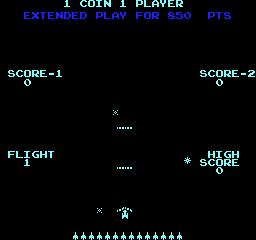
|
SPARKZ (1992) |
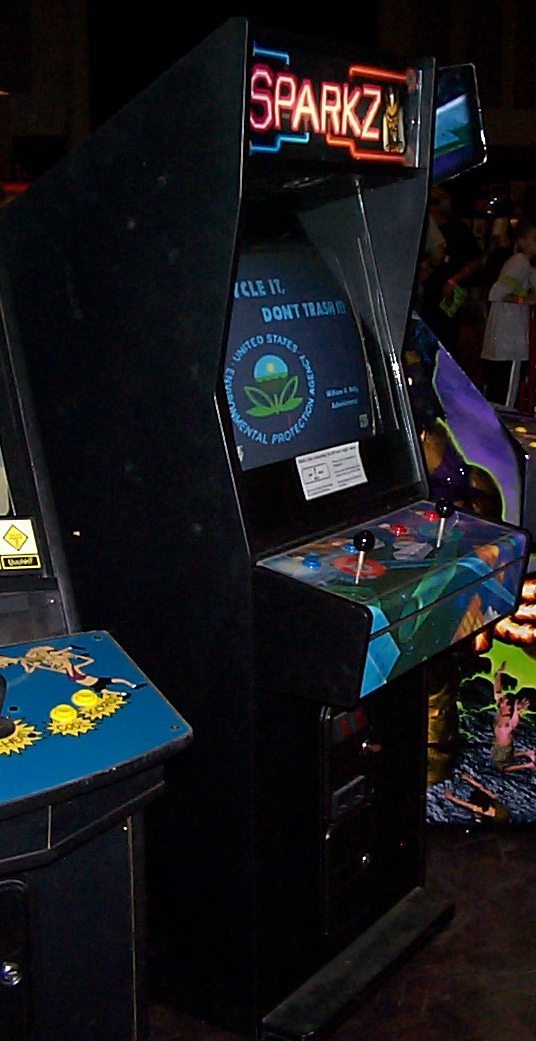
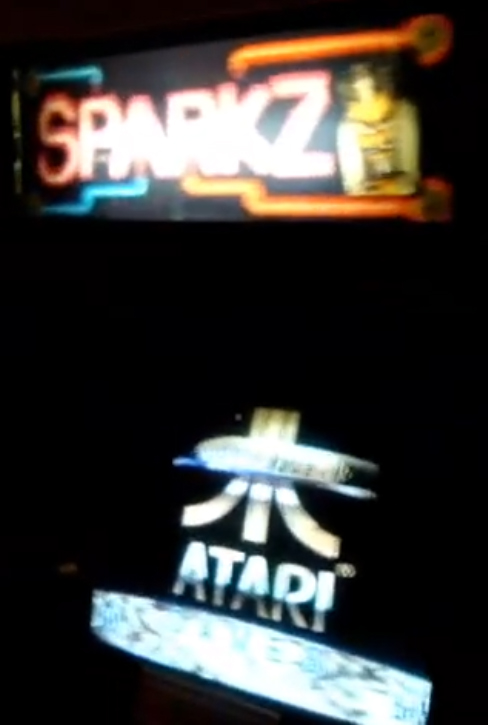
|
SPOOK (1984) |
Possible laserdisc game (according to this site). From Steve Englehart's website:
|
I designed Spook - at least, the original version -
with a guy I liked a lot at the time but whose name escapes me now (the
down side of moving into and out of the industry). If he's reading
this: please get in touch. It was going to be an arcade game; its
transition to a computer game must have come post-Tramiel. My
buddy and I spent several days cruising Silicon Valley, exploring "spooky"
houses pointed out to us by local realtors, and of course we visited the
Winchester Mystery House on Atari's dime. If you're not familiar
with this place, Sarah Winchester, wife of the man who invented the
Winchester rifle, was warned by a psychic that she was haunted by the
ghosts of everyone the rifles killed, and she could only survive by
building a mansion that would never be finished. So the house is
filled with projects that are essentially busy work: stairways that go
nowhere, windows in the floor, and a door opening onto an 8-foot drop into
a kitchen sink. |
Note that the screenshot on Englehart's website is for an Atari ST game under the same name from a different company that was released in 1986. That game is nothing more than a Pac-Man knockoff (LINK). Considering the Atari ST doesn't use cartridges, I have no idea what Englehart is talking about.
|
STAR TRAP / STAR TRAP 2000 (1982) |
Designed by David Theurer?
|
STAR WARS: RETURN OF THE JEDI (1983) |
Hidden in the prototype Road Runner laserdisc footage is a “Coming Soon!” picture.
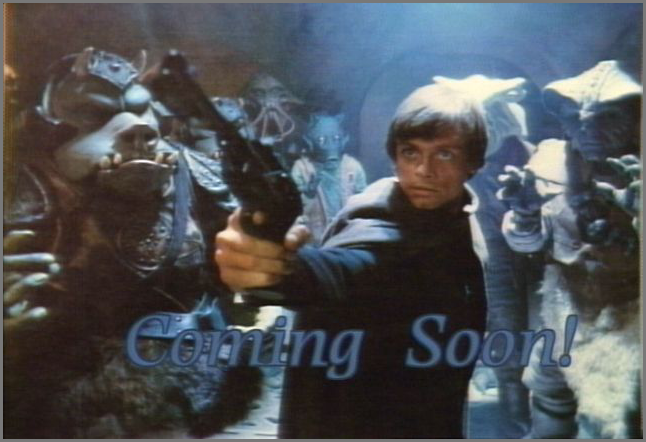
|
STARSHIP X (197?) |
Development name for Starship 1.
|
SUPER MAN / ORION XIV / SOLAR WAR (1979-80) |
A kind of sequel to Video Pinball. 5 units were built and around 300 kits sold to a Greek company. Originally to be called Superman but the licensing deal fell through and they needed another name to fit the 5-3 pattern (because of the drop targets). Deemed a medium priority, according to a 5-23-80 memo. From Michael Albaugh:
|
I was tapped to do another game that became Solar War (after being Superman, Orion XIV, and possibly a few other names), to soak up leftover Video Pinball PCBs. We added some ROM (to allow, e.g. selectable message languages) which meant moving some of the I/O. Anyway, those changes were to go into a "new board" *if* we sold out of the initial "recycling" boards. So the software was written to be configurable for either board. This was how I got hit by karma for suggesting the minimal-chip ball circuit. But it was fun, and Dave Theurer (IIRC) pushed that digital sound generator pretty far. Also, it occurred to me that not everybody knows that Solar War and Orion XIV were candidate names because the underlying playfield and rules were based on Superman, which had a five and three letter spell-out for bonus. |
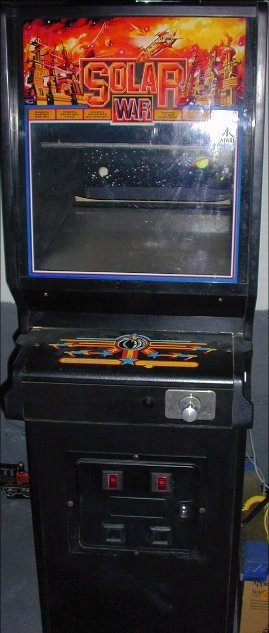
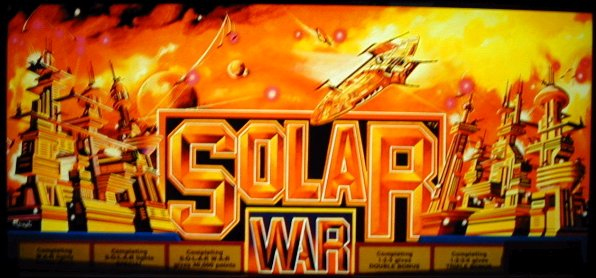
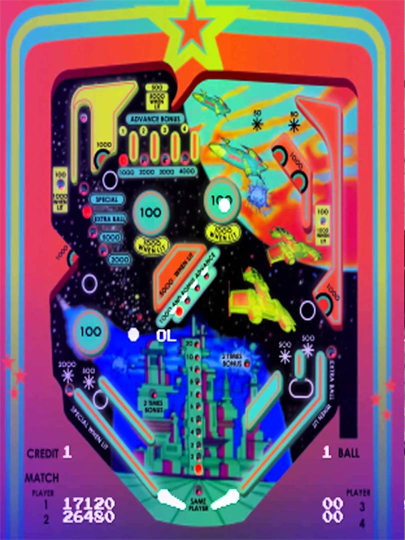
|
TANK (1994) |
This was the early in-house name for T-Mek.


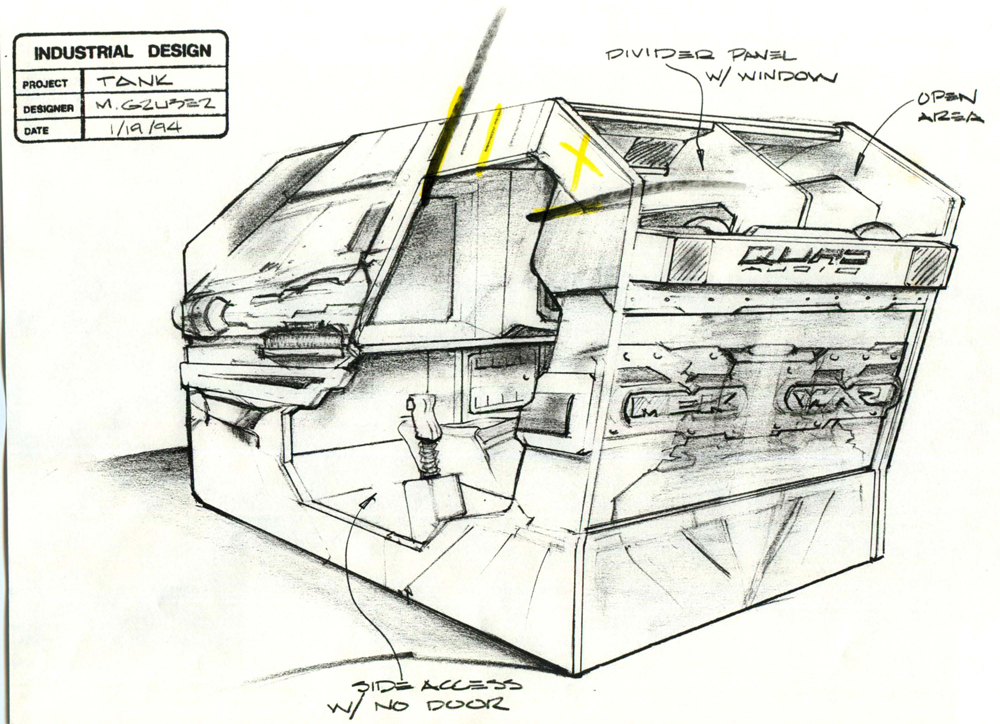
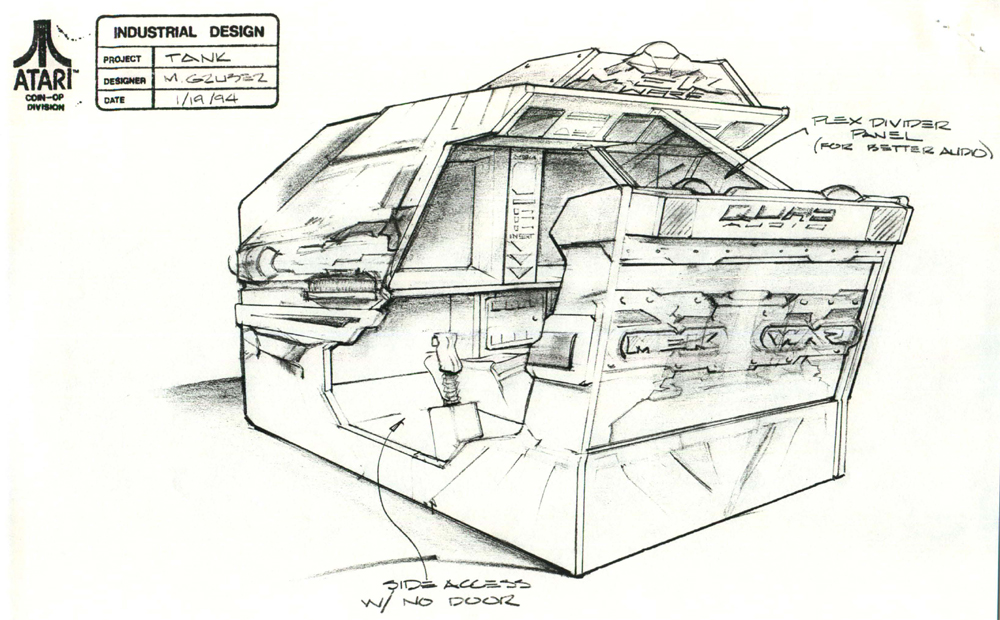
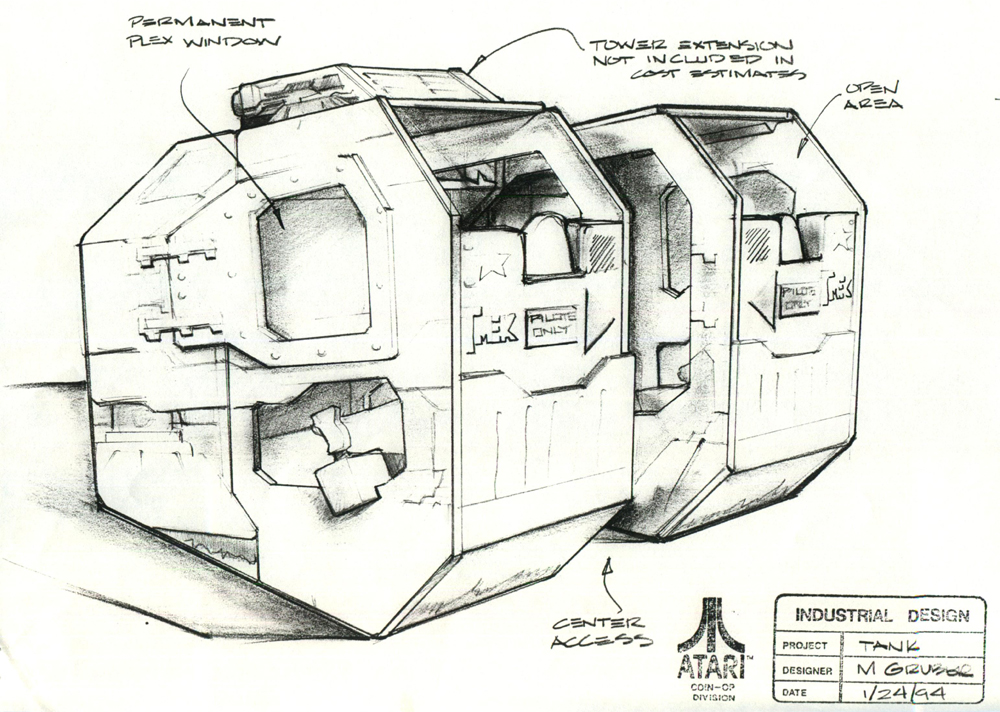
|
TENTH DEGREE (1996) |
|
THOGS (1981) |
|
TIME BOMB (1977-78) |
Based on Sprint 4 hardware. Frank Gasking's book, The Games That Weren't, contains a detailed 6-page full story about Time Bomb, talking to those involved in the development, with input from Chris Downend, Lyle Rains, and John Ray. When talking with John Ray, John mentioned Scott Evans now owns his Time Bomb prototype. John took photos of the game (below) before selling it to Evans, who created the video:
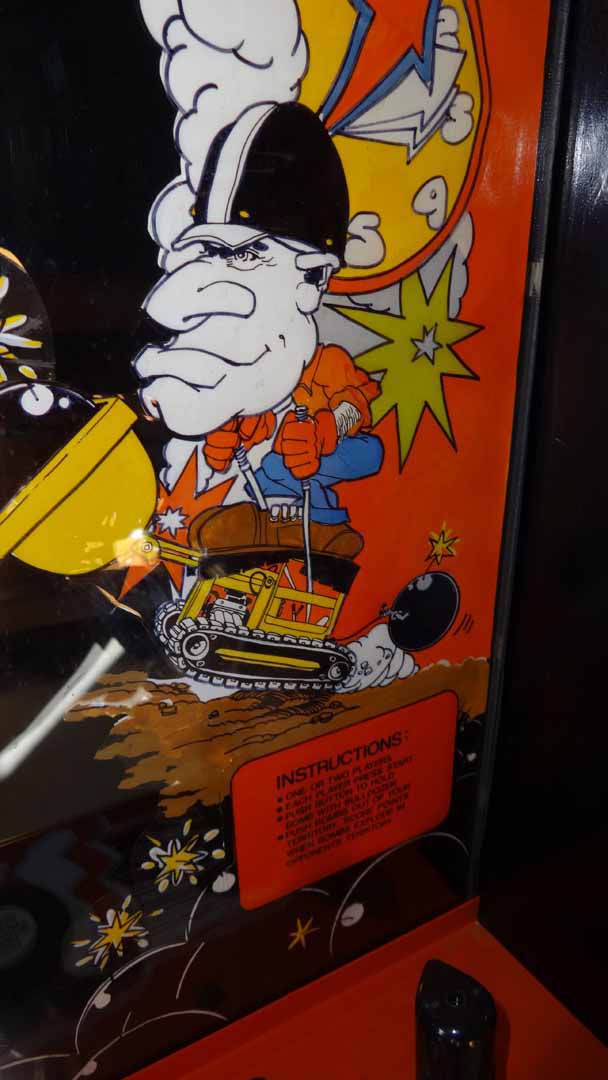
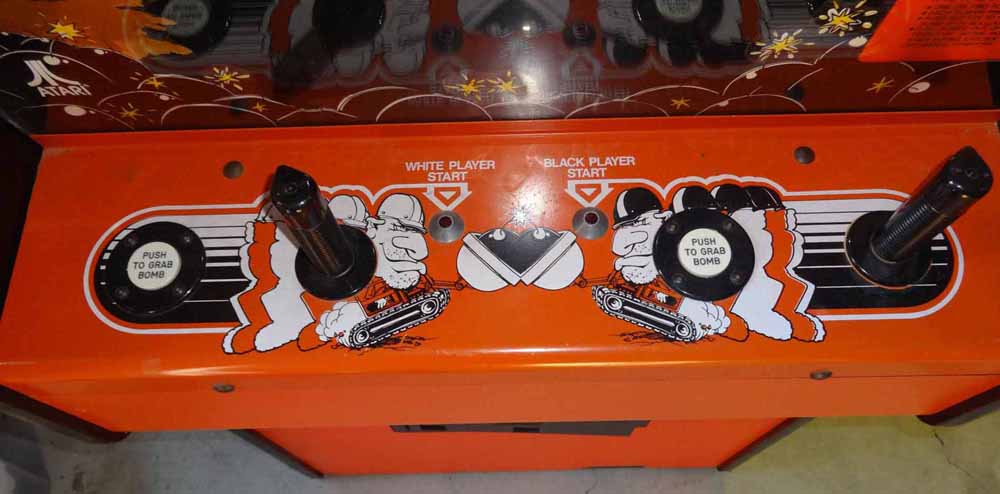

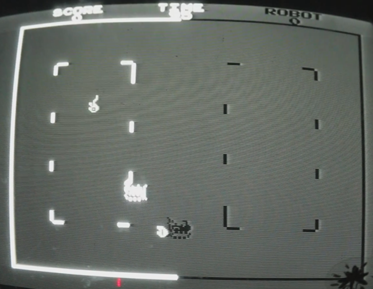
|
TIME SCANNER (1987) |
Created by Sega and released in Japan in 1986. They leased it to Atari, who planned to release it in 1987.
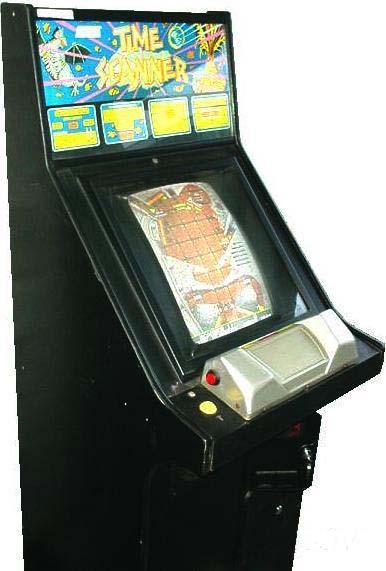
|
TIME TRAVELER (1981) |
|
TOLLIAN WEB (1983) |
This was the original name for The Adventures of Major Havoc. The name is derived from an episode of Star Trek called "The Tholian Web" (S3E9). From Owen Rubin:
|
I was already a year into Major Havoc when Mark Cerny joined the game. He had (I guess still does have) a HUGE ego. Even though he was very new at Atari at the time, he said he would not work on the game unless he got an even say. I really did not care so I agreed. He worked on one of the space waves (the flying fish) and the last 4 base ship mazes. He also added some objects to the mazes (like the gun and floating boots) and helped clean up old items that never got shipped. We actually worked quite well together. It was a lot of fun working with him; he really IS that good! Actually I quit before Havoc shipped and they asked me to come back and finish it. I agreed. |


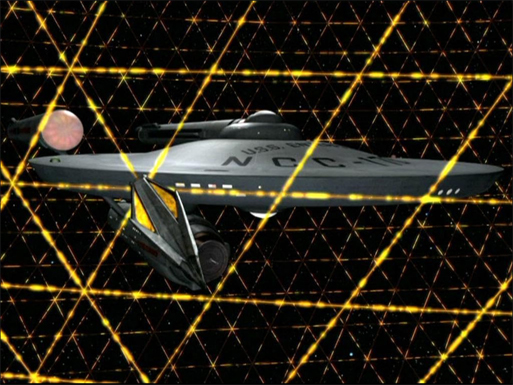
|
TOMCAT (1983) |
A color vector flight simulator where the player chooses between a fixed-wing jet or a helicopter. The player can choose between flying a fixed-wing jet and a helicopter. The universe shows a horizon line, a heads-up display, some simple objects on the ground to provide a reference, and a BattleZone tank (also on the ground). There is also an enemy helicopter that came from the US Army version of "Battlezone".
Work on this game began late in 1983. It was the next XY project after Star Wars, but it was almost immediately interrupted when the programmer was rescheduled to work on Firefox instead. Most projects where started by putting together a core project team consisting of a Project Leader, Hardware Engineer, Programmer, and Technician. Sometimes the Programmer was also the Project Leader and sometimes there was more than one Programmer. Tomcat was different, however, since it was a research project. The plan was to develop the hardware and write some 3-D software to demonstrate its capabilities. After that, a team would be recruited to create a flight simulator game. The game was begun using the Star Wars hardware. Greg Rivera, the lead Star Wars programmer (Norm Avellar was the other programmer), modified the Star Wars program to create software hooks so Jed Margolin could insert his own graphics.
|
TRAP (1980) |
Early version of Star Trap. Deemed a medium priority, according to a 5-23-80 memo.
|
TRENCH (1994) |
A racing game similar to S.T.U.N. Runner.
|
TRIANGLE (pinball) (1981) |
This was a narrow-bodied game and Gary Slater was the designer. This game did not proceed beyond the prototype stage. It never existed as a complete machine, only parts.
|
TUBE CHASE
(1979-80) |
Designed by Owen Rubin. This later became Tunnel Hunt. After the vector hardware was cost-reduced a few times, it was changed to raster graphics, renamed Vertigo, and sent to Exidy (likely some time in 1980 or early 1981). Exidy tested it for a short time and then decided not to buy/license it and sent it back to Atari. Atari renamed it Tunnel Hunt and licensed it to Centuri in 1981, who released it in 1982. So Tunnel Hunt was the exact same version Exidy originally had. Atari (with Owen Rubin's help) designed the Tunnel Hunt cabinet. From Owen Rubin's website:
|
Tube Chase started very early as a vector game. I got the idea from the opening of the original Alien movie during the landing sequence. However, we could not do hidden line removal, and all those lines got very confusing. It went through several version of raster hardware from cool ellipses that could split, to the cheaper square hardware that we finally used, all called Tube Chase. It was killed and brought back at least 3 or 4 times at Atari under the same name. It became Vertigo when Exidy first took it, but they decided to pass on it when it did not test well at the arcades any more (at that time, it was only 3rd for 10 weeks!), and then finally Tunnel Hunt at Centuri. |
From Owen Rubin's interview with Brian Deuel:
|
Tunnel Hunt was actually my first vector game, although it did not end up as a vector game. I really liked the opening sequence of the movie Alien (the part where they landed) and thought it might be fun. Using the vector system from Asteroids and some software from Night Driver, I created a early version where you could fly down tunnels. But because the system did not do hidden line removal, the tunnels could not move much. It just did not work. A hardware engineer at Atari came up with an expensive hardware that drew ellipses. I re-wrote the game to use that. It looked great. Multiple tunnels with splits and rotates. But it was too expensive. Then the hardware was changed to circles, but still too expensive. Then it was changed to rectangles. That was what finally shipped. But marketing felt just flying was not fun enough, so we added Star Wars-like objects that flew down the tube at you and you had to shoot them. It was a good game, but they kept wanting changes. It did a solid #2 and #3 for 12 weeks in tests, but Atari could not decide to ship it. It would just not earn a #1 spot. I loved the game. So they decided to sell it to Exidy. They tested it, and again #2! I guess they only wanted a game that was #1. It later was sold to Centuri, but by then, it was way too old (at least 3 years out of date). Why they sold it at all is beyond me. If you stare straight at the middle for too long a time, it will make you quite dizzy! Maybe that is why it was called Vertigo when Exidy had it! |
From Owen Rubin's interview with Keith Smith:
|
I started the game as a vector graphics project based on the opening landing sequence in the movie Aliens. It did not work in vector, but that took several months to discover. Dave Sherman had an ellipse generator that he thought would be good, so I spent nine months or so and did this great game of flying down tunnels. The tunnels split and merged and you occasionally exited into space where you could fly into one of several other tunnels (worm holes). The only way you could slow down was to hit the walls, but that raised the hull temperature. It was a good strategy to bump the wall to hold off a target so that you would not overtake it, especially if your lasers were out. It had a great cabinet. It “wrapped” around you with speakers behind and in front. You stood, not sat, and it blocked out outside noise. The controller was a flight stick for flying with buttons for firing and shields.
So we cheapened the hardware to do circles only. This made the split tubes ugly,
and the warping of the tunnel effect was lost. It took another four months
to make the changes. We field tested it again - #2, solid! They changed the
hardware again to make it even cheaper, which allowed only one sorted list of
circles and so I had to take out the splits. The game was MUCH simpler now, but
still the same basic game play.
About three months later, they rolled the game back into my lab and asked if I
could make “just one more change”. This line became a joke because they’d asked
this maybe 70 times by now. I changed it AGAIN, this time for Centuri in
Florida, and they did build the game. Unfortunately it was now almost three
years out of date… |

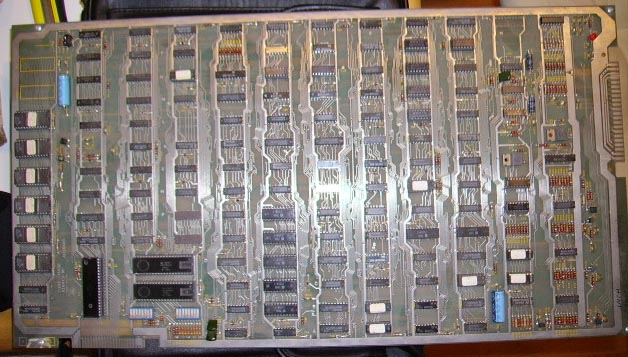
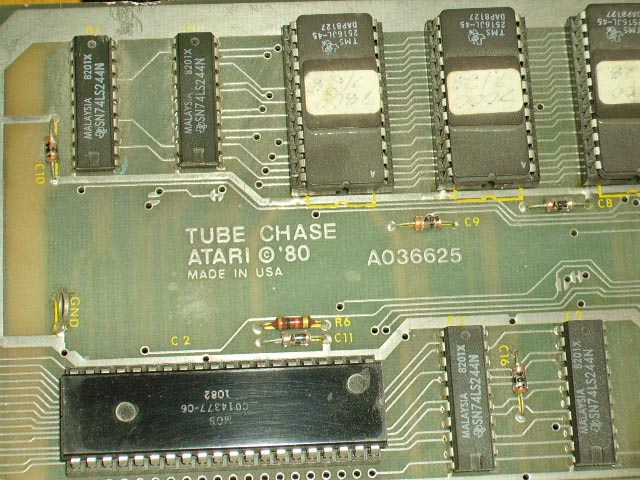
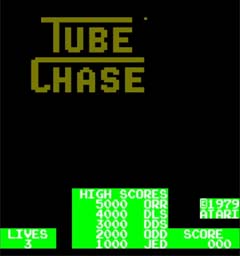
An Atari memo dated 2/26/80 shows the game was tested at Stevens Creek Time Zone in CA:
The same year Centuri released Tunnel Hunt, Exidy was showing off a different Vertigo - a vector graphics knockoff of Tube Chase / Vertigo in a converted Tail Gunner II cabinet. It briefly appears in this video called "Game On! The Unauthorized History of Video Games", being played by none other than Nolan Bushnell! 2 years later, Exidy showed off a completely different vector graphics Vertigo that used a full-motion sit-down cabinet. This game ended up being the early version of Top Gunner, which was released in 1986.
|
UFO
(1978-79) |
This was a prototype wall game. UFO was mentioned in the December 1978 issue of Play Meter (pg. 19). From Owen Rubin:
|
In the last 70's early 80's there were bar wall games making the rounds.
Basically there was a wireless controller with 1 button (typically, this may
have had three) and two controllers, one for each player if multiplayer, which
this was. On the wall was a rather large game (rather flat, but maybe 5 to
6 feet wide and 3 to 4 feet tall, with a series of graphics on plex with lights
behind each graphics, so that if you sequenced the lights correctly, an
animation of a sort will show up. These wall games included horse shoes,
duck hunting, and Atari did one called UFO. |

|
unknown prototype (1974) |
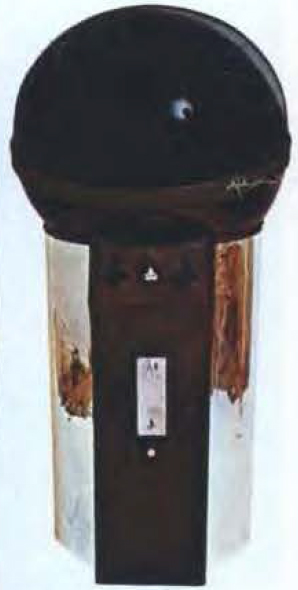
|
unknown 1980s prototype cabinet |
It's unknown what game this Atari cabinet was originally for, but it doesn't match anything that Atari released. The marquee design is very similar to Atari Force Liberator.

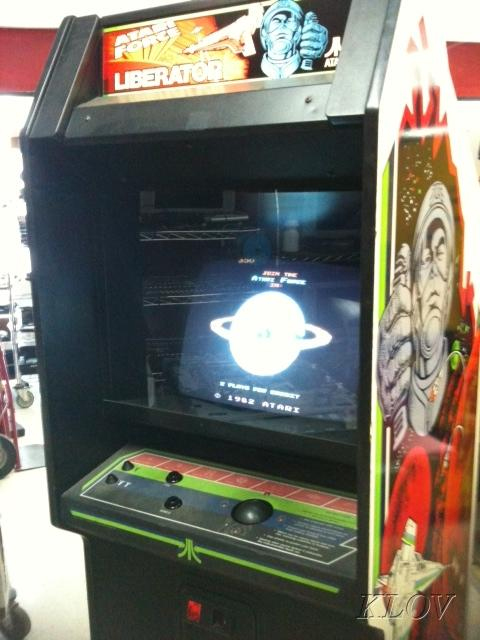
|
unknown 1980s prototype (1980s) |
A shooting game that plays like a raster Tempest, or like a cross between Tank, Centipede, and Robotron: 2084.
|
VICIOUS CIRCLE (1996) |
9 characters bearing a Killer Instinct-like look go head-to-head in this Atari fighting game. Prototype dated March 1996. Brian McKee was the engineer. Runs on the Cojag hardware.
|
VORTEX (1981) |
This was the early name for Tempest.


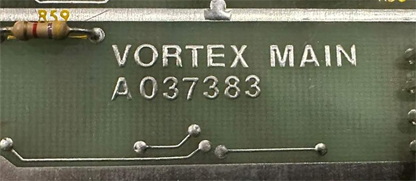
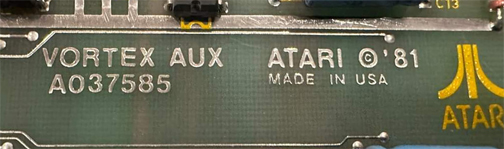
|
WARP SPEED (1980-82) |
Mike Hally was the designer. The game was designed to develop 3-D image capabilities, and later turned into the basis for Star Wars. Deemed a low priority, according to a 5-23-80 memo.
|
WEATHER WAR / CLOUD 9 (1983) |
Shoot clouds in the sky. Avoid rain drops and other enemies. Try to destroy all clouds before your chamber is flooded. Designed and programmed by Paul M. Resch. Cloud 9 was originally supposed to be written by Dona Bailey (the coder for Centipede), but she left and Paul inherited it. Originally called Weather War the original game concept had a plug in the bottom of the screen that the character had to pull to let the water out. This game unfortunately only received one weekend of play testing at one location before being cancelled.
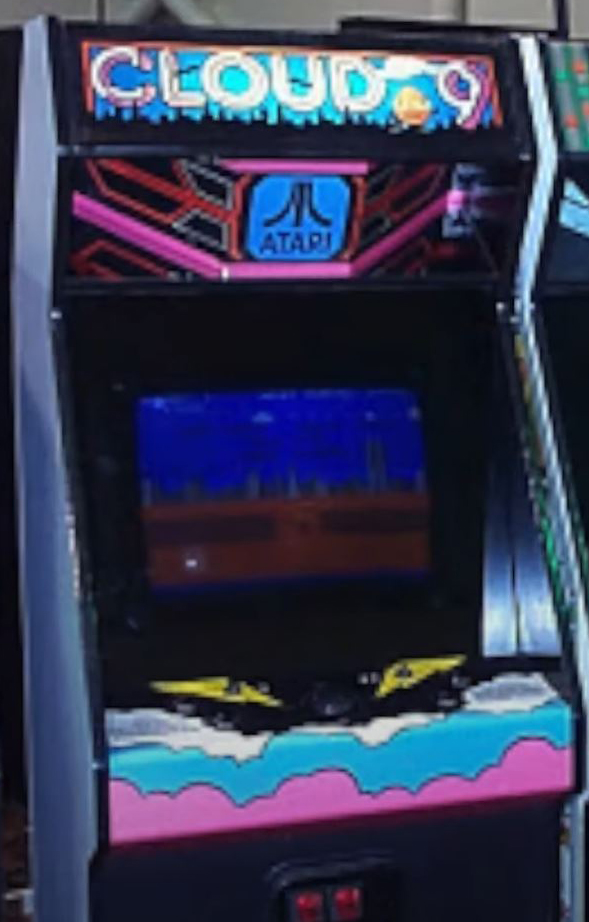
|
WOLF PACK
(1978) |
This was a Sea Wolf variant. The periscope had real water in it (in a partition between the player and the monitor) to create the illusion you were underwater. There were a lot of 'firsts' with that one, such as voice synthesis!
From Dennis Koble:
|
"There were a variety of other games that I worked on that were handed off to other programmers, such as a variant of Dirt Bike that Ed Logg took over and finished, and another variant of Sea Wolf (a popular game by a competitor) that was never finished called Wolf Pack. The team members varied with the project, but I worked with Howard Delman and Dan Van Elderen and shared an office with them for a time. Sea Wolf was one of my favorite games of that era. I loved how you got immersed in being in a sub and tracking those bad guys. Atari’s version had an actual periscope but was beset with mechanical problems which were never solved as I remember. Probably also it was partially my fault, as my intent was to recreate Sea Wolf (since I loved it so much) and then alter it to give it some originality. In those days, most of us worked on more than one game at a time and I think perhaps I got distracted while doing other games as the mechanical problems dragged on. It looked great but it wasn’t very fun while I worked on it. Just could never take it to the next step, I guess. |
From Michael Albaugh:
|
Rich Patak created the 'ping-bang-boom' audio for Destroyer, which was also used in Wolf Pack. I had very little to do with Wolf Pack, other than admiring it as it was being developed in an adjacent work area. Dave Sherman did the wake circuit for Wolf Pack, essentially a triangle generator modulated by pseudo-random noise to make it sparkle. HydroPlane used a variant with a bit-map rather than a triangle generator, to allow more flexibility. Of course, we could not afford a full-screen bitmap, so there were two small (32x32?) bitmaps, one for each boat, each with a square "window". We got a patent for that. But, as mentioned, Gene (Lipkin) hated boat games. Also, players did not get into the physics of the boats or the pylons rather than a track, and if we went back to more car/track-like play, what's the point? There is truth to "Gene Lipkin didn't like boat games". He also didn't like various other things and was prone to snap judgment cancellations. That's one reason games often had a "Lipkin switch" to make them act up or shut down, to lend authority to the programmer saying, "Sorry, Gene, it's broken at the moment so we can't show it to you. |
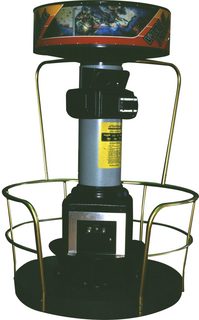
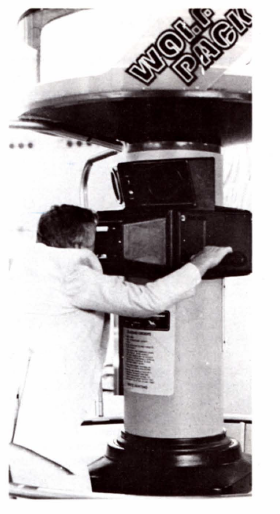
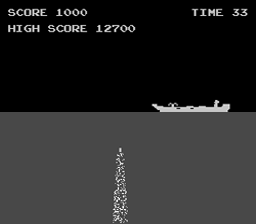
|
WONDER WOMAN (pinball) |
These undated concept drawings were created by Eveyln Seto, possibly in 1978. The code name for the project was 'Roulette'. The game was never produced.